





Home / Functional Web Design / Marketing / What 235 Client Experiences Reveal About Choosing a Web Design Agency
 Written by
 Original Research by Bless Web Designs
What 235 Client Experiences Reveal About Choosing a Web Design Agency
2026 Web Design Client Experience Study
Choosing a web design agency usually involves reviewing portfolios, comparing proposals, discussing project costs, looking at services, and speaking with the people who may work on the project. Those steps are useful, but they do not always show what the working relationship will be like after the project begins. Client reviews provide another source of information because they describe how an agency communicates, how quickly it responds, whether projects stay on schedule, how technical problems are handled, and what happens after a website is launched.
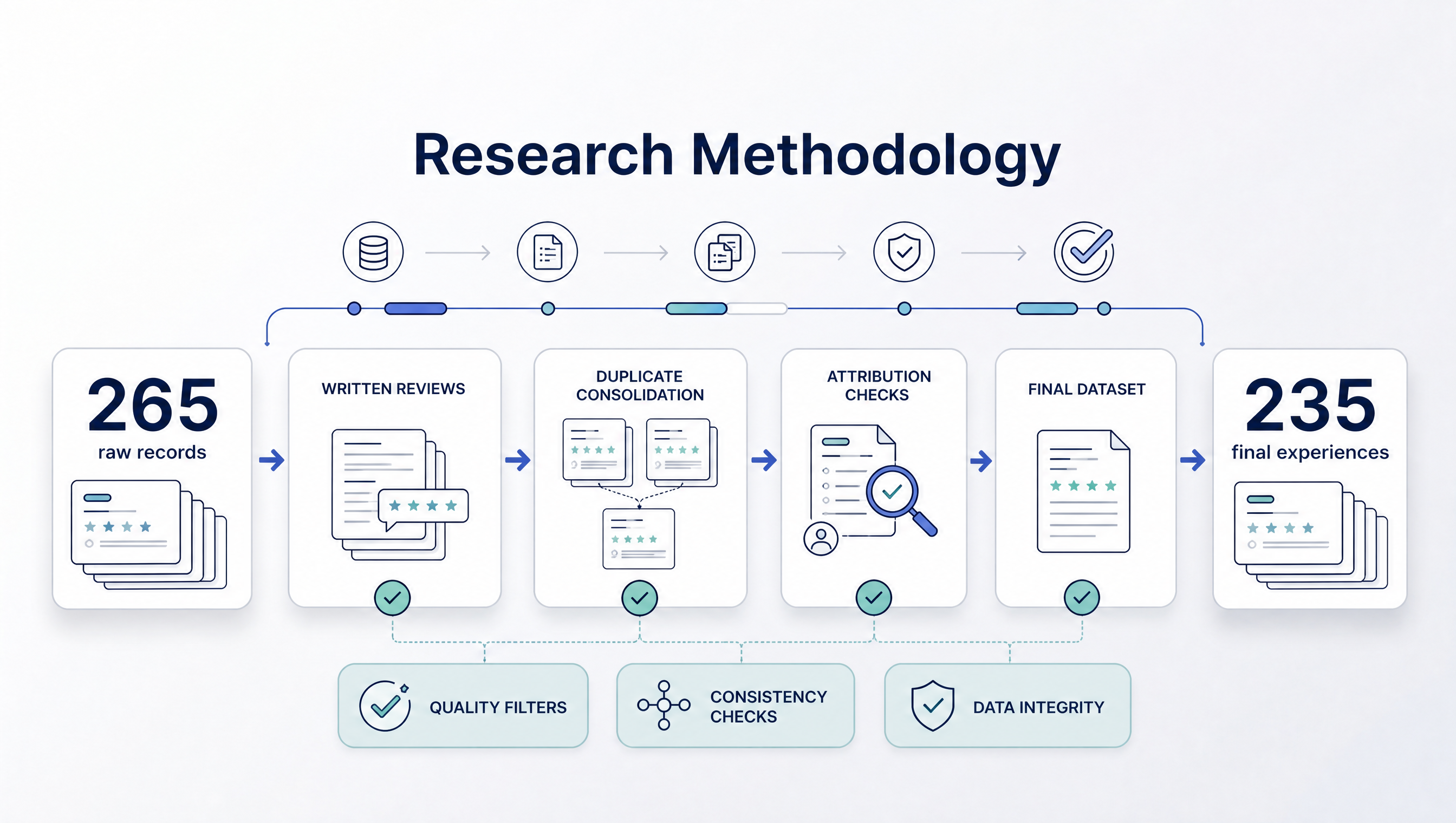
Bless Web Designs reviewed 265 customer review records published across Google Business Profile, Clutch, GoodFirms, TechBehemoths, DesignRush, Trustpilot, Better Business Bureau, Facebook, TopDevelopers.co, and Yelp. The Google review data included Bless Web Designs locations in Dallas, Garland, and Mesquite, Texas. The raw review total was not used as the research sample because some customers appeared on more than one platform and a small number of records had attribution problems. After rating only entries were removed from the text analysis, duplicate publications were consolidated, and questionable records were excluded, the final research dataset contained 235 unique usable written client experiences.
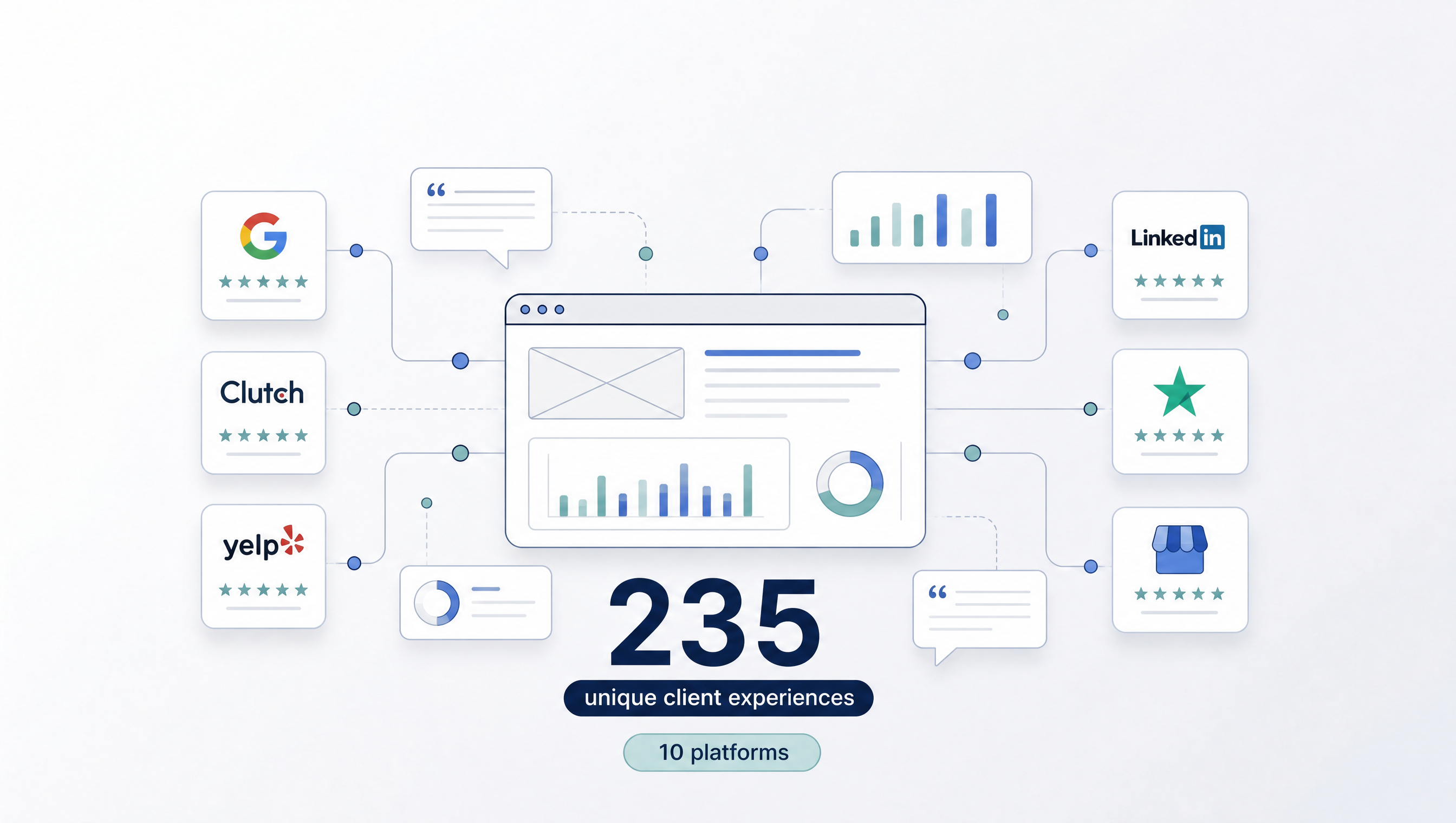
The purpose of the study was to identify recurring patterns in what clients say about working with a web design and digital agency. The analysis covered communication, project timing, design quality, technical knowledge, ease of working with the agency, understanding of the client’s business, user experience, search engine optimization, project management, support, and reported business outcomes. The study also reviewed constructive feedback to identify areas where clients wanted more information, training, reporting, or project structure.
Study Summary
Executive Summary
The final dataset included 235 unique written client experiences associated with projects covering website design, website development, UX and UI design, search engine optimization, branding, ecommerce, digital advertising, custom development, automation, website maintenance, hosting, and related digital services. The most common themes were not limited to the finished visual design. Clients repeatedly discussed how the agency handled the work, communicated during the project, responded to requests, and kept the project moving.
235Unique usable written client experiences
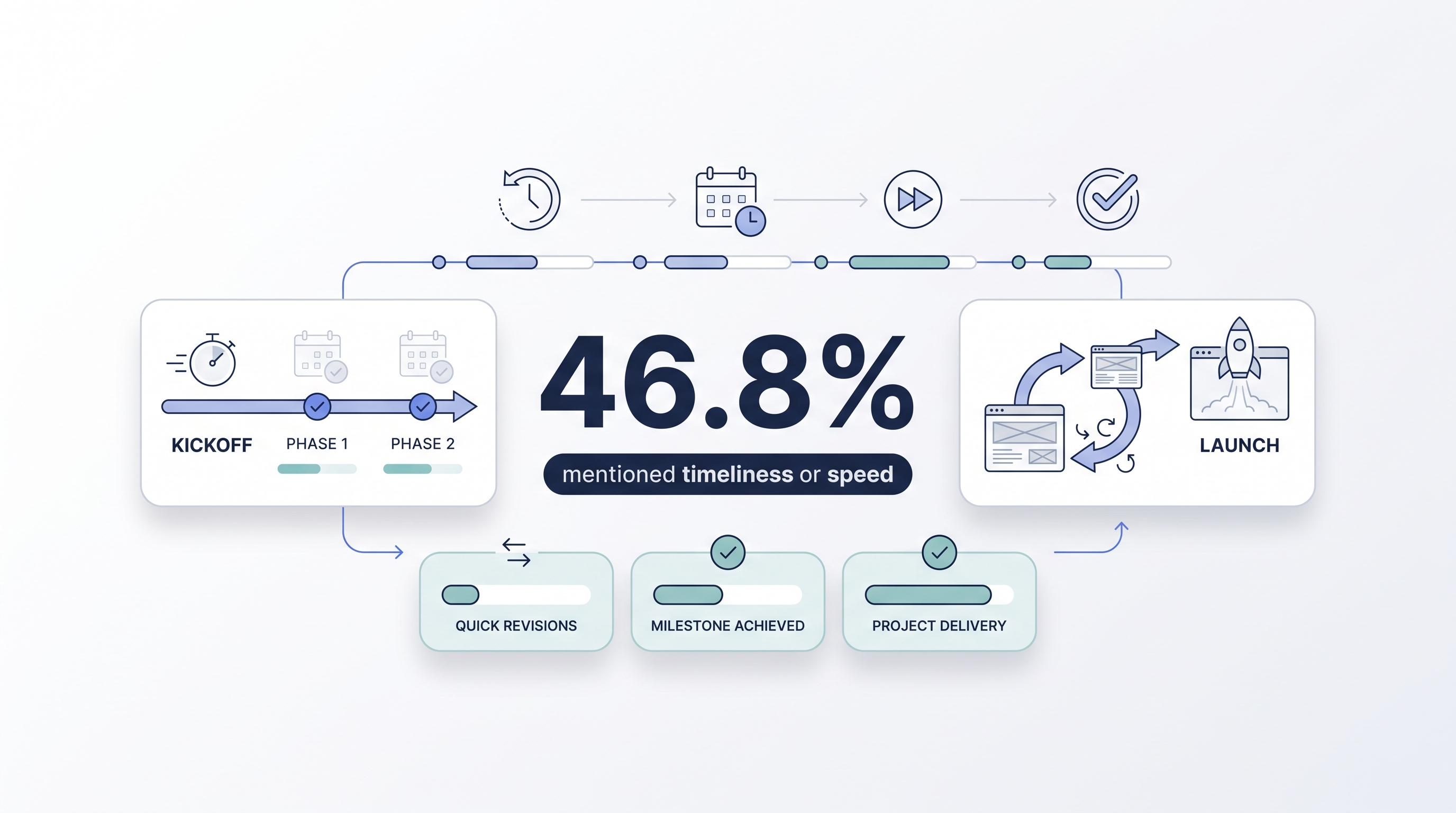
46.8%Mentioned timeliness or speed
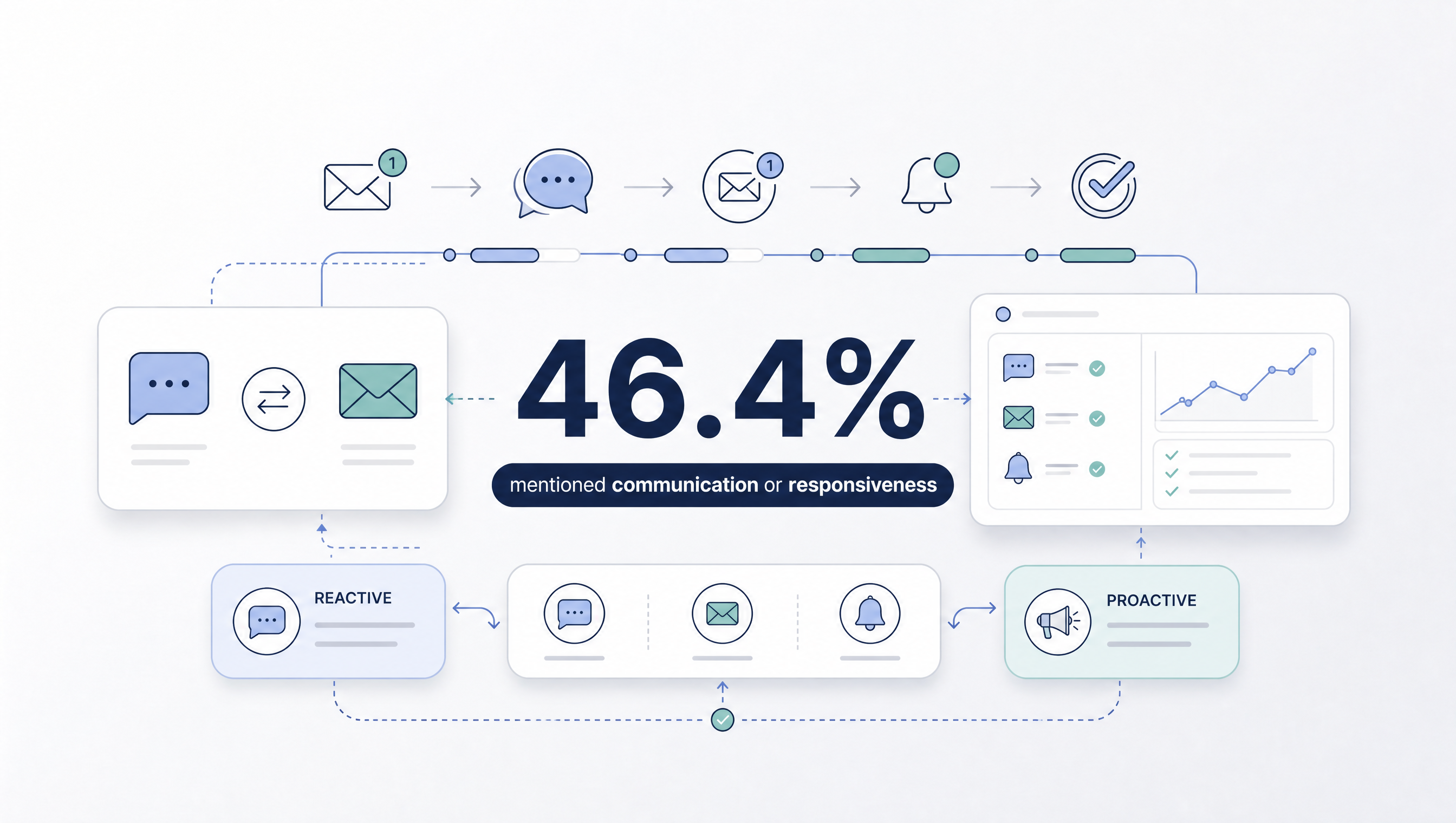
46.4%Mentioned communication or responsiveness
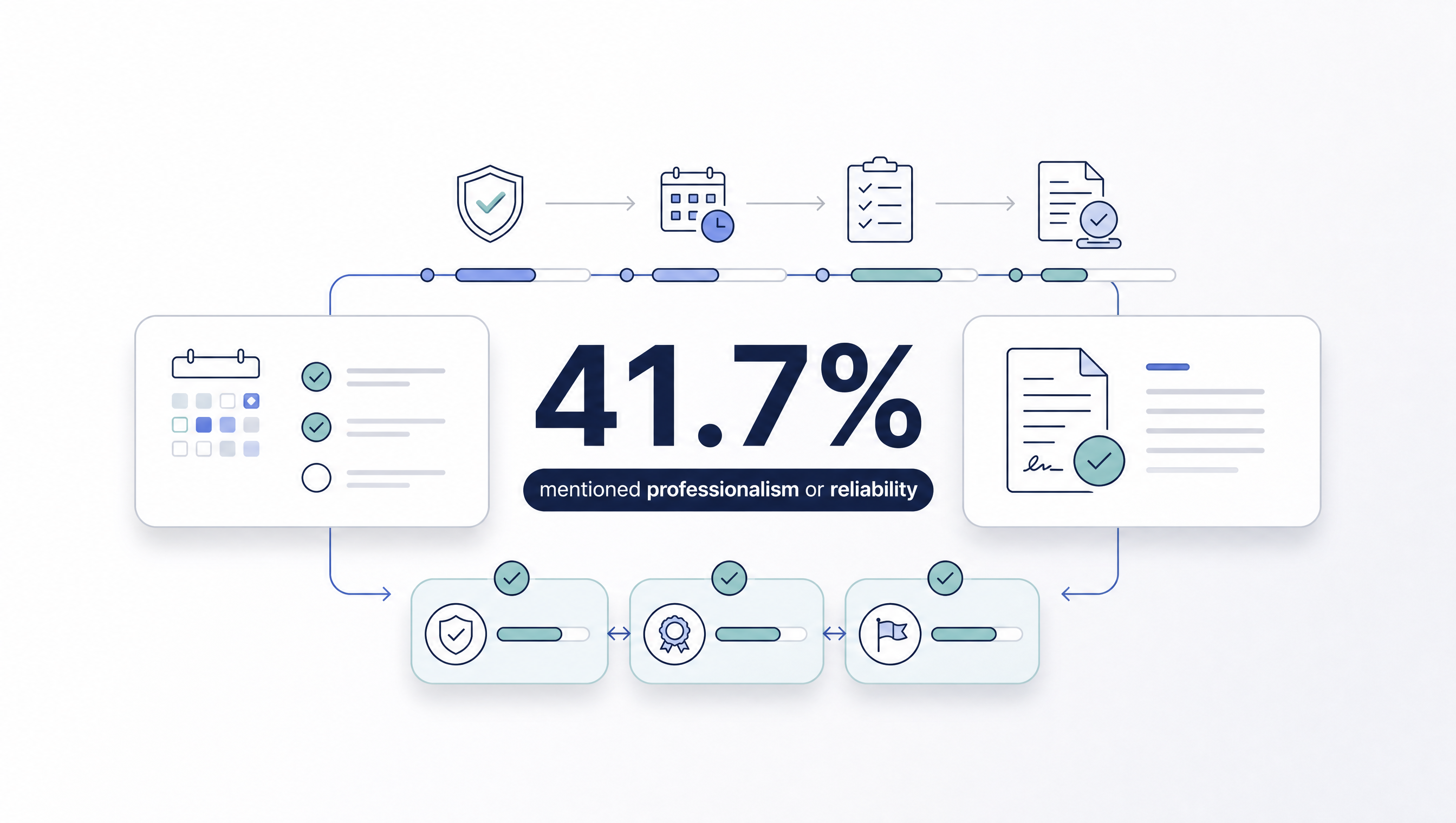
41.7%Mentioned professionalism or reliability
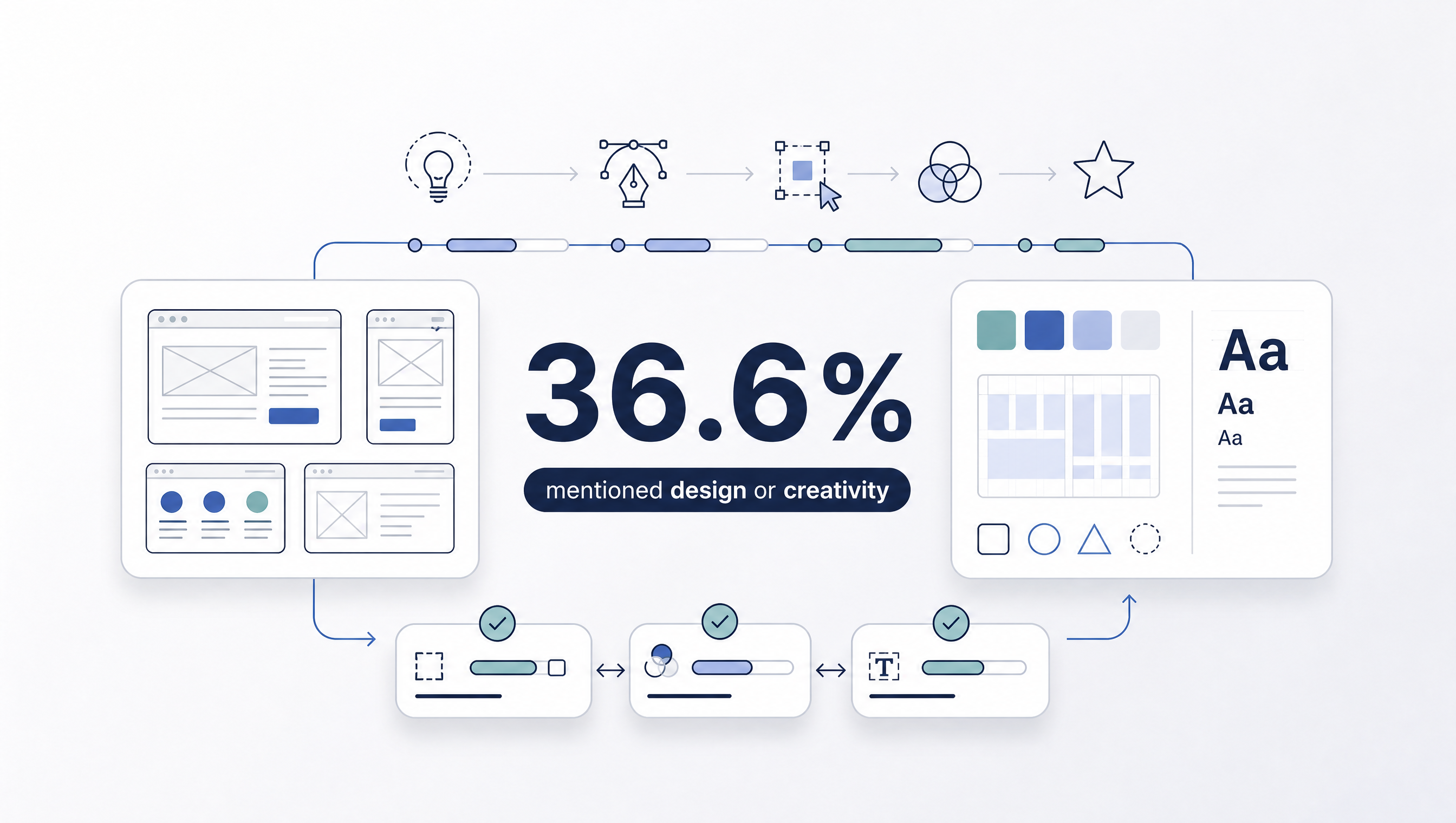
36.6%Mentioned design or creativity
24.3%Reported a business or operational outcome
Timeliness and speed appeared in 110 of the 235 experiences, or 46.8%. Communication and responsiveness appeared in 109 experiences, or 46.4%. Professionalism and reliability appeared in 98 experiences, or 41.7%. Design and creativity appeared in 86 experiences, or 36.6%. Technical expertise and development capability appeared in 75 experiences, and 74 experiences described an easy or smooth process.
The analysis also separated comments about the service experience from comments about business performance. Fifty seven experiences, or 24.3% of the final dataset, described a business or operational outcome. These included increases in website traffic, stronger engagement, more leads or inquiries, higher conversion activity, increased bookings or orders, better search visibility, sales growth, and reduced operational friction. These outcomes came from client review text and were not independently audited for this study.
Structured Clutch reviews provided additional information about why clients selected the agency. Among the 54 Clutch reviews, good value for cost was identified 29 times, high ratings 25 times, referrals 18 times, and alignment with company values 15 times. Geographic proximity was identified in three reviews. The same structured reviews also provided cost ranges and service categories that helped place the client feedback in context.
Constructive comments were retained. The most common improvement requests involved stronger post launch training, clearer project schedules, more proactive updates, deeper SEO reporting, clearer backlink expectations, and additional testing or quality assurance. These comments are useful because they show what clients wanted in addition to the work they already rated positively.
Research Context
Background and Purpose of the Study
Bless Web Designs is a web design and digital marketing agency based in Dallas, Texas, with additional locations in Garland and Mesquite. The company provides services that include custom web design, WordPress development, UX and UI design, search engine optimization, branding, ecommerce, digital marketing, paid advertising, automation, hosting, maintenance, and custom website functionality. Over time, customer feedback about these services accumulated across several public review platforms.
Individual testimonials are useful when a prospective client wants to understand a specific project or customer experience. A larger set of reviews can answer a different type of question. When hundreds of records are reviewed together, it becomes possible to identify recurring subjects and compare how often clients discuss them. This research was developed to study those recurring subjects rather than to select a few positive testimonials.
Research Questions
The study was organized around practical questions that businesses often consider when comparing agencies. We wanted to know which parts of the client experience appeared most often in review language, whether customers talked more about the final design or the working process, how often clients connected website projects with measurable business results, and what clients said they would have liked the agency to handle differently.
Project Experience
What do clients mention most often about communication, responsiveness, timing, project management, and the ease of the process?
Work Quality
How often do clients discuss design, creativity, development skill, user experience, SEO, and industry knowledge?
Business Results
How many reviews describe changes in traffic, leads, bookings, conversions, search visibility, sales, or operational efficiency?
Improvement Areas
What do clients say could have been clearer, better documented, better reported, or better supported after launch?
The research also considered the effect of the review platform itself. A customer writing a short Google review is not responding to the same prompts as a client completing a detailed Clutch or GoodFirms review. The full cross platform dataset therefore provides a broad view of the client experience, while a separate Google analysis helps show which themes customers mention without a detailed B2B questionnaire.
Disclosure
Research Disclosure
Bless Web Designs is both the subject and publisher of this research. The study is not an independent survey of the web design industry, and the figures in this report should not be treated as industry wide benchmarks.
The dataset represents customers who published reviews associated with Bless Web Designs. Review data also has a natural selection issue because customers choose whether to leave a public review. People who publish reviews may not perfectly represent every customer who worked with the company. For these reasons, the purpose of this study is limited to identifying patterns within the available review history.
Several controls were used to make the dataset more conservative. Rating only reviews were excluded from theme analysis because they contained no language to classify. Duplicate review publications were consolidated when the same underlying client experience appeared on more than one platform. Records with substantial attribution problems were excluded rather than being used to increase the sample. Constructive comments were retained even when the rest of the review was highly positive.
These choices reduce the headline number but improve the usefulness of the research. The difference between 265 raw review records and 235 unique usable written experiences is explained in the methodology below.
How the Study Was Built
Research Methodology
Review Sources
The raw archive contained 265 review records from 10 platforms. Google Business Profile data covered the Dallas, Garland, and Mesquite locations. The remaining sources included B2B directories, general review websites, a social recommendation platform, and the Better Business Bureau. The review systems are not identical, so the platform was retained as part of the research context rather than being ignored.
| Review Source | Raw Records |
|---|---|
| Google Business Profile, Dallas, Garland, and Mesquite | 136 |
| Clutch | 54 |
| TechBehemoths | 23 |
| GoodFirms | 21 |
| Facebook readable recommendations | 17 |
| TopDevelopers.co | 6 |
| DesignRush | 3 |
| Trustpilot | 2 |
| Yelp | 2 |
| Better Business Bureau | 1 |
| Total | 265 |
Rating Only Reviews
Four of the 136 Google review records contained a rating without usable written review text. These ratings can contribute to a public rating average, but they cannot tell us which part of the client experience mattered to the reviewer. The four rating only entries were removed from the qualitative text analysis, leaving 261 written review records before duplicate review handling.
Cross Platform Deduplication
A raw review record is not always a unique customer experience. Several customers appeared on more than one platform. In some cases the wording was nearly identical. In other cases the reviewer name, company, project details, service type, timing, and project description showed that two records represented the same underlying engagement even though the wording was different.
Fifteen high confidence duplicate groups were identified. Those groups contained 33 raw review records representing 15 underlying client experiences. Consolidating those groups removed 18 duplicate publications from the research sample. The raw platform appearances were still retained in the audit notes, but the underlying client experience was counted once in the main study.
Attribution and Content Quality Review
Eight additional written records were excluded because the attribution or review content created a material reliability problem. Examples included review text that repeatedly referred to another agency, content that appeared to have been assigned to the wrong profile, and records where the identity and project details did not provide enough confidence to use the review as evidence about Bless Web Designs.
| Research Stage | Records |
|---|---|
| Raw review records collected | 265 |
| Rating only records removed from text analysis | 4 |
| Written records before deduplication | 261 |
| Duplicate publications consolidated | 18 |
| Attribution conflict records excluded | 8 |
| Final unique usable written client experiences | 235 |
Theme Classification
The reviews were coded using multi label classification because one review can describe several parts of the client experience. A customer may praise communication, say the work was delivered on time, describe a customized solution, and report more website inquiries. Limiting that review to one category would remove information. Each theme was therefore counted separately when the review contained evidence for that subject.
The categories included communication and responsiveness, timeliness and speed, professionalism and reliability, design and creativity, technical expertise and development, ease of process, customization, business and industry understanding, listening, UX and usability, accessibility, performance, value, project management, SEO, collaboration, problem solving, support, branding, training, documentation, automation, AI, and CRM related work. Outcome categories were analyzed separately.
How to read the theme figures: the theme figures do not add to 100% because a single client experience can contribute to several themes.
Business Outcome Classification
Comments about the service experience were separated from comments about business performance. A statement that the agency responded quickly was treated as a service experience. A statement that website inquiries increased was treated as a reported business outcome. Outcome categories included traffic growth, engagement, leads, conversions, bookings, orders, sales, revenue, search visibility, and operational efficiency.
Business outcome claims in this report are based on what clients reported in their reviews. They were not independently audited as part of this research and should not be interpreted as guaranteed results for other businesses.
A Methodology Finding
Review Platform Differences
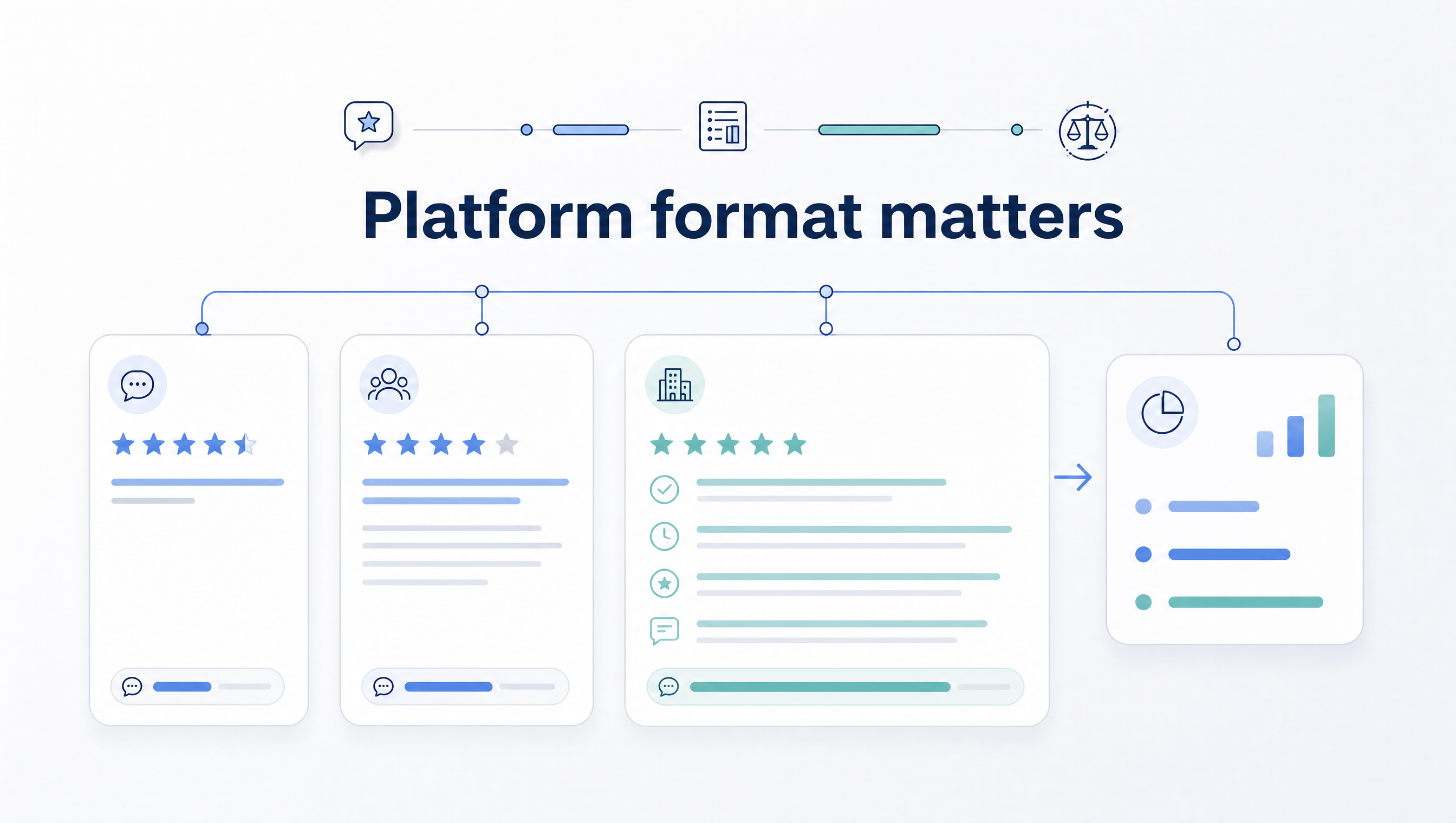
One of the clearest methodology findings was the difference in review length and structure between platforms. Google reviews are usually short and open ended. Clutch uses detailed questions about project goals, scope, outcomes, project management, communication, and areas for improvement. GoodFirms also asks structured questions about quality, communication, schedule, project details, and what could be handled differently.
| Platform | Median Review Length |
|---|---|
| Clutch | 262 words |
| DesignRush | 177 words |
| GoodFirms | 151 words |
| TechBehemoths | 114 words |
| 97 words | |
| Trustpilot | 45 words |
| Google Business Profile (Dallas, Garland, Mesquite) | 30 words |
| Yelp | 22 words |
The Google row combines the 132 written reviews from the Dallas, Garland, and Mesquite profiles. The combined median is 29.5 words, rounded to 30 for this table.
A 20 word review may describe one subject. A 250 word B2B review can discuss the project goals, communication, design, development, business results, project management, and improvement areas. Longer reviews therefore have more opportunities to match several themes. The structured prompts on Clutch and GoodFirms also increase the likelihood that reviewers will discuss measurable outcomes and project management because those platforms ask about them directly.
For that reason, the complete cross platform dataset is used to understand the broad client experience, while the 132 written Google reviews are analyzed separately later in the report. The Google subset is especially useful when we want to know which themes customers mention without a detailed questionnaire.
Main Findings
What Clients Mentioned Most
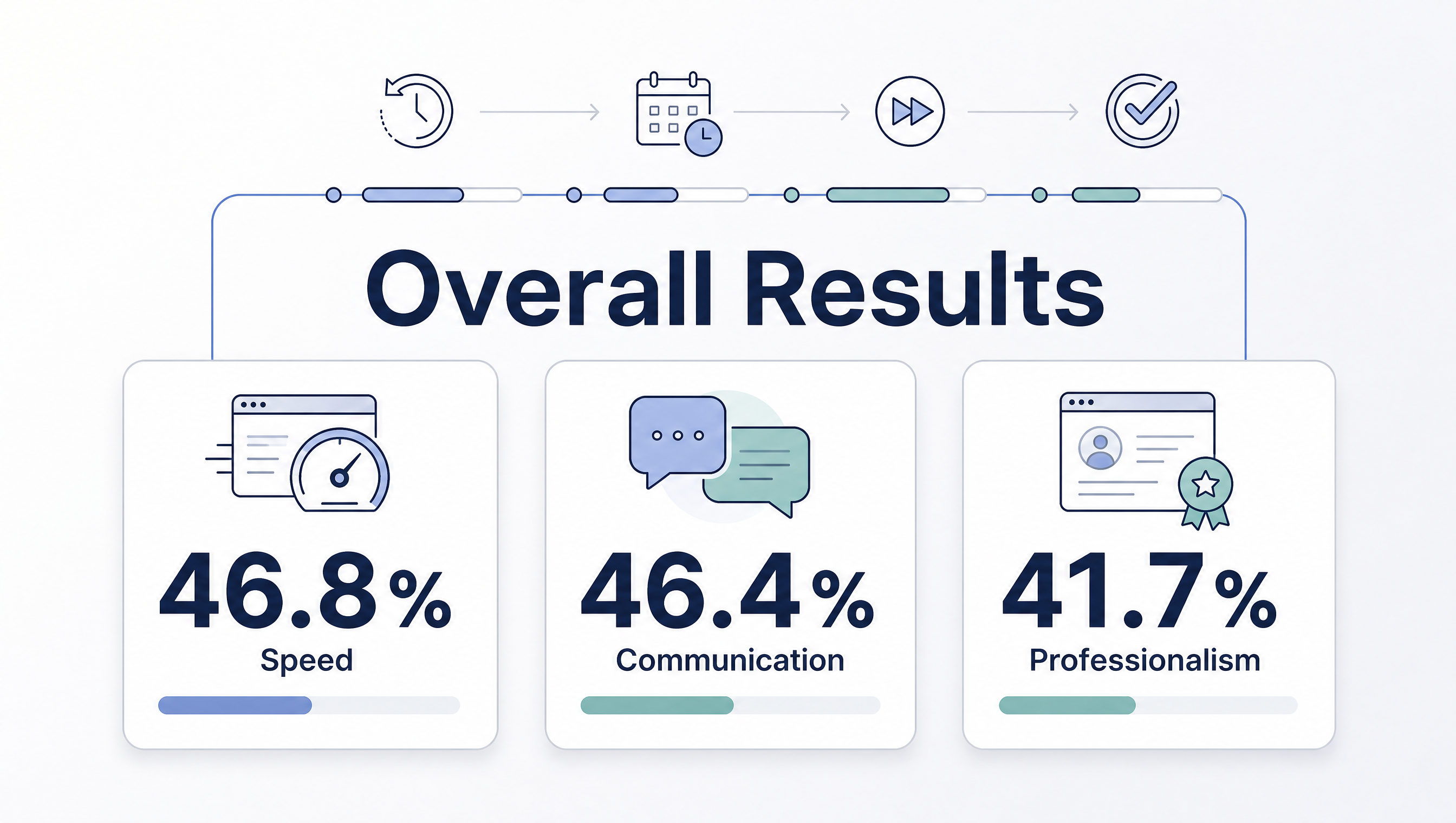
The full analysis included 235 unique usable written client experiences. The first three categories relate mainly to how the project was handled rather than how the website looked. This matters because agency selection often starts with visual work. A portfolio remains useful, but the review data indicates that clients also pay close attention to response time, deadlines, reliability, organization, and the day to day experience of working with the team.
| Theme | Experiences | Share |
|---|---|---|
| Timeliness / speed | 110 | 46.8% |
| Communication / responsiveness | 109 | 46.4% |
| Professionalism / reliability | 98 | 41.7% |
| Design / creativity | 86 | 36.6% |
| Technical expertise / development | 75 | 31.9% |
| Easy / smooth process | 74 | 31.5% |
| Customization / tailored solution | 69 | 29.4% |
| Business / industry understanding | 59 | 25.1% |
| Listening / understanding client needs | 57 | 24.3% |
| UX / usability / accessibility / performance | 56 | 23.8% |
| Value / budget | 48 | 20.4% |
| Project management / organization | 48 | 20.4% |
| SEO / search visibility | 47 | 20.0% |
| Collaboration / partnership | 43 | 18.3% |
| Flexibility / problem solving | 42 | 17.9% |
| Support / maintenance | 28 | 11.9% |
| Branding / positioning | 26 | 11.1% |
| Training / documentation / handoff | 19 | 8.1% |
| Automation / AI / CRM | 11 | 4.7% |
Finding 1
Timeliness and Speed
Timeliness and speed appeared in 110 of the 235 unique client experiences, representing 46.8% of the final dataset. This was the most frequently identified theme in the full cross platform analysis. The category included references to meeting deadlines, completing work quickly, responding to requested changes, handling revisions efficiently, fixing problems promptly, moving between project stages without long delays, and staying on schedule.
The comments were not limited to the original website launch. Clients also discussed speed when requesting later changes, receiving technical support, approving designs, fixing website problems, updating pages, migrating websites, and working through revisions. This shows why the total project duration is only one part of the customer experience. A client may agree to an eight week schedule but still become frustrated if each question takes several days to answer or small changes remain unresolved for long periods.
Where Clients Experience Speed
Fast Replies
Clients notice how quickly routine questions, approvals, and project messages are acknowledged and answered.
Quick Revisions
Design and content changes need to move through the revision process without unnecessary waiting.
Prompt Fixes
Technical issues and unexpected problems affect trust when they remain unresolved after the client reports them.
On Time Milestones
Discovery, design approval, development, testing, and launch should remain reasonably close to the agreed schedule.
Speed also needs context. Completing a project quickly is not useful if quality drops, accessibility is ignored, testing is skipped, or the agency launches before the client is ready. The review data does not suggest that clients want agencies to rush. It suggests that they value steady progress and quick handling of normal project tasks.
Questions to Ask About Project Timing
How quickly are routine requests answered?
Ask what response time is normal for email, messages, project comments, and routine support requests.
How long do revisions usually take?
Find out how design changes, content revisions, and development changes enter the production schedule.
Who keeps the project moving?
Identify the project manager or team member responsible for timelines, approvals, dependencies, and follow up.
How are delays communicated?
Ask how the agency reports changes to scope, missing materials, technical problems, or other issues that affect the schedule.
For businesses comparing agencies, the practical lesson is to ask about response time and production flow in addition to the proposed launch date. A clear answer about revisions, approvals, communication, and support is usually more useful than a promise that the project will be completed quickly.
Finding 2
Communication and Responsiveness
Communication and responsiveness appeared in 109 of the 235 unique client experiences, or 46.4%. Only one client experience separated communication from the leading theme of timeliness and speed. The category included clear communication, quick replies, regular project updates, availability, explanation of technical information, listening to questions, and responding to client feedback.
Website projects require information from both the client and the agency. The client understands the business, customers, services, internal priorities, and sales process. The agency contributes design, development, UX, SEO, project management, and technical recommendations. Poor communication between those two sides can affect nearly every part of the project. A design decision can be based on incomplete information, content can arrive late, a feature can be misunderstood, or a client can lose confidence because nobody explains what is happening.
Reactive and Proactive Communication
Reactive Communication
The team responds when the client asks a question, reports an issue, submits feedback, or requests clarification.
Proactive Communication
The team provides progress updates, explains upcoming milestones, identifies risks, and requests decisions before the client has to ask.
Clear Explanations
Technical recommendations are explained in language the client can use to make a business decision.
Feedback Handling
The agency records, interprets, and responds to feedback without forcing the client to repeat the same request several times.
The constructive feedback later in this report shows an important distinction. Some clients described the agency as responsive but still wanted more proactive updates. Responding quickly when contacted is not the same as keeping the client informed before they have to ask. Longer projects can benefit from scheduled status reports that show what was completed, what is being worked on, what the client needs to provide, and what is expected next.
The separate Google analysis supports the importance of this subject. Communication and responsiveness appeared in 34 of the 132 written Google reviews, or 25.8%. Those customers were not answering a structured project management questionnaire. They chose to mention communication in short, open ended reviews, which makes it one of the stronger spontaneous themes in the research.
Finding 3
Professionalism and Reliability
Professionalism and reliability appeared in 98 of the 235 unique client experiences, representing 41.7% of the final dataset. Reviewers used language related to professionalism, reliability, knowledge, trust, confidence, organization, care, expertise, and dependability.
A company website can be connected to lead generation, customer service, online sales, recruiting, advertising, search visibility, booking systems, payment systems, and internal operations. Hiring a web agency therefore involves giving another company responsibility for an important digital asset. Clients want confidence that the people working on the project will handle that responsibility in an organized and dependable way.
Professional behavior can include showing up for scheduled meetings, keeping project information organized, documenting decisions, setting reasonable expectations, protecting account access, explaining technical problems, delivering agreed work, and responding appropriately when something goes wrong. These parts of the experience are difficult to judge from a portfolio because the finished website does not show how the project was managed.
What Reliability Looks Like During a Web Project
Clear Commitments
Deliverables, responsibilities, approvals, and important dates are documented rather than left to memory.
Organized Project Work
The client can understand what has been completed, what is waiting for approval, and what the team is working on next.
Technical Confidence
The agency can explain a problem, recommend a path forward, and handle the work without creating unnecessary confusion.
Professional Follow Through
The quality of support after launch is consistent with the service the client received during the sales and design process.
Finding 4
Design and Creativity
Design and creativity appeared in 86 of the 235 unique client experiences, or 36.6%. Reviewers discussed visual quality, modern design, branding, layout, color, graphics, user interface, creative ideas, and the ability to turn a client’s ideas into a finished digital experience.
Design remains one of the strongest themes in the study, but it ranked behind timeliness, communication, and professionalism. This does not mean visual quality is less important. A web design agency is expected to deliver work that is appropriate for the business and its audience. The data suggests that good visual design is only one part of how clients judge the engagement.
A useful portfolio review should also go beyond appearance. Businesses should examine whether the site communicates the company’s value clearly, whether navigation makes sense, whether service or product information is easy to find, whether the mobile experience is strong, and whether the calls to action match the business goal. It is also useful to compare several projects from the same agency. When every site follows the same layout and visual pattern, the work may be less customized than the portfolio suggests.
What to Look for in a Web Design Portfolio
Business Fit
Does the visual direction match the client’s industry, audience, credibility needs, and market position?
Information Structure
Can a first time visitor understand what the company does and find the most important services or products?
Mobile Experience
Do menus, buttons, forms, content, images, and calls to action remain easy to use on a phone?
Conversion Path
Is the next step clear for a visitor who wants to call, book, request information, or make a purchase?
Finding 5
Technical Expertise and Development Capability
Technical expertise and development appeared in 75 of the 235 unique client experiences, or 31.9%. The review data included WordPress development, custom development, ecommerce, booking systems, payment gateways, CRM integrations, mobile optimization, custom portals, website migrations, accessibility work, content management systems, performance improvements, hosting, maintenance, SEO implementation, and other technical requirements.
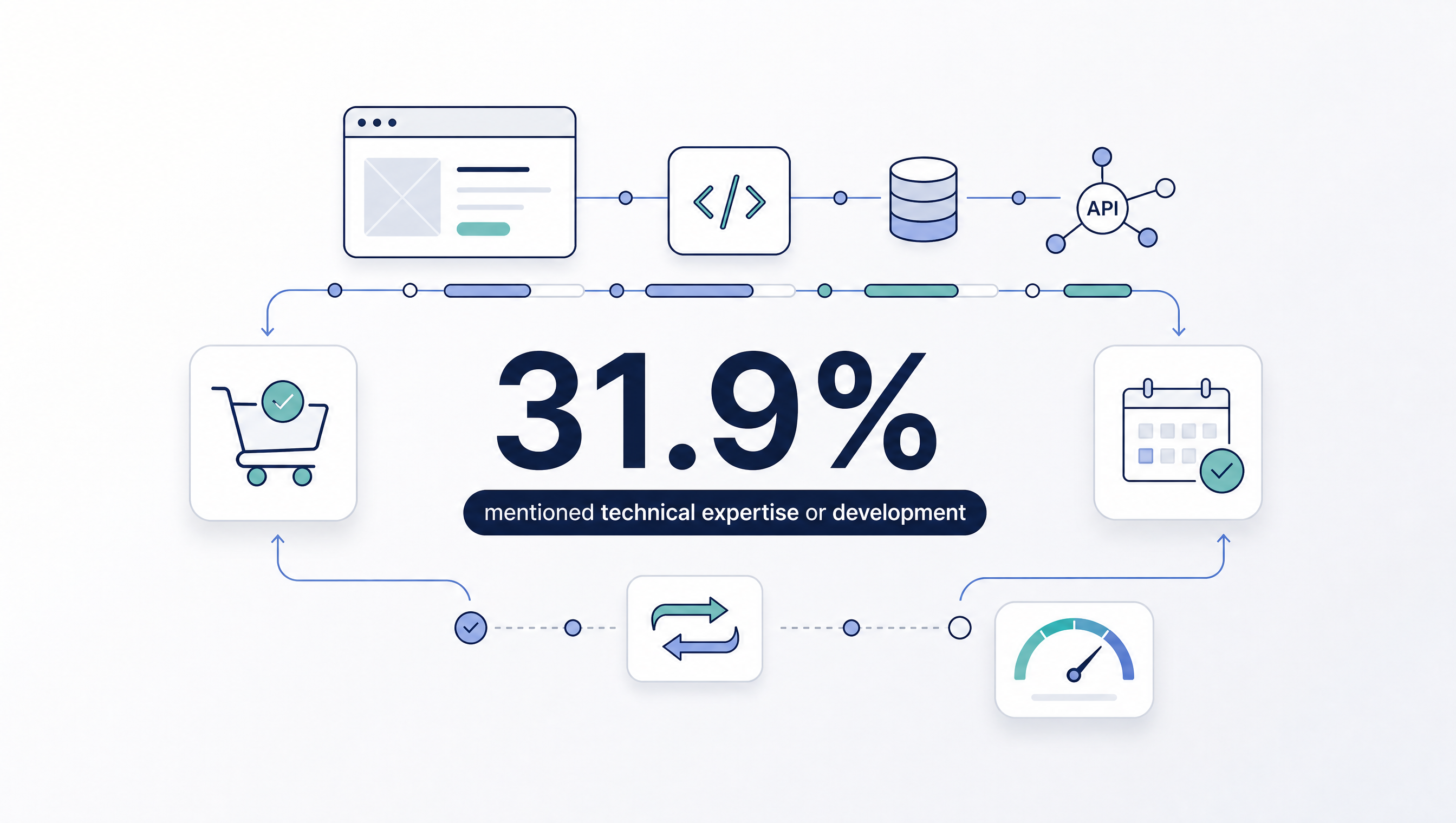
The term web design can describe very different projects. One business may need a small marketing website. Another may need ecommerce, a customer login, a booking system, API integration, automated lead routing, multilingual content, or a custom portal. A company can have strong graphic designers without having the engineering capability to build and maintain more complex functionality.
Technical questions should therefore be part of agency selection when the project includes anything beyond basic page creation. It is useful to ask who will perform the development work, what platform will be used, how integrations will be tested, how custom functionality will be documented, and what will happen when the business needs changes after launch.
Technical Questions to Ask Before Hiring an Agency
- Has the agency built functionality similar to what this project requires?
- Who will perform the development work and who will review it?
- What content management system, framework, or ecommerce platform will be used?
- How will custom integrations and third party services be tested?
- How will backups, updates, security, and maintenance be handled after launch?
- Will the business receive the credentials and access needed to control its own website?
- How will future changes be handled if the original development team is unavailable?
Finding 6
Ease of the Website Process
Seventy four of the 235 unique client experiences, or 31.5%, described parts of the project as easy, smooth, organized, manageable, patient, stress free, or well guided. Many business owners and marketing managers do not build websites regularly. They may understand their company very well while having little interest in learning technical terminology. A good process helps the client make the business decisions the project requires without forcing them to become a developer.
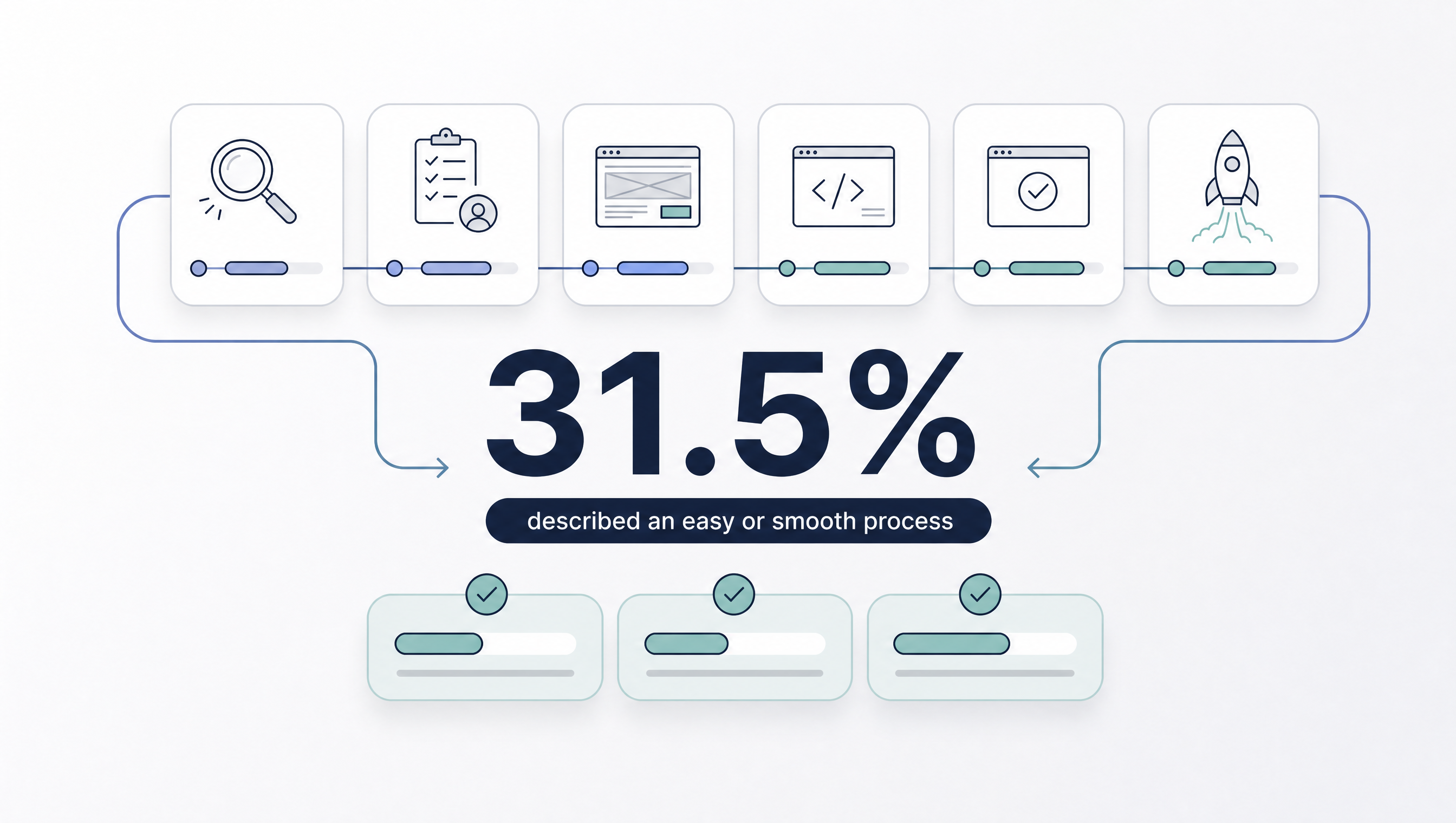
Reviewers frequently mentioned patience, guidance, clear explanations, organized steps, and help understanding what needed to happen next. These comments point to the value of a defined process that explains who is responsible for content, how designs will be reviewed, how revisions work, when development begins, how testing is handled, and what the launch and handoff process includes.
Discovery
Business goals, users, content, competitors, requirements, and priorities.
UX and Planning
Navigation, page structure, user journeys, content priorities, and conversion paths.
Design
Page layouts and visual direction are created, reviewed, and revised.
Development
Approved designs are built and required functionality is implemented.
Quality Assurance
Forms, links, mobile layouts, tracking, redirects, and integrations are tested.
Launch and Handoff
The site goes live and the client receives training, access, and support information.
The details of the process can change depending on the project. A small informational website does not need the same workflow as an ecommerce platform or custom portal. The important point is that the client should understand the process before the project becomes complicated.
Finding 7
Customization and Understanding the Client’s Business
Customization appeared in 69 experiences, or 29.4%. Business or industry understanding appeared in 59 experiences, or 25.1%, and listening or understanding client needs appeared in 57 experiences, or 24.3%. These categories overlap, but they describe related parts of the same working process. Clients want an agency to listen to what they need and understand the business well enough to make useful recommendations.
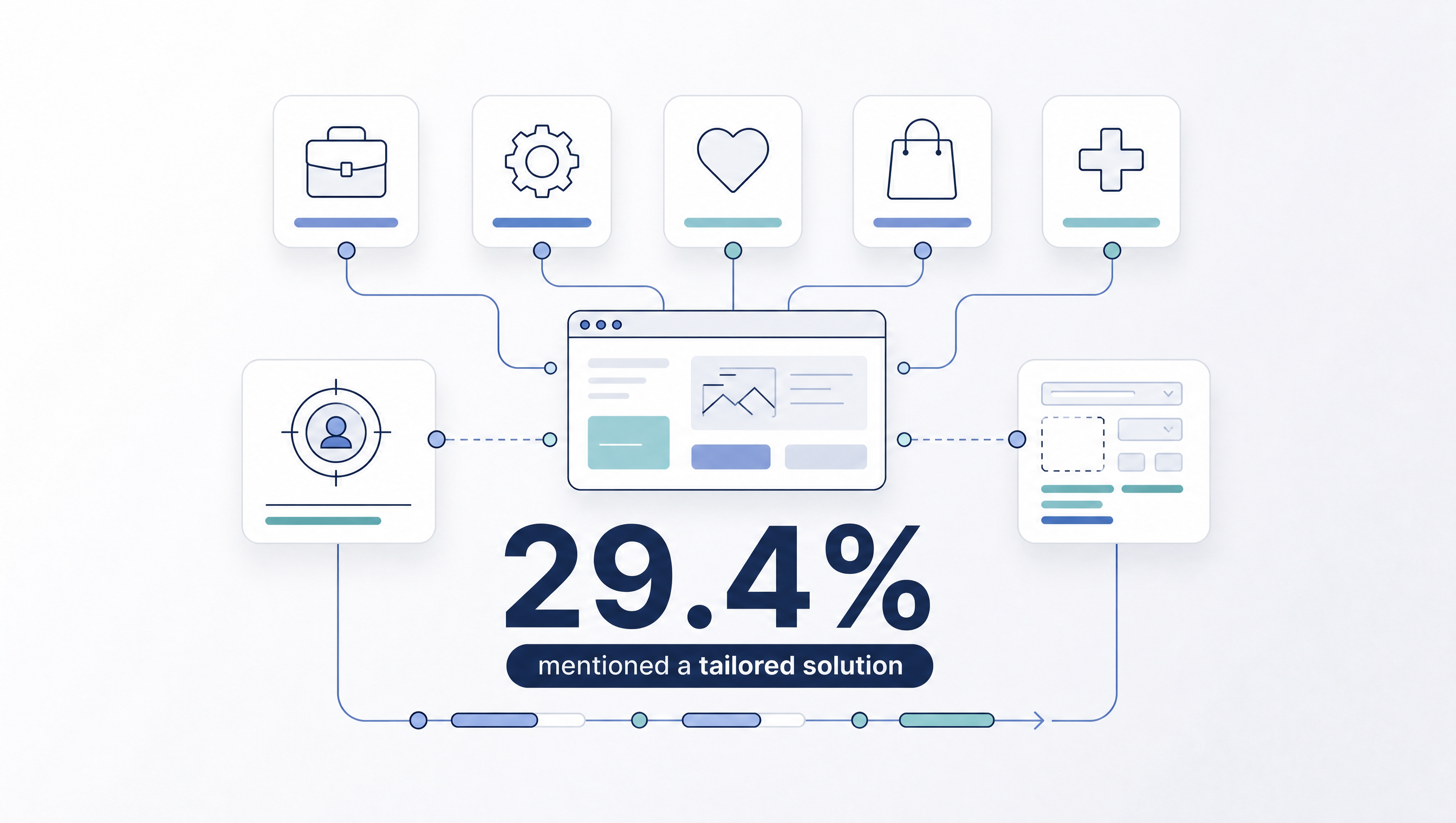
A professional services website should not be planned in the same way as an online store. A law firm has different visitor needs from a restaurant. A manufacturer may need to explain capabilities, certifications, equipment, and technical information. A nonprofit may focus on donors, volunteers, programs, or community services. A healthcare organization may need clear navigation, accessibility, trust, and appointment information. An ecommerce company must support product discovery and purchasing.
Industry knowledge becomes useful when it changes design, content, UX, and technical decisions. A discovery process should therefore cover the business model, audiences, services, competitors, sales process, geographic market, common customer questions, brand position, existing website problems, conversion goals, SEO needs, and technical requirements.
Audience
Who is using the site, what information do they need, and what action should they take?
Business Model
How does the company generate revenue, leads, bookings, donations, applications, or other important outcomes?
Sales Process
What happens between a website visit and a completed sale, consultation, booking, or customer relationship?
Market Context
Which competitors, locations, industry expectations, and customer objections should influence the site?
Finding 8
User Experience, Accessibility, Mobile Use, and Performance
Fifty six experiences, or 23.8%, mentioned UX, usability, accessibility, navigation, page speed, mobile experience, website performance, or related improvements. These reviews show that clients do not judge a website only by appearance. They also notice whether customers can use it effectively.
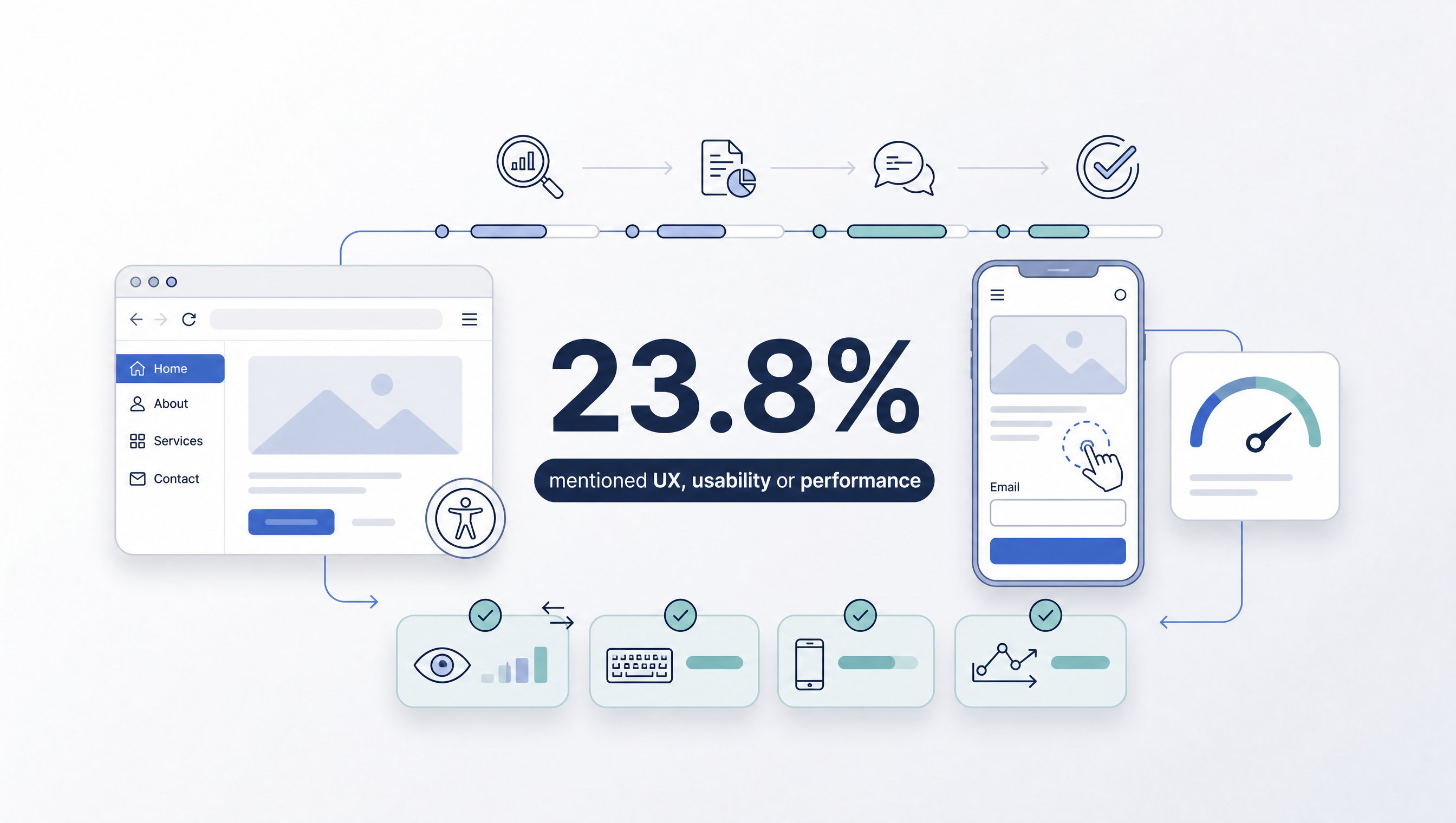
A website visitor may need to find a service, understand a product, request an estimate, complete a form, book an appointment, make a purchase, download information, or contact the company. The design should support those actions. Reviewers noticed improvements when navigation became clearer, mobile layouts improved, pages loaded faster, content was easier to understand, or forms and booking systems became easier to use.
Navigation
Visitors should find important information without knowing the company’s internal terminology or organization.
Mobile Usability
Menus, buttons, forms, content, and calls to action need to work well on smaller screens.
Accessibility
Content structure, labels, keyboard access, contrast, controls, and alternative text should be considered as part of the build.
Performance
Image weight, scripts, hosting, code quality, and third party tools can affect how quickly the site responds.
These areas should be discussed during planning and design rather than treated as items to fix at the end. A layout that looks good in a desktop mockup can still create problems when content is long, a form is used on a phone, keyboard navigation is required, or a slow third party script is added during development.
Finding 9
Reported Business and Operational Outcomes
The review analysis identified 57 unique client experiences that reported a business or operational outcome. This represents 24.3% of the final dataset. The outcome needed to describe a change related to traffic, engagement, inquiries, conversions, bookings, orders, sales, search visibility, or an operational process. General praise such as saying that the website looked good was not counted as a business outcome.
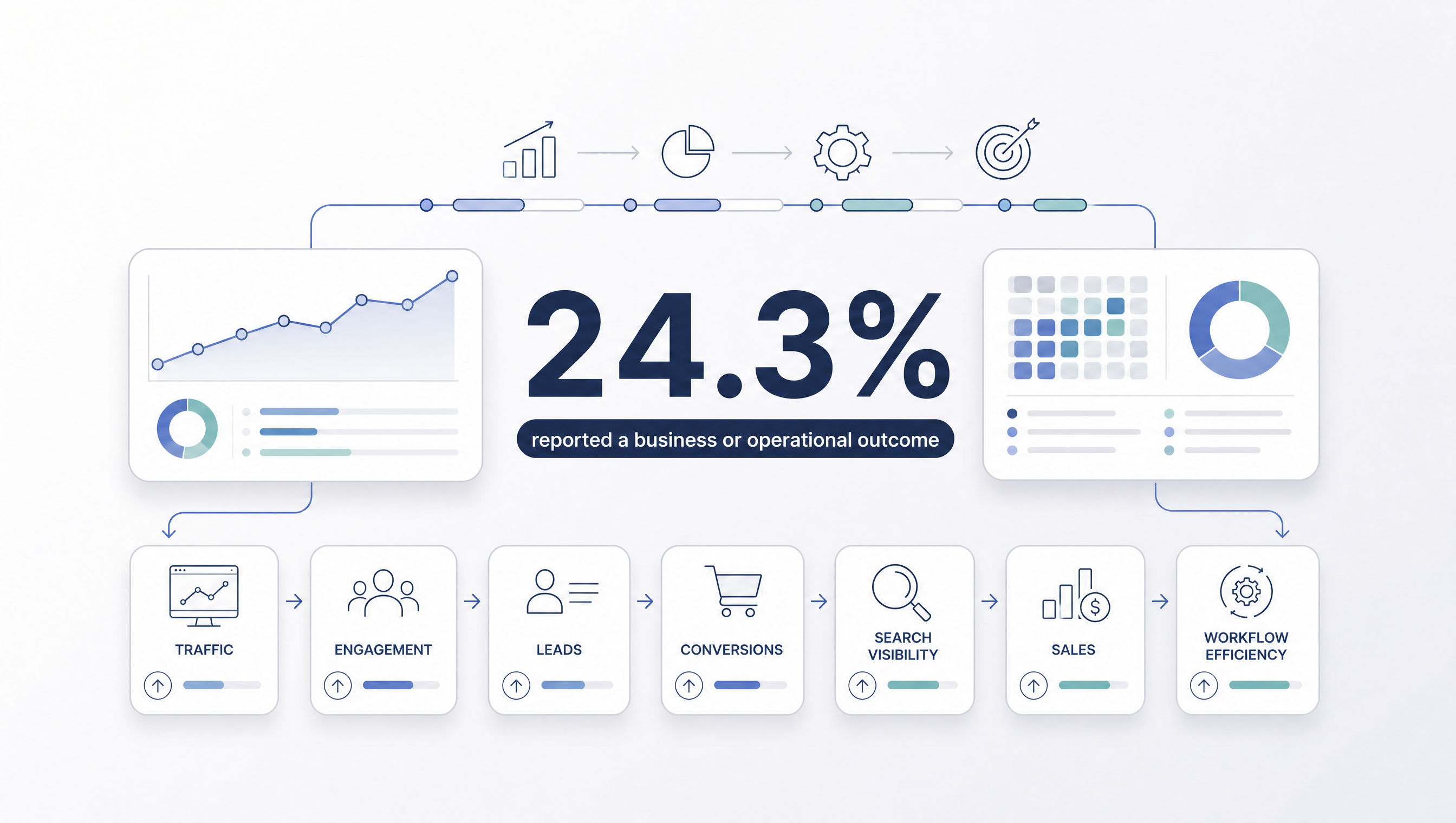
Important: the outcome categories overlap. A client may have reported higher traffic and more sales in the same review. The outcome shares should not be added together. The outcomes are client reported and were not independently audited for this research.
Traffic and User Engagement
Traffic growth appeared in 25 unique experiences, and engagement or retention improvement also appeared in 25. Reviewers described increases in website visitors, longer time on site, stronger page engagement, improved mobile usage, or more interaction with products and services. Several factors may contribute to these changes, including SEO, clearer navigation, faster pages, stronger content, paid marketing, and improved mobile usability. The review data does not allow this study to isolate the effect of each factor.
Leads, Inquiries, Bookings, and Conversions
Seventeen client experiences reported increased leads or inquiries, and 18 reported improvements in conversions, bookings, orders, or registrations. These outcomes are especially relevant for service businesses because more traffic does not automatically produce more business. Calls to action, forms, service page structure, trust signals, mobile usability, page speed, and the clarity of the offer can all affect whether a visitor completes the intended next step.
Sales and Revenue
Twelve unique client experiences described increased sales or revenue. These reports appeared most often in work connected with ecommerce, SEO, advertising, or websites that played a direct role in a purchasing decision. A website should not automatically receive credit for every change in revenue because sales can also be affected by pricing, competition, seasonality, product availability, market demand, sales teams, and advertising budgets. The value of these comments is that some clients judge web work using business performance rather than visual satisfaction alone.
Search Visibility
Twelve client experiences reported improved search rankings or search visibility, while SEO appeared more broadly in 47 of the 235 experiences. Some clients hired Bless Web Designs specifically for SEO, while others received search related work as part of a website project. The relationship between web design and SEO becomes especially important during a redesign because changes to URLs, navigation, content, internal links, page titles, templates, and redirects can affect organic performance.
Operational Improvements
Twenty experiences described some form of operational efficiency or reduced friction. Examples included easier customer booking, improved lead handling, simpler website management, reduced spreadsheet use, online systems replacing manual work, improved hiring workflows, and more efficient data collection. This area becomes more important as websites connect with CRM systems, payment platforms, scheduling software, email tools, and internal business processes.
Client Selection Data
Why Clients Selected the Agency
Clutch includes structured questions about why a client selected an agency, which provides a useful view of the decision process. Across the 54 Clutch reviews in the research dataset, good value for cost was the most frequently selected reason. High ratings, referrals, and alignment with company values also appeared regularly. Clients could select more than one reason, so these figures should be read independently rather than added together.
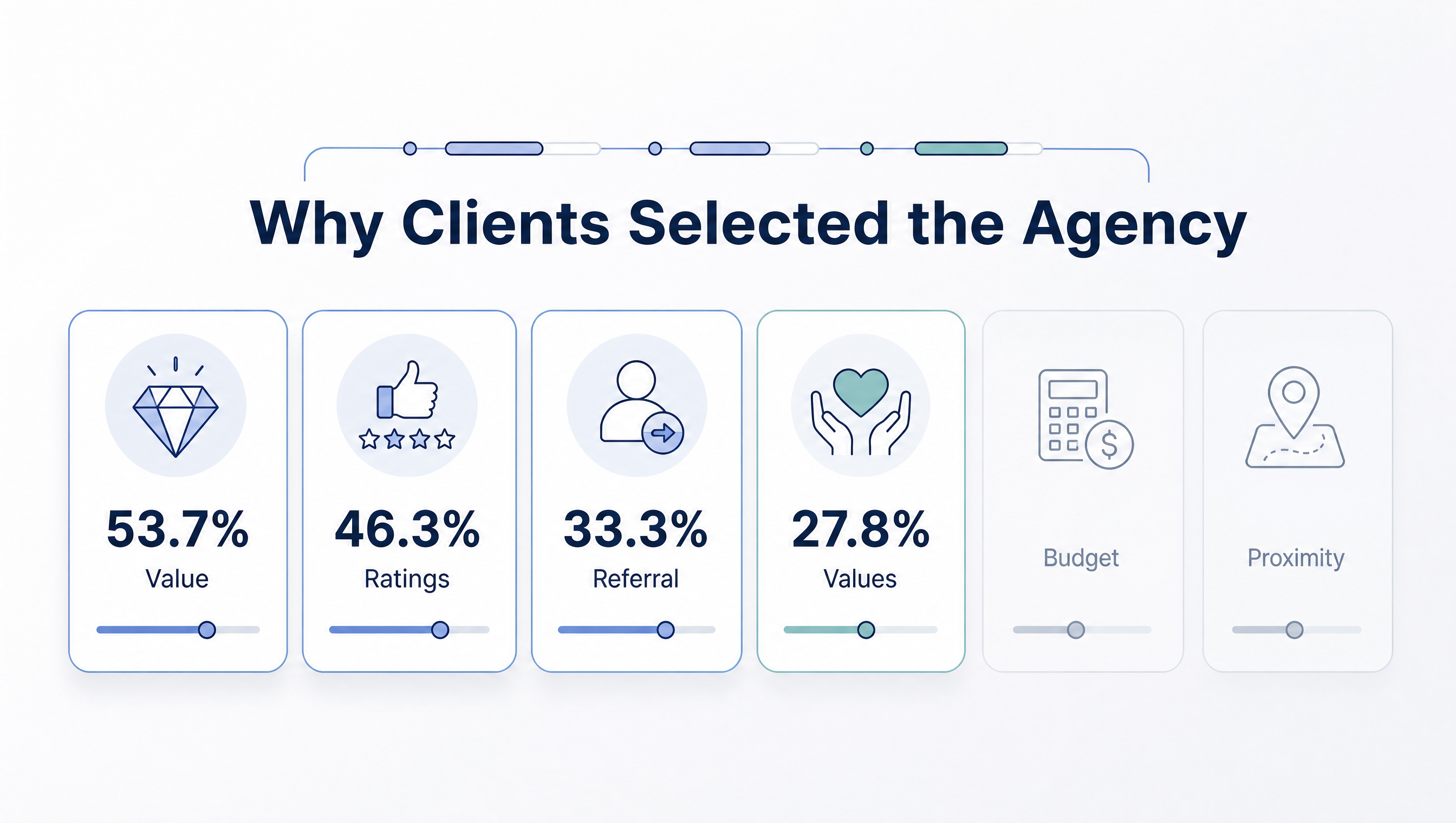
The data suggests that reputation and perceived value were more common reasons for selecting the agency than physical proximity. This does not mean location is unimportant. A Dallas business may prefer a Dallas web design agency because of local market knowledge, the same time zone, local search experience, or the option to meet in person. The review data indicates that local presence still needs to be supported by evidence of quality, fit, and value.
Project Context
Project Cost Information From Clutch
Clutch provides project cost ranges, which helps place the feedback in context. Among the 54 reviews included in this part of the study, 35 projects were reported below $10,000, 18 were reported between $10,000 and $49,999, and one project did not provide a usable cost range.
| Project Cost | Reviews | Share |
|---|---|---|
| Less than $10,000 | 35 | 64.8% |
| $10,000 to $49,999 | 18 | 33.3% |
| Unspecified | 1 | 1.9% |
These figures describe the projects represented in this Bless Web Designs review dataset. They should not be treated as general pricing for the web design industry.
Website cost can vary according to page count, content requirements, custom design, development complexity, ecommerce, integrations, APIs, booking systems, accessibility requirements, SEO, content migration, testing, and other factors. The useful observation from the review data is that clients across different project sizes still discussed many of the same service factors, including communication, timing, responsiveness, technical ability, organization, and business understanding.
Scope of Work
Services Represented in the Review Data
The Clutch review data shows that modern website engagements often include several services rather than one isolated area of work. Web design and web development were the most common service categories, followed by search engine optimization, UX and UI design, and branding. Smaller numbers of reviews covered ecommerce, pay per click advertising, AI development, graphic design, digital strategy, and other digital marketing work.
| Service | Mentions |
|---|---|
| Web Design | 35 |
| Web Development | 31 |
| Search Engine Optimization | 19 |
| UX/UI Design | 14 |
| Branding | 9 |
| Ecommerce Development | 4 |
| Pay Per Click | 2 |
| AI Development | 2 |
| Other Digital Marketing | 2 |
| Graphic Design | 2 |
| Digital Strategy | 1 |
| Packaging Design | 1 |
Many projects included more than one service. A redesign may involve development, SEO, UX, content changes, analytics, and branding. An ecommerce website may involve payment processing, product structure, mobile usability, SEO, and conversion planning. A custom portal may require UX planning, database work, integrations, security, and ongoing support. The service categories are therefore related and should not always be viewed as separate activities.
Spontaneous Review Language
What the Written Google Reviews Show
The Google review subset included 132 written reviews after rating only entries were removed. This subset is useful because Google reviewers generally write short, open ended feedback rather than responding to detailed B2B project questions. The themes in this section therefore show what customers chose to mention without being prompted to discuss project management, measurable outcomes, or improvement areas.
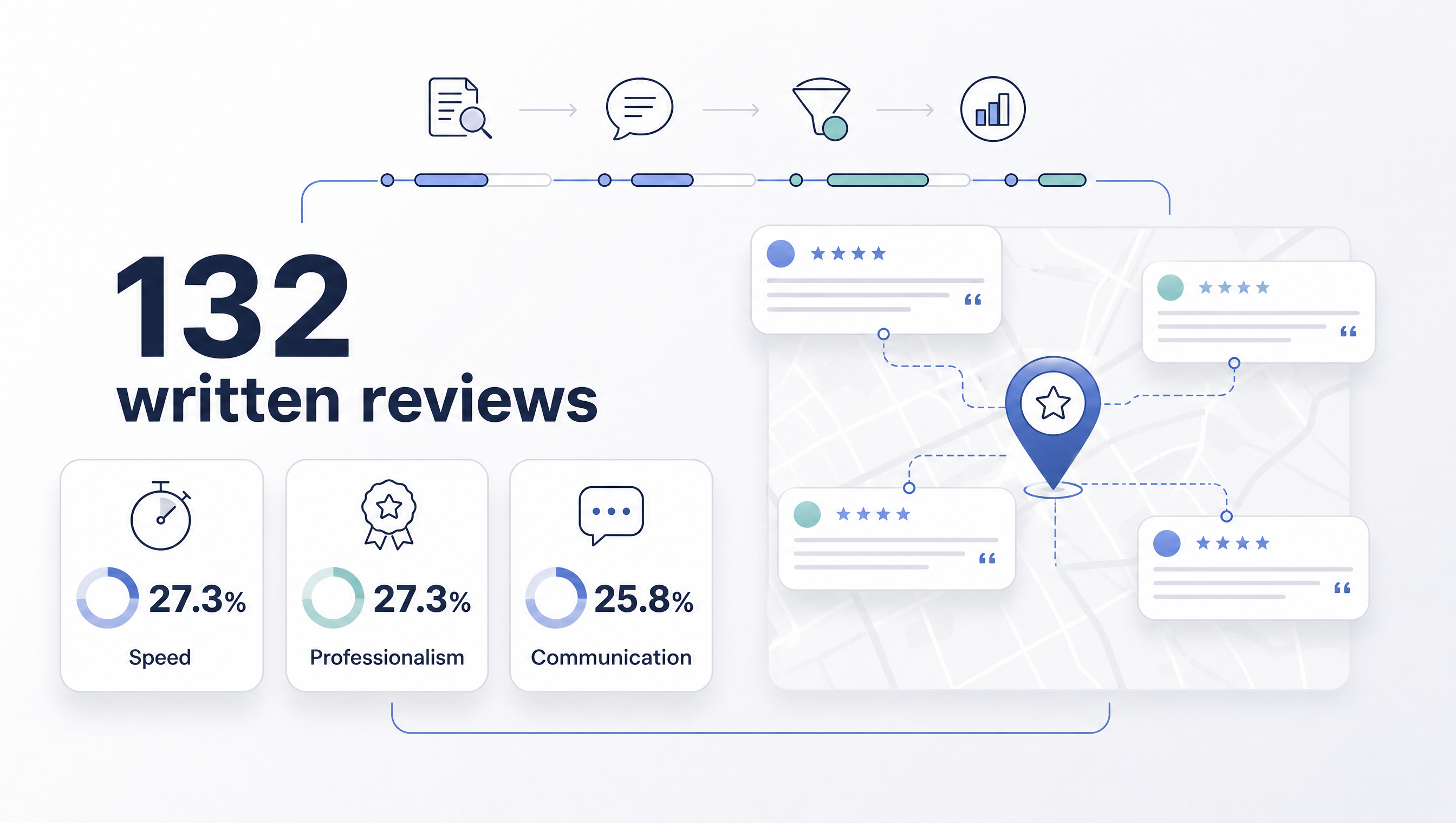
| Theme | Reviews | Share |
|---|---|---|
| Timeliness or speed | 36 | 27.3% |
| Professionalism or reliability | 36 | 27.3% |
| Communication or responsiveness | 34 | 25.8% |
| Design or creativity | 24 | 18.2% |
| Easy or smooth process | 20 | 15.2% |
| Technical expertise or development | 20 | 15.2% |
| Customization or tailored solution | 16 | 12.1% |
| Client understanding or listening | 11 | 8.3% |
| Collaboration or partnership | 10 | 7.6% |
| SEO or search visibility | 10 | 7.6% |
The Google theme shares are lower than the full cross platform results because Google reviews are much shorter. A short review may discuss one topic while a structured review may contain several hundred words and cover many parts of the project. Even with that difference, speed, professionalism, and communication remained the three leading Google themes. This makes those factors especially useful when looking for subjects that customers mention without a structured prompt.
Constructive Feedback
What Clients Said Could Be Improved
A research report about client experience is more useful when it includes constructive comments as well as praise. Most reviews in the dataset were highly positive, but some clients still identified specific ways the service could improve. Structured platforms are more likely to collect this type of feedback because they ask reviewers directly what the agency could have done differently.
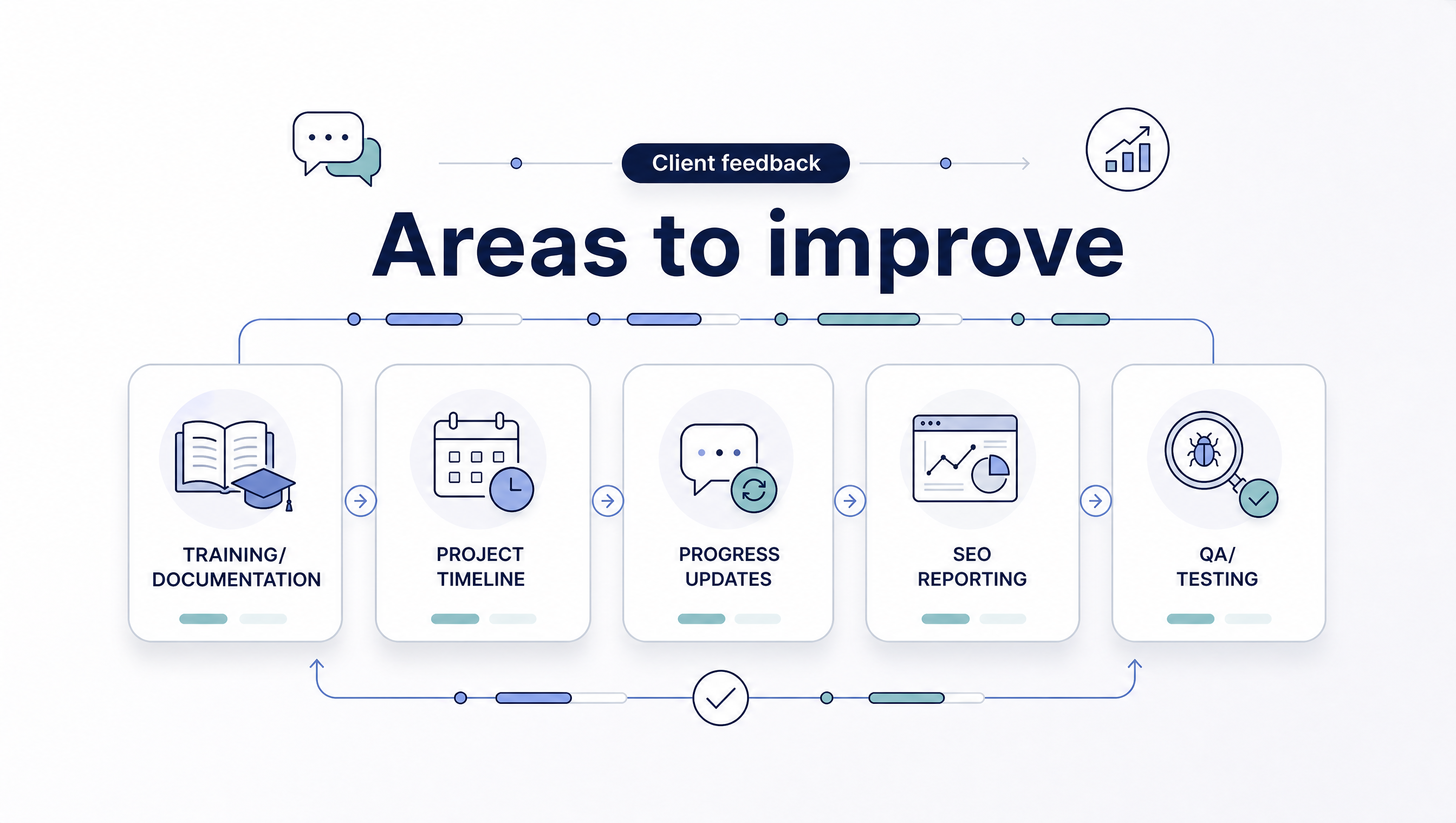
| Improvement Area | Mentions |
|---|---|
| More post launch training, documentation, or handoff support | 14 |
| Clearer planning, timelines, or scope communication | 10 |
| More SEO insight, reporting, or clearer backlink expectations | 5 |
| More proactive progress updates or follow ups | 5 |
| More analytics, testing, or specialized quality assurance | 3 |
| More strategic pushback or additional ideas | 1 |
These counts should not be converted into a share of all 235 experiences because not every platform asks customers what could have been improved. The data is most useful as a list of recurring subjects that appeared when clients were given an opportunity to provide constructive feedback.
Post Launch Training and Documentation
The clearest recurring request involved training, documentation, or handoff. Clients sometimes wanted more information about how to manage the site after launch, including backend training, written instructions, video tutorials, or a more organized handoff process. This suggests that training should be planned as a project stage rather than handled as a short task immediately before launch.
Project Timelines and Milestones
Several customers wanted clearer information about project stages or schedules. A web agency may understand its production process, but clients may not know what discovery, wireframing, design approval, development, content migration, quality assurance, launch, and post launch support involve. A written roadmap can reduce uncertainty by showing major stages, expected approvals, client responsibilities, and issues that may affect the schedule.
Proactive Updates
Some clients said the agency responded well when contacted but would have preferred more proactive communication. Longer projects can benefit from a fixed weekly update that shows completed work, current work, decisions needed from the client, schedule changes, and the next milestone. This allows the client to understand progress without having to request a status update.
SEO Reporting and Expectations
Some SEO related reviews requested more detail about strategy, reporting, content recommendations, or backlink expectations. SEO becomes difficult for clients to evaluate when deliverables are described in broad terms. Terms such as link building, authority, local SEO, content optimization, technical SEO, and reporting should be defined clearly during the sales and onboarding process.
Testing and Measurement
A smaller number of clients wanted additional testing, analytics, or quality assurance. This supports the use of a formal launch checklist covering forms, mobile layouts, browser compatibility, redirects, analytics, search indexing, performance, integrations, and other important functions. Measurement should also continue after launch so the business can compare the new site with the previous baseline.
Actions Bless Web Designs Is Planning From This Feedback
The purpose of this review analysis is not only to summarize positive feedback. Based on the recurring improvement comments, Bless Web Designs plans to implement or formalize the following process updates. These are planned process changes and are not presented as claims that every item was already in place when the reviews were written.
Planned update
Handoff Package
Standardize recorded training, written editing instructions, access details, and support procedures for website launches.
Planned update
Kickoff Roadmap
Provide a clear milestone plan showing project stages, approvals, client responsibilities, dependencies, and likely schedule risks.
Planned update
Proactive Status Updates
Use a consistent progress update schedule on longer projects so clients do not have to request routine status information.
Planned update
Clearer SEO Scope
Define SEO deliverables, reporting, backlink expectations, measurement, and responsibilities more clearly before ongoing work begins.
Planned update
Launch QA Checklist
Formalize checks for forms, mobile layouts, redirects, analytics, search indexing, integrations, browser behavior, and launch readiness.
Planned update
Post Launch Follow Up
Add a structured follow up after launch to confirm access, answer editing questions, review early performance issues, and identify support needs.
Practical Buyer Guide
How to Evaluate a Web Design Agency
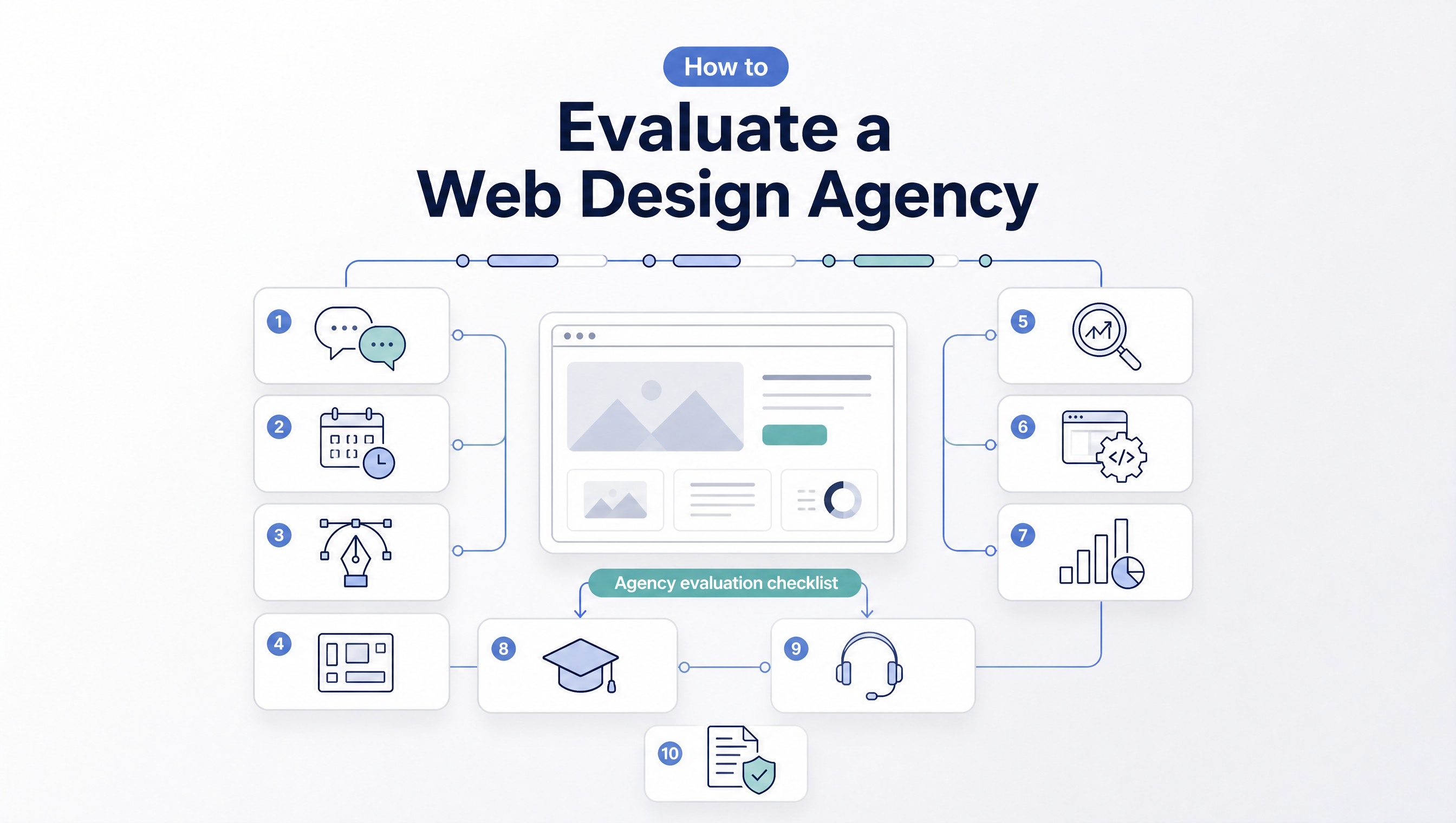
The review findings support a broader agency evaluation process. A portfolio and proposal are important, but they should be reviewed together with communication, project management, technical capability, business understanding, support, ownership, and measurement. The questions below are designed to help businesses evaluate those areas before signing a contract.
Communication
Who will be the primary contact? How often will updates be provided? What response time is normal?
Schedule
What is the expected timeline, what can delay it, and how are schedule changes communicated?
Design
Will the site be designed for the business, how many review stages are included, and what design files are delivered?
Development
Who builds the site, what technology is used, and how will custom functionality be maintained?
User Experience
How will navigation, mobile usability, accessibility, forms, performance, and calls to action be handled?
SEO
How will URLs, redirects, content, metadata, internal linking, and existing search visibility be protected?
Measurement
Which conversions and KPIs will be tracked before and after launch?
Training and Support
What training, documentation, maintenance, backup, and support options will be available?
How to Review a Portfolio
Visit live websites when possible rather than relying only on screenshots. Check how the site behaves on a phone, whether navigation is easy to understand, how clearly the company explains its services or products, and how easy it is to find the next step. Compare several projects from the same agency to see whether the designs are adapted to each business or whether every client receives the same layout.
A financial services company, manufacturer, law firm, restaurant, nonprofit, healthcare organization, software company, and ecommerce business have different communication and conversion needs. The portfolio should show that the agency can adjust design and content structure to those differences.
How to Evaluate Reviews
Review quantity is useful, but detail also matters. A short five star review provides evidence of satisfaction. A detailed review can explain the original problem, the type of work performed, how the project was managed, what changed after launch, and what the client would have preferred the agency to handle differently. It is also useful to compare several review sources rather than relying on a single directory.
Cross platform repetition should be considered. The same client experience appearing on several directories should not automatically be interpreted as several separate customers. Detailed research should distinguish between raw review records and unique underlying experiences.
Local Agency or Remote Agency?
The Clutch selection data found that only three of the 54 reviewers specifically identified geographic proximity as a reason for choosing the agency. Value, ratings, referrals, and company alignment appeared more often. This does not make location irrelevant. A Dallas business may benefit from working with a Dallas web design agency that understands North Texas, operates in the same time zone, can meet locally, and has experience with the Dallas Fort Worth market.
Location should still be considered together with technical ability, communication, service quality, relevant experience, and fit. A nearby agency is not automatically the right agency for a project, and a remote agency is not automatically a poor choice.
Specialist Agency or Full Service Agency?
Some companies need only web design. Others need design, development, SEO, branding, advertising, automation, analytics, hosting, integrations, or ongoing maintenance. A specialist may be the best choice when the problem is narrow and the business already has other resources. A broader agency can be useful when several parts of the digital operation need to work together.
The length of an agency’s service list should not be the deciding factor. The important questions are who will perform each part of the work and whether those people have relevant experience.
What Does Custom Web Design Mean?
Customization appeared in almost 30% of the final dataset. The term custom web design should therefore be defined before a project begins. Custom may refer to visual design, UX planning, WordPress templates, page layouts, custom functionality, or all of those areas. Some agencies build a visual system specifically for the client. Others modify an existing framework or theme.
Both approaches can be appropriate when expectations are clear. Businesses should ask which parts of the site will be custom, what may use existing components, whether design happens before development, what editing control the client will have, and how future pages will be created.
SEO During a Website Redesign
A redesign can affect search performance in several ways. URLs may change, pages may be removed, internal links may change, content may be shortened, metadata may be replaced, and new templates can introduce technical issues. Businesses that already receive organic search traffic should discuss these risks before development begins.
The agency should review important landing pages, current URLs, redirects, metadata, internal links, site architecture, Google Search Console data, mobile performance, and indexation. Ongoing SEO may be a separate service, but the redesign itself should not ignore the search value already built by the existing site.
Post Launch Support and Ownership
Support and maintenance appeared in 28 client experiences, while training and handoff appeared in 19. Websites need updates after launch. Software changes, forms may stop working, businesses add services, security issues can appear, and marketing campaigns create new landing page requirements. The support relationship should therefore be discussed before the initial project is complete.
Businesses should know who maintains the site, what ongoing services cost, how backups and updates are handled, and what response time is available for urgent problems. The business should also understand ownership of the domain, hosting account, code, content, images, design files, analytics accounts, and important credentials.
Research Context
Research Limitations and Transparency
The Research Covers One Agency
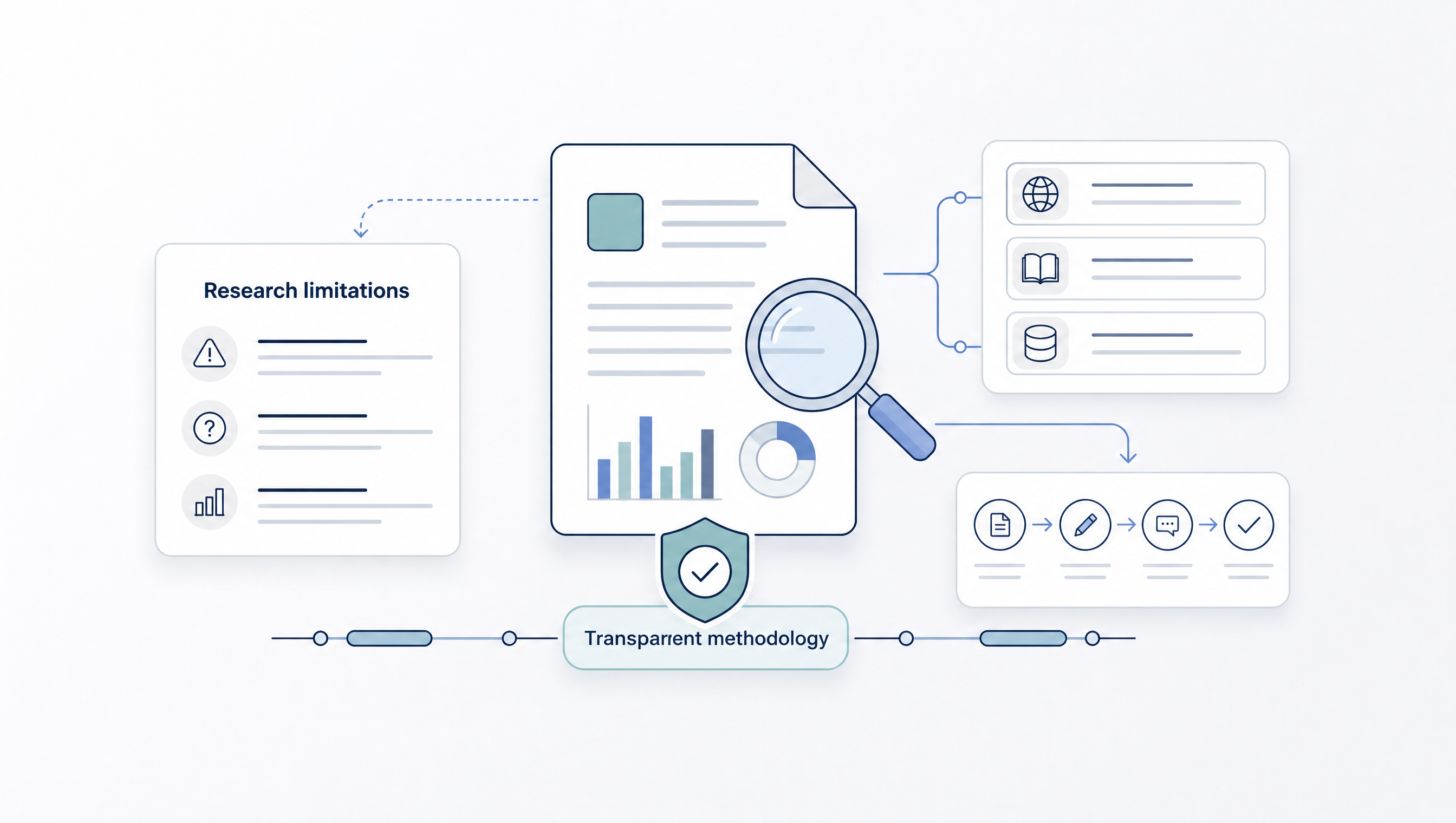
All reviews in the final dataset relate to Bless Web Designs. The findings cannot be used to claim that these exact figures represent every web design agency or every web design client. A multi agency study would be required for broader industry conclusions.
Reviews Are Voluntary
Customers decide whether to publish reviews. People who leave public feedback may have different experiences from clients who do not post reviews. This is a common limitation of research based on online review data.
Platforms Use Different Review Formats
Clutch and GoodFirms collect much more project information than Google or Yelp. Longer reviews have more opportunities to contain several themes, and structured questions can increase the frequency of subjects such as measurable outcomes and project management. The separate Google analysis is included partly to reduce this problem.
Business Outcomes Are Client Reported
Traffic, sales, bookings, search visibility, and other outcomes came from customer review statements. They were not independently audited for this research. The study therefore reports that clients described these outcomes, not that the research independently proved the results.
Services Vary Across the Dataset
The review corpus includes web design, development, SEO, branding, ecommerce, advertising, UX, automation, hosting, maintenance, and related services. The study should therefore be understood as research into the broader web and digital agency client experience rather than a controlled analysis of one identical service.
Theme Classification Requires Judgment
Some review statements can reasonably belong to more than one category. A comment saying that a team responded quickly relates to both communication and speed. Multi label classification was used to preserve these overlaps rather than forcing every sentence into one category.
The Dataset Is a September 2026 Snapshot
New reviews will change the dataset over time. Future updates should identify the new research date and methodology version so readers can distinguish one edition of the study from another.
Conclusion
What the Review Data Suggests About Choosing a Web Design Agency
The analysis of 235 unique usable written client experiences found that customers discuss the working relationship with a web design agency at least as much as the finished website. Timeliness and speed appeared in 46.8% of the dataset, communication and responsiveness in 46.4%, professionalism and reliability in 41.7%, and design and creativity in 36.6%.
Technical ability, an easy project process, customized solutions, business understanding, user experience, project management, SEO, collaboration, and support also appeared regularly. Fifty seven client experiences, or 24.3% of the dataset, described a business or operational outcome such as traffic, engagement, inquiries, bookings, conversions, search visibility, sales, or reduced operational friction.
The findings indicate that businesses should evaluate web design agencies across several areas. Portfolio quality remains important, but it should be considered together with communication, reliability, technical capability, discovery, project organization, support, and the agency’s ability to connect the website with a business goal. The review data also shows that clients notice parts of a project that can be overlooked in sales materials, including training, progress updates, documentation, launch testing, and post launch support.
Detailed client feedback can provide information that is difficult to obtain from a portfolio or proposal alone. A portfolio shows what the agency produced. Reviews can show how the agency worked, how it handled problems, how the client felt during the project, and what happened after launch. Using both types of evidence provides a more complete basis for choosing a web design partner.
Common Questions
Frequently Asked Questions
What should I look for when choosing a web design agency?
Review the portfolio, but also look at communication, project management, technical experience, client reviews, support, business understanding, and measurement. In this study, speed, communication, and professionalism were mentioned more frequently than design itself.
How important are customer reviews when choosing a web designer?
Reviews can provide information that a portfolio cannot. They can show how the agency communicates, handles deadlines, manages revisions, responds to technical problems, and supports clients after launch. Detailed reviews are more useful when they explain the project and the client experience rather than only providing a rating.
Should I use Google reviews or Clutch reviews when researching an agency?
Both can be useful for different reasons. Google reviews are usually shorter and more open ended. Clutch reviews are more structured and often include project scope, budget, project management, outcomes, and improvement areas. Looking at more than one source provides a broader view.
Can review totals from several websites be added together?
Not reliably. A client can leave feedback on several platforms, and some directories may contain syndicated or repeated reviews. Cross platform totals should be checked for duplicate client experiences before they are described as unique customers.
Does a web design agency need to be local?
Not necessarily. A local agency can provide benefits such as same time zone communication, local market knowledge, and the option to meet in person. In the 54 Clutch reviews analyzed here, ratings, value, referrals, and company alignment were mentioned more often as selection factors than geographic proximity.
How much does professional web design cost?
There is no standard cost that applies to every project. Price depends on scope, page count, content, design complexity, development, ecommerce, integrations, SEO, accessibility, and other requirements. In the 54 Clutch reviews analyzed here, 35 projects were listed below $10,000 and 18 were listed between $10,000 and $49,999. These figures describe this dataset only.
Should SEO be considered during a website redesign?
Yes, especially when the existing site already receives organic search traffic. URLs, redirects, content, metadata, internal links, indexation, and site structure can all change during a redesign. These items should be reviewed before launch.
What should an agency provide after launch?
The client should understand how the site is managed, how support works, where important credentials are stored, what maintenance is required, and which analytics or conversions are being monitored. Training and documentation were among the more common improvement areas identified in structured feedback.
How can I tell whether an agency understands my business?
Review the questions the agency asks during discovery. The team should want to understand the audience, services, business model, competitors, sales process, geographic market, current website problems, and project goals before recommending a design or technical approach.
What is more important, a portfolio or customer reviews?
They answer different questions. The portfolio shows the work the agency has produced. Reviews provide information about the working relationship, communication, timing, support, and client experience. Both should be evaluated before making a decision.
Publisher and Sources
About the Research
About Bless Web Designs
Bless Web Designs is a Dallas, Texas web design and digital marketing agency serving businesses in Dallas Fort Worth and other markets. Services include custom web design, WordPress development, UX and UI design, search engine optimization, branding, ecommerce development, digital marketing, paid advertising, automation, managed hosting, website maintenance, and related digital services.
Bless Web Designs has operated since 2012 and maintains locations associated with Dallas, Garland, and Mesquite, Texas. The company published this study to identify recurring patterns in its own customer feedback and to provide businesses with additional information when evaluating web design agencies. Because Bless Web Designs is the subject of the review data, that relationship is disclosed in the methodology and limitations.
About the Author
Nibin Varghese is Co-Founder and Creative Director of Bless Web Designs. His work includes website strategy, custom web design, user experience, project planning, development strategy, search engine optimization, conversion strategy, branding, digital marketing, and client discovery. His role in this research was to review and interpret customer feedback in the context of website and digital agency projects while retaining both positive and constructive findings.
Research Sources
The study used customer review records from Google Business Profile and Google Maps for Bless Web Designs locations in Dallas, Garland, and Mesquite; Clutch; GoodFirms; TechBehemoths; DesignRush; Trustpilot; Better Business Bureau; Facebook; TopDevelopers.co; and Yelp. Each platform uses its own system for collecting, moderating, displaying, or verifying reviews. References to verification apply only when the source platform specifically describes the review that way.
- Google Business Profile
- Clutch
- GoodFirms
- TechBehemoths
- DesignRush
- Trustpilot
- Better Business Bureau
- TopDevelopers.co
- Yelp
Methodology Summary
| Raw records collected | 265 |
|---|---|
| Review platforms | 10 |
| Google Business Profile locations | 3 |
| Rating only records removed from text analysis | 4 |
| Written records before deduplication | 261 |
| High confidence duplicate groups | 15 |
| Duplicate publications consolidated | 18 |
| Records excluded for attribution problems | 8 |
| Final unique usable written experiences | 235 |
| Analysis method | Multi label qualitative review analysis |
| Business outcome data | Client reported |
| Research date | September 2026 |
| Methodology version | 1.0 |
Research conducted and published by Bless Web Designs, Dallas, Texas. Last updated September 2026.