



Home / Functional Web Design / Google Trends / How to Market a Restaurant in Dallas: A Practical Plan for Independent Owners
 Written by
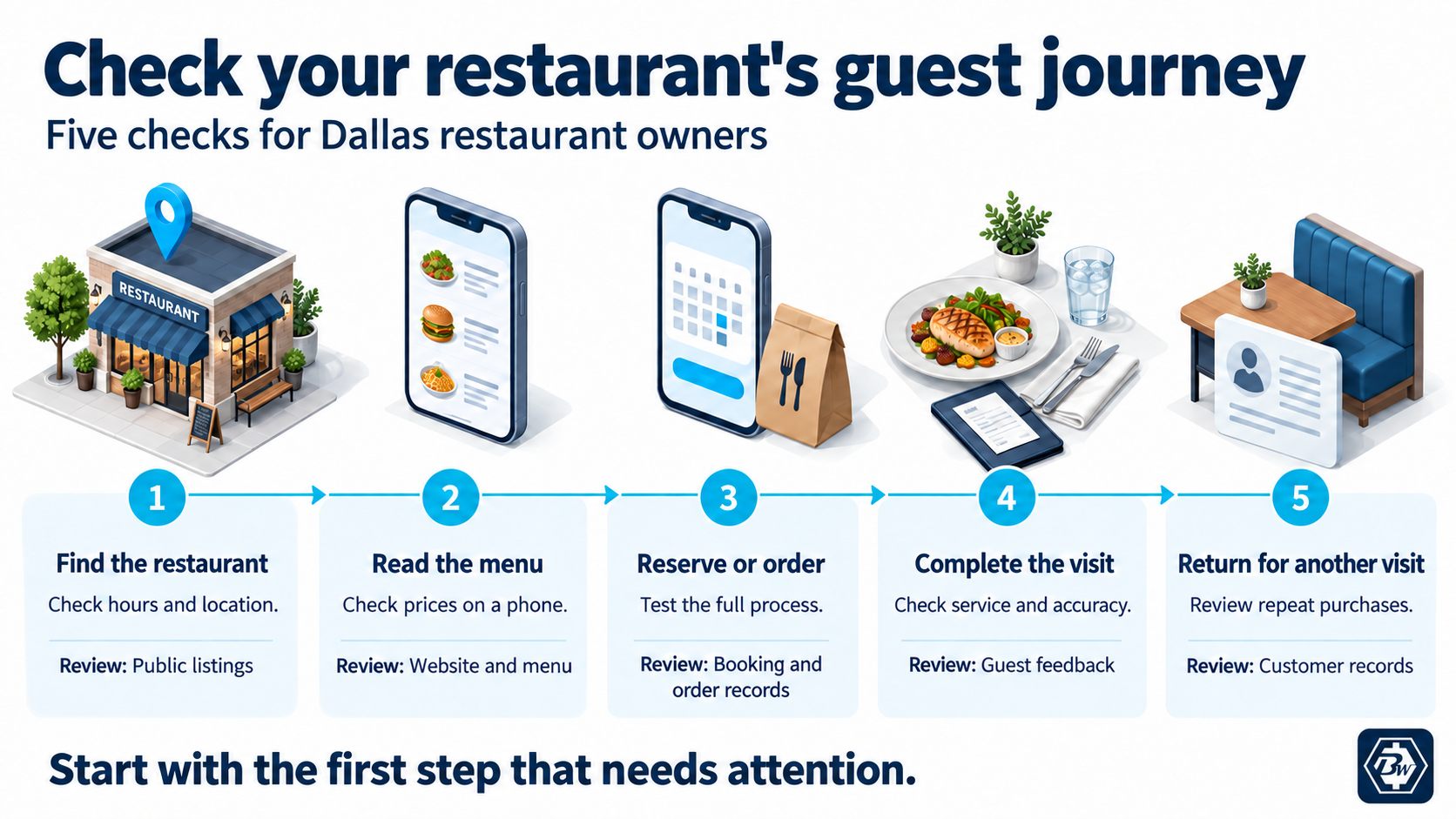
 Before you spend more on restaurant marketing in Dallas, decide which part of the business needs attention. A quiet Tuesday lunch, unanswered reservation calls and weak catering sales call for different work. Choose one priority and follow the customer from the first inquiry through to a completed visit or order.
A restaurant receiving few inquiries may need better local visibility. If people are already calling but cannot reach anyone, the immediate problem is handling those calls. When first visits are steady and return visits are scarce, look at what guests experience and whether they have a reason to come back.
The steps below cover local visibility, websites, menus, reservations, customer follow-up and marketing costs. Start with the section that matches your main problem, then use the 90-day plan to assign the work and review the results.
Where should your restaurant start?
| What you are seeing | First place to investigate |
|---|---|
| Too few discovery searches, calls or direction requests | Check the Google Business Profile, menu, categories, hours, action links and location information on the website. |
| Website or profile activity without enough completed orders or bookings | Test the menu, phone, reservation and ordering route from beginning to confirmation. |
| First visits without enough return business | Review the guest experience, repeated feedback, follow-up permission and the reason offered for another visit. |
1. Choose the customers and occasions to focus on
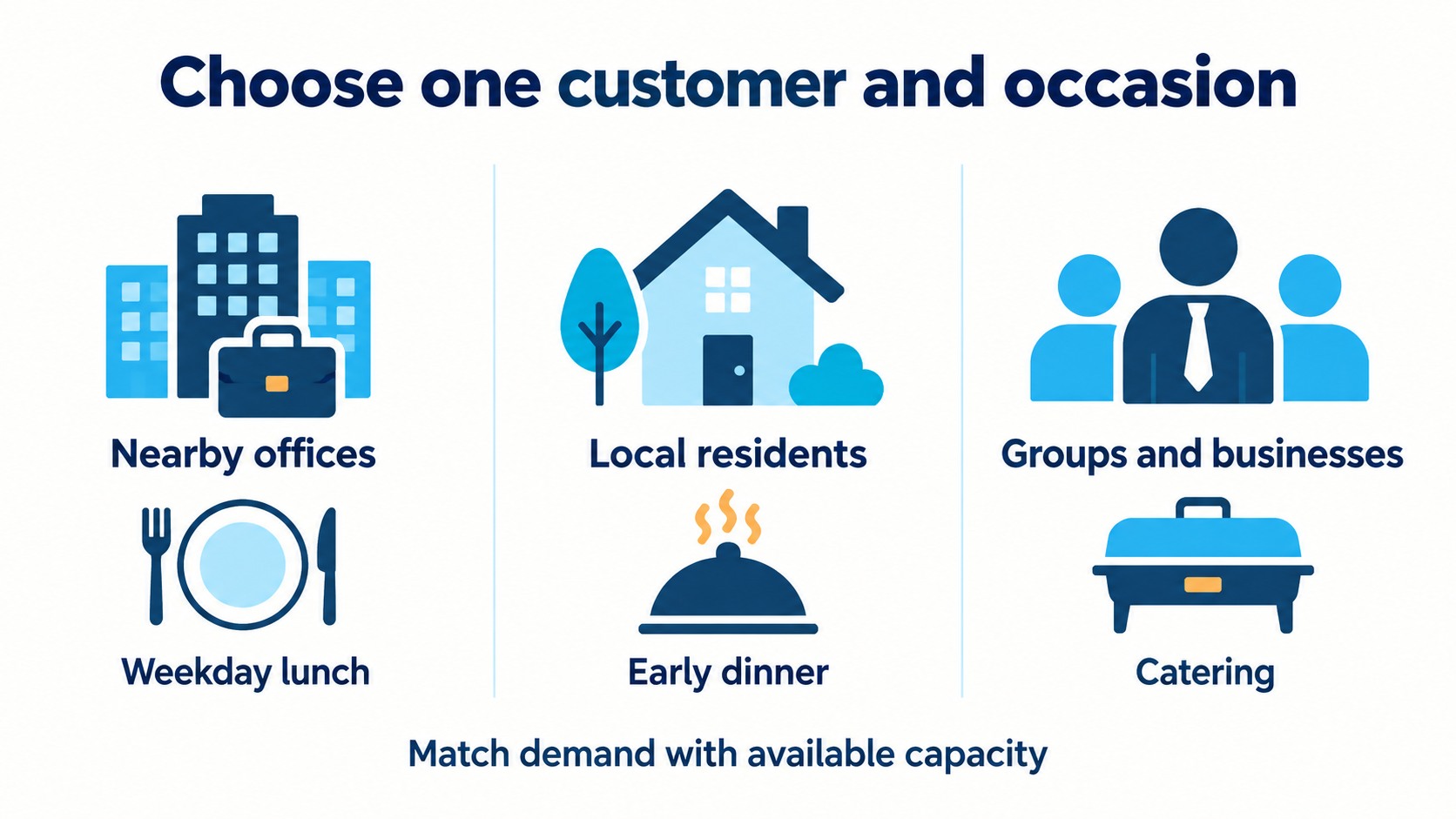
Choose an occasion you can serve well before choosing a marketing channel. “More weekday lunch orders from nearby workplaces” gives you a clearer starting point than “more exposure in Dallas.” It identifies the customer, the time and the result you want.
Your sales by day and hour are a useful starting point. Compare dine-in, pickup, delivery and catering, then ask staff which requests they hear most often. Customer addresses can help define a delivery area, while a short conversation at the table may tell you more about what brings dining-room guests to the neighborhood.
The neighborhood helps explain the occasion. Visit Dallas’s guides to Uptown and Deep Ellum describe their dining and entertainment settings. Use that background alongside what you know about your customers, nearby workplaces and the times your kitchen has room for more orders.
An Uptown lunch restaurant could test an office pickup offer with a clear price and pickup time. Its kitchen would need to prepare those orders before the lunch rush. A Deep Ellum restaurant could test an early dinner offer around a nearby venue’s schedule, allowing guests enough time to eat and reach the event. These are hypothetical examples to adapt and test with your own customers.
Before either restaurant advertises, the owner should work through the visit with the team. An office customer needs to know where to collect lunch and how long the pickup will take. An evening guest may need parking directions and an honest estimate of how much time to allow. These details belong in the offer and the staff briefing.
Write one objective that includes a period and a result. For example, you could aim to increase completed weekday pickup orders over the next month while maintaining your chosen contribution per order. Use your current numbers to set the target.
2. Check how guests find and book your restaurant
Follow the same path a new guest would take before paying for more traffic. Use a phone to find the restaurant, check the hours, open the menu and attempt the main action. Complete a reservation test or a small test order, then remove any test booking promptly.
The profile may show the right hours while the ordering provider closes an hour early. A reservation button may lead to a form that leaves the guest unsure whether a table is booked. Write down where the process breaks and assign the correction to someone who controls that account or system.
Ask a manager to review incoming and missed calls during a defined period. Count reservation inquiries separately from supplier calls, existing booking changes and unrelated questions. A missed call is an opportunity to investigate, but it is not automatically a lost table.
Next, establish a baseline using a consistent period, such as the previous four complete weeks. Export the relevant information from your point-of-sale system, reservation records and website reports. Keep the definitions unchanged when you compare the next period.
Choose the measures that fit your restaurant. A counter-service lunch business might begin with completed orders, average order value and repeat purchases. A dining room that accepts reservations also needs to know how many inquiries become bookings and how many booked guests arrive. Start with records staff can maintain during an ordinary week.
| Measurement | Working definition | Where to obtain it |
|---|---|---|
| Completed orders | Orders fulfilled during the period, with canceled orders excluded. | Point-of-sale or ordering records. |
| Average order value | Net food and drink sales divided by completed orders; exclude sales tax and tips and handle refunds consistently. | Sales report using the same dates. |
| Reservation completion | Confirmed reservations divided by identifiable reservation inquiries for the same inquiry group. | Call, form and reservation records. |
| Guests actually served | People seated from reservations, recorded separately from bookings and walk-ins. | Host or reservation records. |
| Observed repeat-guest share | Identifiable guests with at least two purchases in the period divided by all identifiable purchasing guests in that period. | Consistent customer records; coverage will be incomplete. |
| Campaign cost per completed order | Total advertising, management and creative costs divided by completed orders attributed to that campaign. | Campaign costs and matched order records. |
Count repeated messages about the same reservation as one inquiry, and allow a consistent time for that inquiry to become a booking. Do not describe the repeat-guest measure as the behavior of every diner if many transactions cannot be connected to a person. Likewise, a click on a phone button does not prove that someone called, booked or arrived.
A campaign link or offer code can show which orders were associated with a promotion; those are attributed orders. To judge growth, you also need to estimate how many purchases the promotion added. Some existing guests will use a discount for a visit they already intended to make.
The audit should leave you with a specific job to do. If people open the menu but cannot complete an order, repair that part of the website. If orders are coming through and customers regularly wait past their pickup time, work through preparation and handoff with the kitchen team.
Bless Web Designs offers an AI and automation opportunity audit for Dallas restaurants that need help reviewing their call and inquiry process. The review identifies tasks suitable for automation and sets out a scope for implementation.
3. Keep your local listings accurate
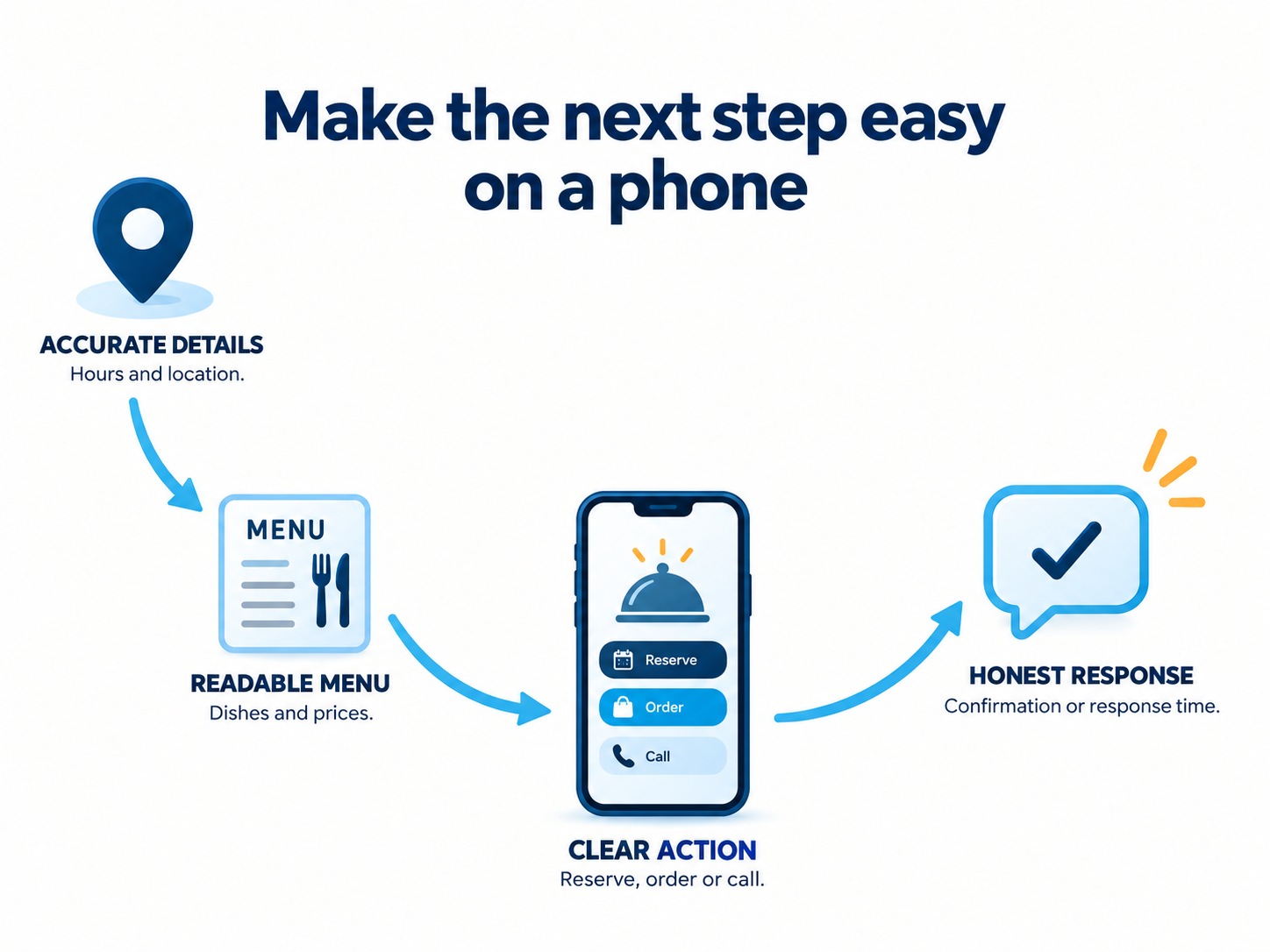
Your business information should answer the practical questions a guest asks before leaving home or placing an order. Maintain the restaurant name, address, phone number, hours, cuisine and service options wherever customers commonly find you.
Start with your Google Business Profile. Check the map location and entrance, choose the most accurate primary category and add only other categories that describe the actual business. Show special hours when they differ from the normal schedule. Check the public result after making an update.
Google allows a restaurant to add links for its menu, reservations and food ordering. Where several links are available for the same action, the restaurant can identify a preferred link. Review every destination as a customer would, including any third-party links that appear automatically. Google’s instructions for managing local business links explain the available controls.
| Profile item | Restaurant check |
|---|---|
| Business name and categories | Use the real-world name and categories that accurately describe the restaurant and its cuisine. |
| Hours | Maintain regular hours, special hours and any separate service hours that customers need. |
| Menu | Show current dishes, descriptions and prices, with a working link to a readable menu. |
| Guest actions | Test reservation, pickup and delivery links through to a clear result or confirmation. |
| Attributes and service options | Keep dine-in, takeout, delivery, accessibility and other applicable information accurate. |
| Photographs | Use current photographs of real dishes, the dining room, entrance and pickup area. |
| Ownership | Assign an employee to check the public profile and connected destinations on a recurring schedule. |
Google provides menu-management tools for food and drink businesses, including menu information and a menu link. Available controls can vary with the way the menu is supplied. Check that the menu guests see contains current descriptions and prices, even when another provider supplies the information.
Photographs should help a guest recognize both the food and the place. Show dishes as they are served, enough of the dining room to explain the setting, and the entrance or pickup area if either is difficult to find. Update photos that prominently feature an offer you no longer sell.
Review Apple Maps and the directories or reservation platforms your customers actually use. Keep a record of the accounts your business controls and the person responsible for updates. This makes a holiday-hours change much easier to complete accurately.
On your website, connect the restaurant to its actual neighborhood and address. Explain parking or access when it is likely to affect the visit. A specific entrance description is more useful than repeatedly calling the restaurant “the best in Dallas.” Use the same care with private dining, patio seating, delivery areas and accessibility information; describe the arrangements you can actually provide.
Make restaurant information clear for search and AI answers
Give search tools and their users a clear account of the restaurant. Put your cuisine, location, opening hours, menu, reservation method and service options in readable text on the relevant pages. A private-dining page, for example, should explain how to inquire and what information the restaurant needs to assess a request.
Treat the website menu as restaurant information rather than a decorative image. Put dish names, descriptions, current prices and applicable dietary information in crawlable page text. A PDF may remain as a download, but it should not be the only practical way to read the menu on a phone.
Answer the questions guests repeatedly ask. Explain whether you accept reservations, how large-party inquiries work, when lunch is served and where pickup takes place. Assign someone to update those answers when operations change. If you discover an incorrect description in a search result or AI response, first check the public sources it appears to use.
Follow search visits through to inquiries where your reporting allows it, and ask new customers how they found the restaurant when practical. Compare those records over time. Seeing the restaurant in a search result is encouraging, but bookings and orders tell you more about its value to the business.
Avoid shortcuts that put the listing or website at risk
- Do not add “Dallas,” a cuisine or another keyword to the Google Business Profile name unless it is part of the restaurant’s real-world name. Google’s business representation rules require the name used on the profile to match the name customers encounter in the real world.
- Do not create duplicate profiles, virtual locations or separate profiles for departments that are not independently eligible.
- Do not publish nearly identical neighborhood pages for areas where the restaurant has no distinct information, offer or customer use.
- Do not buy reviews, filter requests so only satisfied guests reach the public review page, set review quotas for employees or tell customers what words to include.
- Do not buy large batches of unrelated directory entries or links. Pursue listings and links that a customer could reasonably use to learn about the restaurant.
- Do not present generated food images as photographs of dishes the restaurant actually serves.
Our Google Business Profile checklist covers the setup in more detail. Bless Web Designs provides Dallas SEO services for restaurants, including work on local listings, website information and useful answers for search and AI discovery. Bring the inconsistencies found during your audit so the work addresses specific problems.
4. Make your website easy to use
If your restaurant has no website, begin with a site that gives guests a reliable place to check the menu, hours, location and next step. Decide whether the main action is calling, reserving, ordering pickup or sending a catering inquiry. Give that action a clear place on the page.
Put the menu, prices and booking or ordering button where guests can find them on a phone. Your restaurant’s story and photographs can sit alongside those essentials. Before signing off on the design, ask someone unfamiliar with the site to find a dish, check its price and explain how they would order it.
Describe dishes in ordinary language. A house name may matter to regulars, but a new guest also needs to understand the main ingredients, portion and available choices. Keep dietary information accurate and tell customers how to ask staff about an allergy or preparation concern.
If your current menu is a PDF, open it on a small screen and try to read the prices. Repeated zooming or a slow download gives you a reason to improve it. Presenting the menu as ordinary web content may make reading and updating easier, especially when dishes or prices change often.
Test the full order or reservation route. Check required fields, item availability, fees, pickup times and confirmation messages. If a guest moves to another provider’s website, make the destination recognizable and check that the restaurant identity stays clear. Follow the completed transaction into the system staff use.
For a reservation request form, explain when staff will respond and whether the table is confirmed. For catering, tell the customer which details are needed and who will handle the inquiry. A form submission should produce a useful acknowledgment and reach someone responsible for the next step.
Before buying or replacing a site, establish who controls the domain, hosting account, website content and connected services. Ask how you can update a sold-out item or unusual opening time. Check ongoing fees, support arrangements and whether you can export customer information you are entitled to use.
A useful design brief can come directly from your audit. If guests cannot find the lunch menu, specify where it should appear and who will maintain it. If catering forms arrive without an event date, add that field and test the acknowledgment. Give the designer actual tasks to complete, then repeat those tasks on a phone before accepting the finished work.
Use our restaurant website guide to plan the information and functions your site needs. Bless Web Designs offers Dallas website design for restaurants that need a new site or improvements to an existing one. The scope can include a readable menu, clear reservation routes and catering inquiry forms, based on the tasks identified in your audit.
5. Handle reservation calls and website questions
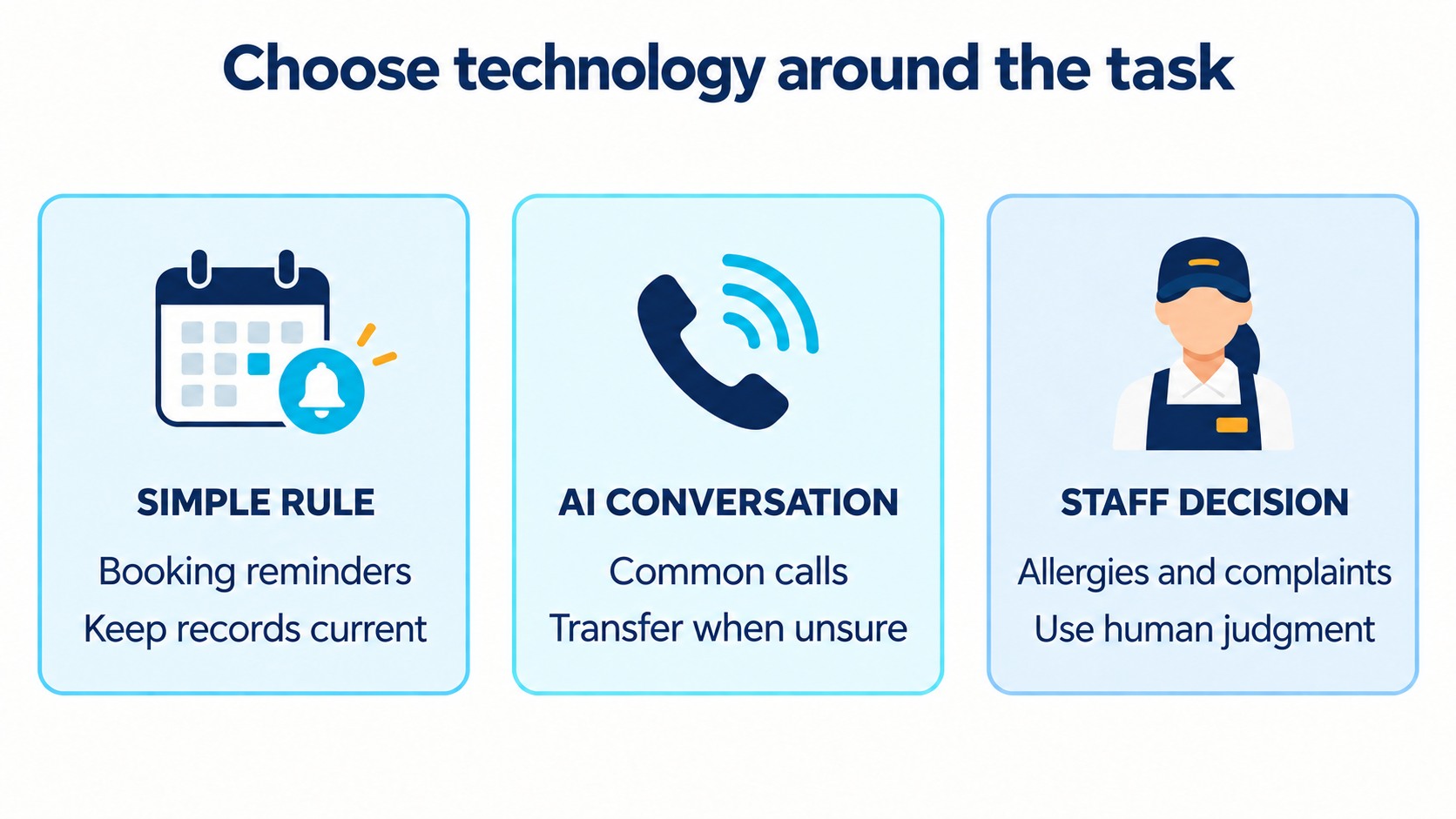
Consider an AI receptionist for restaurant calls if your call records show unanswered reservation inquiries during service. Before choosing a system, establish which information it can access, which requests it can complete and how it transfers other requests to staff.
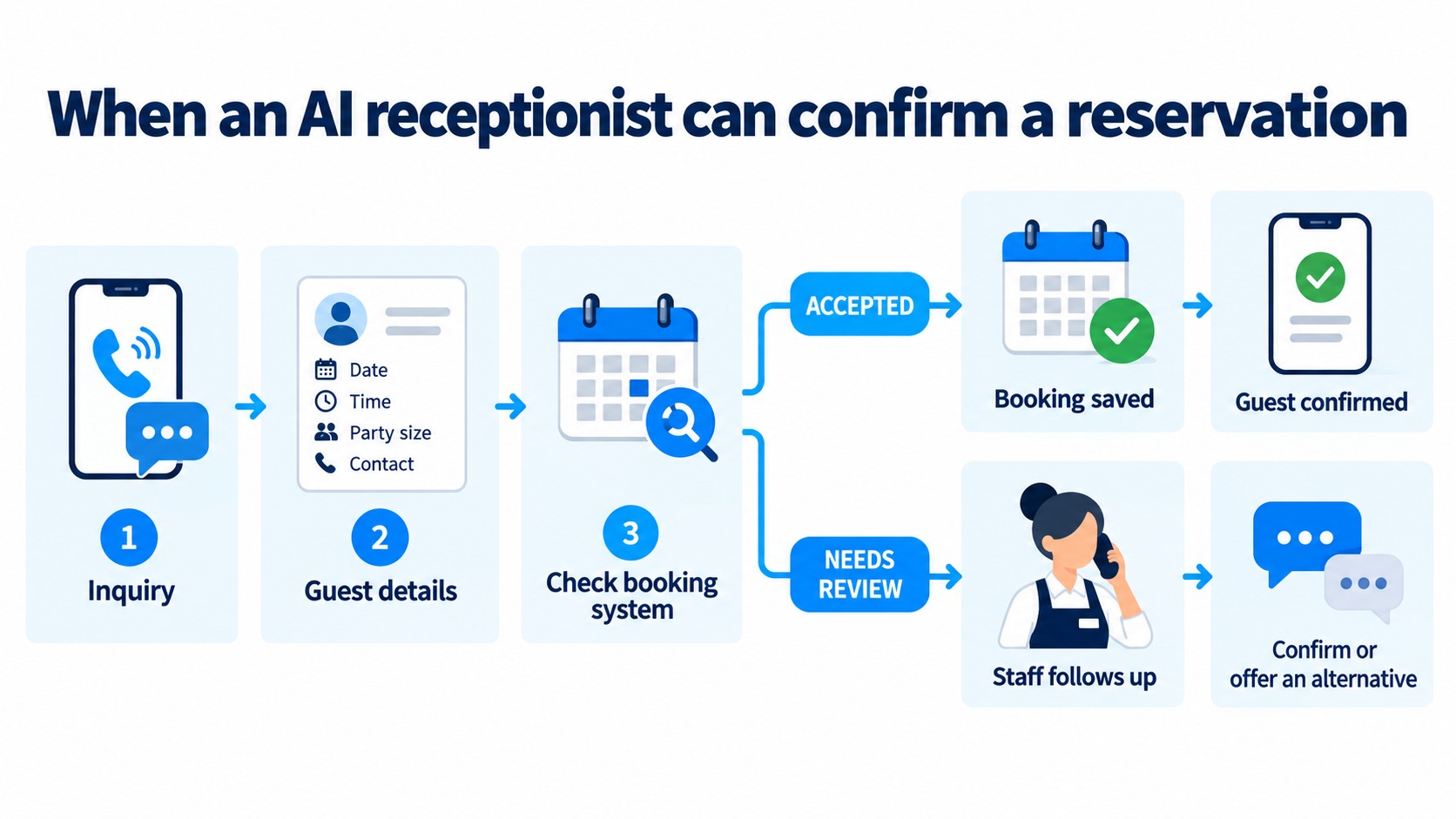
Begin with a narrow job. The assistant might explain approved opening hours, collect a caller’s name and contact details, identify the requested date and party size, and pass the request to the host. Direct booking needs a working connection to the restaurant’s availability and booking rules.
A confirmed reservation requires more than a conversation that sounds successful. The booking must be accepted by the system staff use, with the right location, date, time and party size. The guest should receive an accurate confirmation. When availability cannot be checked, the assistant should explain that staff confirmation is still required.
An AI website assistant needs the same distinction. It can explain information from an approved source and help a visitor reach the appropriate booking or inquiry process. Staff should handle uncertain allergy questions, unusual accommodations, complaints and requests outside the assistant’s authority.
| Proposed test | What the owner should verify |
|---|---|
| A normal reservation request arrives. | The saved booking and guest confirmation contain matching details. |
| The requested sitting is full. | The assistant offers only permitted alternatives or transfers the request. |
| A guest asks to change or cancel. | The correct booking is identified and the approved change reaches the booking system. |
| A large party needs special arrangements. | The inquiry reaches the responsible employee without an unsupported promise. |
| The booking connection fails. | The guest understands the booking status and staff receive a usable follow-up task. |
Run these tests before a limited trial, including overlapping requests for the last available space. During the trial, review incorrect bookings, completed transfers, unresolved inquiries and bookings that result in seated guests. Include setup, usage and supervision costs in the decision.
Keep customer details limited to what the task needs. Decide who can access conversation records and how long they are retained. Make it clear when a guest is interacting with an automated assistant and give them a practical route to a person.
Bless Web Designs offers AI phone reservation assistance and website chat for restaurants in Dallas. Each restaurant’s setup needs to account for its software, booking rules and staff responsibilities. Direct reservation confirmation requires a tested connection to the booking system.
6. Check what each offer contributes
Choose what to promote by looking at customer demand, preparation capacity and the money remaining after the costs of fulfilling an order. A popular item can create work without leaving enough to support the business, especially after discounts and delivery charges.
Basic menu analysis compares an item’s popularity with its contribution margin. The National Restaurant Association’s menu-management teaching material defines item contribution margin as selling price minus food cost. Other expenses still need to be paid from that remainder.
For a marketing decision, extend the calculation to the relevant order costs. The following hypothetical pickup offer includes packaging, a payment fee and incremental labor as well as ingredients. It is an illustration, not a Dallas benchmark.
| Hypothetical pickup order | Amount |
|---|---|
| Selling price after any offer discount, excluding tax and tips | $20.00 |
| Ingredients | $7.00 |
| Packaging | $1.00 |
| Payment fee | $0.60 |
| Additional labor required for this order | $3.40 |
| Contribution after these specified variable costs | $8.00 |
The $8 remaining must still help cover fixed overhead and other expenses. If an extra order requires a delivery charge, an additional employee or overtime beyond the labor allowance, include that cost before using the figure. Do not subtract the same expense again under another label.
Use this calculation to evaluate a signature dish, a meal package or a suitable add-on. Staff should be able to explain the offer, and the kitchen should be able to fulfill it during the promoted period. Compare actual order contribution and service performance before expanding the offer.
Use order contribution to set a test budget
The same figures help you assess marketing spending. At $8 per additional order, a $600 campaign would need 75 additional orders to cover that campaign cost alone. At 100 additional orders, $200 would remain after the specified variable costs and the campaign, before fixed overhead and other expenses. Include advertising, management and creative work in the $600 if you use this example to compare costs.
That calculation assumes the campaign adds those orders. Some customers may use the offer for a purchase they would have made anyway, so counting redemptions alone can overstate the benefit. Set a spending limit the restaurant can afford if the test produces fewer additional orders than expected, and check whether the kitchen can handle the volume needed to cover the cost.
Review the menu before expanding the promotion
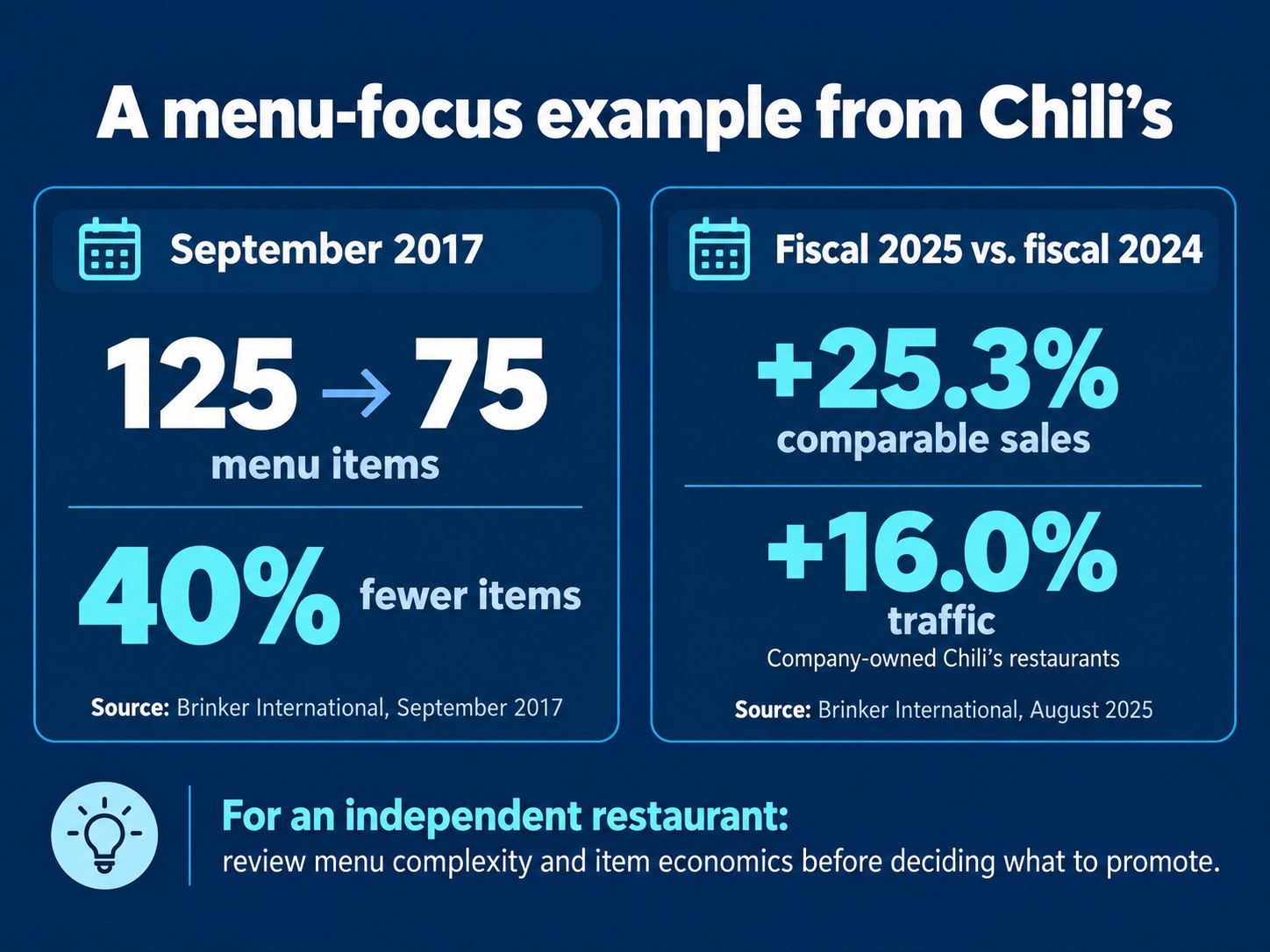
Chili’s provides a limited example of menu focus. In September 2017, the company announced a 40% reduction from 125 menu items to 75. Separately, Brinker reported 25.3% comparable sales growth and 16.0% traffic growth at company-owned Chili’s restaurants in fiscal 2025, compared with fiscal 2024. Those dates do not establish that the earlier menu reduction caused the later growth. For an independent owner, the useful exercise is to inspect menu complexity and item economics before deciding what to promote.
7. Improve the experience before the next promotion
Start with a complaint staff recognize from more than one visit. Late pickup orders warrant a closer look at preparation and handoff. Incorrect modifiers require tracing the instructions from the customer’s selection through the kitchen ticket to the finished order.
The National Restaurant Association’s 2025 off-premises research summary identifies service, ordering convenience, value and loyalty among priorities for repeat business. These are national findings. Your restaurant’s complaints, refunds and repeat orders provide the local evidence for deciding what to change.
Set a standard that staff can understand and check. A pickup order should match the ticket, include the necessary accompaniments and carry the correct customer identification. Give an employee responsibility for that check, and make sure the process fits a busy service.
Test food after the journey it actually makes. The Association’s packaging guidance recommends checking food and packaging after pickup or delivery. Use an ordinary route and record travel time, condition, texture and presentation. Compare packaging changes with the same dish and a similar journey.
For dine-in service, review a few recent complaints with the team. Agree on who can resolve a missing item, delay or billing issue and when a manager should step in. Record the cause and the action taken without turning the discussion into blame.
Try the revised process through several comparable shifts and ask the team where it helps or slows them down. Keep a count of the original problem so you can see whether it is becoming less frequent. Any extra packaging or staff time belongs in the cost of the change.
8. Ask for reviews and act on the feedback
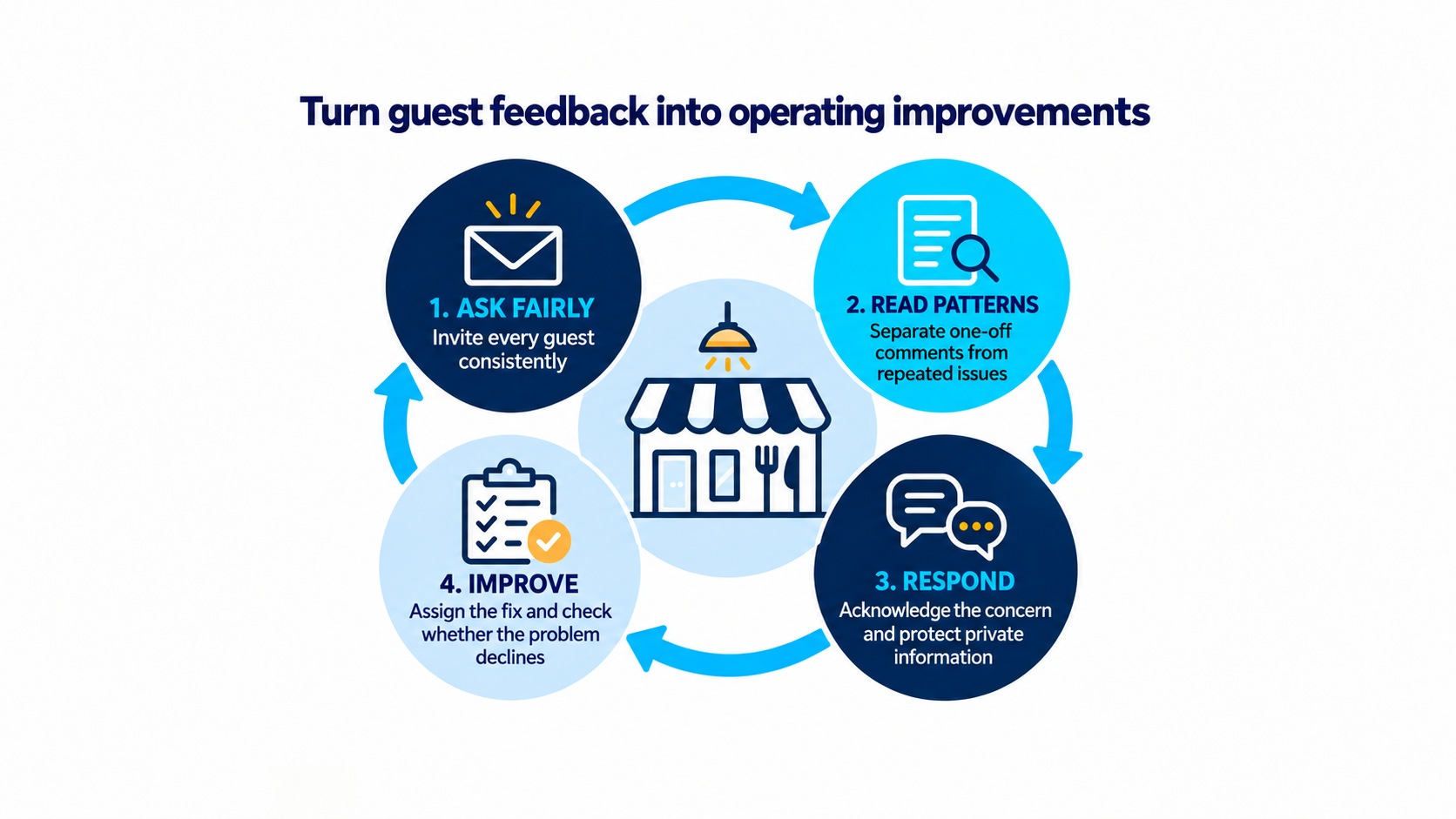
Invite guests to describe their real experience, using a consistent approach that does not depend on whether staff expect a positive response. Make a direct feedback route available as well, so customers can reach someone who can address a problem.
For Google reviews, do not offer a discount or free item in exchange for a review. Do not ask a satisfaction question and send only happy customers to the public review page. Google’s review policy prohibits incentives and selectively soliciting positive reviews.
Read reviews for repeated, specific information. Separate a complaint about food quality from one about parking, communication or waiting time. Record what the restaurant can change and assign an employee to follow through.
Respond with enough detail to show that the issue has been read. Acknowledge a concern, offer an appropriate way to discuss the visit, and protect personal information. Avoid arguing about facts that you have not checked or making compensation promises staff cannot fulfill.
Review and customer feedback automation from Bless Web Designs helps Dallas restaurant owners send consistent requests and flag complaints for staff. A manager should check responses about disputed incidents before they are published. Set up the process so a request for private feedback does not prevent a guest from sharing an honest public review.
Keep basic restaurant information consistent alongside the review work. Our local reviews and citations guide explains those related tasks. Judge progress by the quality of feedback, your response to recurring problems and genuine guest participation.
9. Give guests a reason to return
Plan follow-up around a real reason to contact the guest. A reservation reminder helps someone manage an existing booking. A lunch offer or catering announcement promotes another purchase. Keep those purposes clear when you choose the message and communication channel.
Offer customers a choice about receiving promotional messages and explain what they will receive. A guest who supplies a number to manage a booking should not unexpectedly enter a stream of unrelated offers. Keep the customer’s preferences available to staff and to every connected messaging system.
For commercial email, the FTC’s CAN-SPAM guidance covers accurate sender information and subject lines, required advertising identification, a valid postal address and a clear opt-out method. Opt-out requests must be honored within ten business days. The rules distinguish commercial messages from narrowly defined transactional messages. Check the applicable requirements separately before adding marketing texts or automated outbound calls.
Start with a small number of messages that serve a clear purpose. A welcome email can tell a new subscriber when you serve lunch, where to find the current menu and how to manage their preferences. A later message might introduce a seasonal dish or another reason to return. Choose the timing from what you know about your guests rather than sending every customer the same offer each week.
For example, a restaurant testing weekday lunch could invite subscribers to try a new pickup option. The message should give the available days, price, ordering deadline and collection instructions. Compare completed orders with the campaign cost and check whether pickup remained reliable. This is a proposed test, so the result must come from your own records.
Booking reminders require a different approach. Use the current reservation details and include the approved way to change or cancel. If a booking changes, update the reminder; if it is canceled, stop it. Record incorrect reminders as well as attendance so a full dining room does not hide a messaging problem.
Reservation reminders and guest follow-up can often use straightforward rules. Bless Web Designs sets up these workflows for Dallas restaurants, with message timing and stop conditions based on the restaurant’s policies. AI may be useful for understanding a reply or passing a question to the right person. Agree on when promotional follow-up should end, including after an opt-out or a purchase that makes the original reminder unnecessary.
Review unsubscribes, complaints, delivery failures and completed purchases. Where the list is large enough, compare similar groups receiving different treatment, keeping dates and offers consistent. Small differences in a small sample may be chance, so avoid declaring a result from a handful of responses.
10. Build local relationships and catering sales
Choose local relationships that fit your menu, capacity and location. A nearby office may need a reliable lunch order, while a community organizer may need a group meal at a different time. Find out what the organization needs before creating an offer.
Start with a manageable list of nearby prospects. Record the contact, likely occasion, suitable offer and next action. Prepare clear information about lead time, minimum order, delivery or collection arrangements and who will answer questions. Do not promise a delivery area your staff cannot reliably cover.
Local relationships can also produce useful mentions and links when they reflect real activity. Consider neighborhood organizations, chambers, event organizers, nearby venues, charities, suppliers, apartment communities, offices and Dallas food publications that are relevant to the restaurant. Give them a legitimate reason to mention the business, such as a useful event, partnership, expert contribution or newsworthy menu. Paying an unrelated website to place a keyword-rich link does not create the same customer value or local proof.
For event-related planning, check the Visit Dallas events calendar and the organizer’s current information. A restaurant near Fair Park or a Deep Ellum venue should consider actual travel routes, event timing and its own capacity. An event elsewhere in Dallas does not automatically create useful demand at your location.
A hypothetical catering inquiry shows why response handling matters. An office asks about lunch for a stated date and headcount. The restaurant still needs the delivery address, timing, menu requirements and budget before preparing an accurate proposal. Assign one employee to collect the missing details and tell the customer when a response is expected.
Keep the inquiry open until someone records its outcome. When a proposal goes out, save the agreed terms and the next follow-up date. When the customer accepts, pass the final requirements to the kitchen and delivery or collection team. When the customer declines, close the request so staff do not continue sending reminders.
Automated follow-up for catering inquiries can help maintain that process when messages arrive through several channels. Catering proposal follow-up should stop when a customer has accepted or declined. Check that a reply received by phone reaches the same record as the email proposal; otherwise, an automated message may contradict a conversation the customer just had with a manager.
A shared record may be enough for a small operation. If staff repeatedly copy information between tools, customer inquiry and CRM automation may be worth evaluating. CRM means customer relationship management; its practical purpose here is to keep the inquiry, responsible person and next action together.
For Dallas restaurants handling these requests, Bless Web Designs offers inquiry response, catering proposal follow-up and CRM automation. The setup can assign inquiries to staff, send approved reminders and update the record when a customer responds, using the systems agreed for the project.
After a completed event, ask whether the food, timing and service met the customer’s needs. If the organization has a recurring occasion and welcomes further contact, record an appropriate date to check in. A repeat catering order should still go through a fresh capacity and pricing check before anyone confirms it.
11. Choose a campaign you can measure
With a limited budget, begin by fixing a documented problem affecting people who already want to buy. Incorrect hours, a broken ordering link or unanswered reservation requests deserve attention before additional promotion. Once those tasks work, choose one nearby audience and one occasion your restaurant can serve with available capacity.
Use real restaurant content to support discovery
Organic social content can show what a guest will actually receive before the restaurant pays to promote a post. Photograph and film real dishes, staff preparing an order, the dining room at an appropriate time, a current event setup or the route to the pickup area. The food and surroundings should still look the same when the customer arrives.
Give each post one useful destination. A lunch video can lead to the current lunch menu, an event post can lead to its details, and a private-dining post can lead to the inquiry page. Check the landing page before publishing so the price, date, availability and next action agree with the post.
Use customer footage only with appropriate permission. When working with a local creator, agree on what will be provided, what the creator may say, whether the relationship must be disclosed and how the restaurant will measure the result. A trackable reservation link, ordering link or offer code is more useful than relying on views alone.
Choose a schedule the restaurant can maintain with real material. A steady record of accurate food, staff and event content is more credible than a large batch of generic posts. Our Dallas social media marketing guide explains how different platforms can support a local campaign.
Run a paid campaign with a defined audience, offer, destination and spending limit. The landing page should explain the same offer shown in the advertisement, including its availability and relevant conditions. Check that staff know what customers have been promised.
Use photographs of actual dishes and a clear reason for the visit. Choose the promoted period based on spare capacity. Track completed orders or bookings where possible, and include campaign management and creative work when assessing the result. Account for discounts in the net selling price of each order so they are not deducted twice.
Bless Web Designs provides Dallas ads and marketing services for restaurants that need help planning and managing a campaign. Bring your baseline, offer and order economics so the campaign has a clear objective and spending limit.
Write down when you will review the test and what would make you pause it. A broken order page needs attention immediately. A campaign that brings orders with too little contribution may need a different offer or spending limit. Review the actual purchases and costs before expanding the audience or increasing the budget.
Choose technology around a specific task
Apply the same discipline to automation. A software demonstration should show the task, the information required, the handoff and the record of what happened. For booking reminders, ask to see a changed reservation produce a corrected message. For unanswered calls, compare staff coverage and call routing with a limited AI receptionist trial. For catering, follow an inquiry from its arrival through the proposal and final staff handoff.
Ask who updates opening hours and menu information, fixes broken connections and reviews failures. Establish setup charges, ongoing costs, account access and cancellation arrangements. Changes in sales should be considered alongside holidays, weather, promotions and operating changes during the same period.
Bless Web Designs offers AI implementation and ongoing AI and automation support for Dallas restaurants. This work can cover call handling, website assistants and customer follow-up, with an agreed scope for keeping business information current, reviewing failures and maintaining the connections the restaurant uses.
12. Follow a 90-day plan
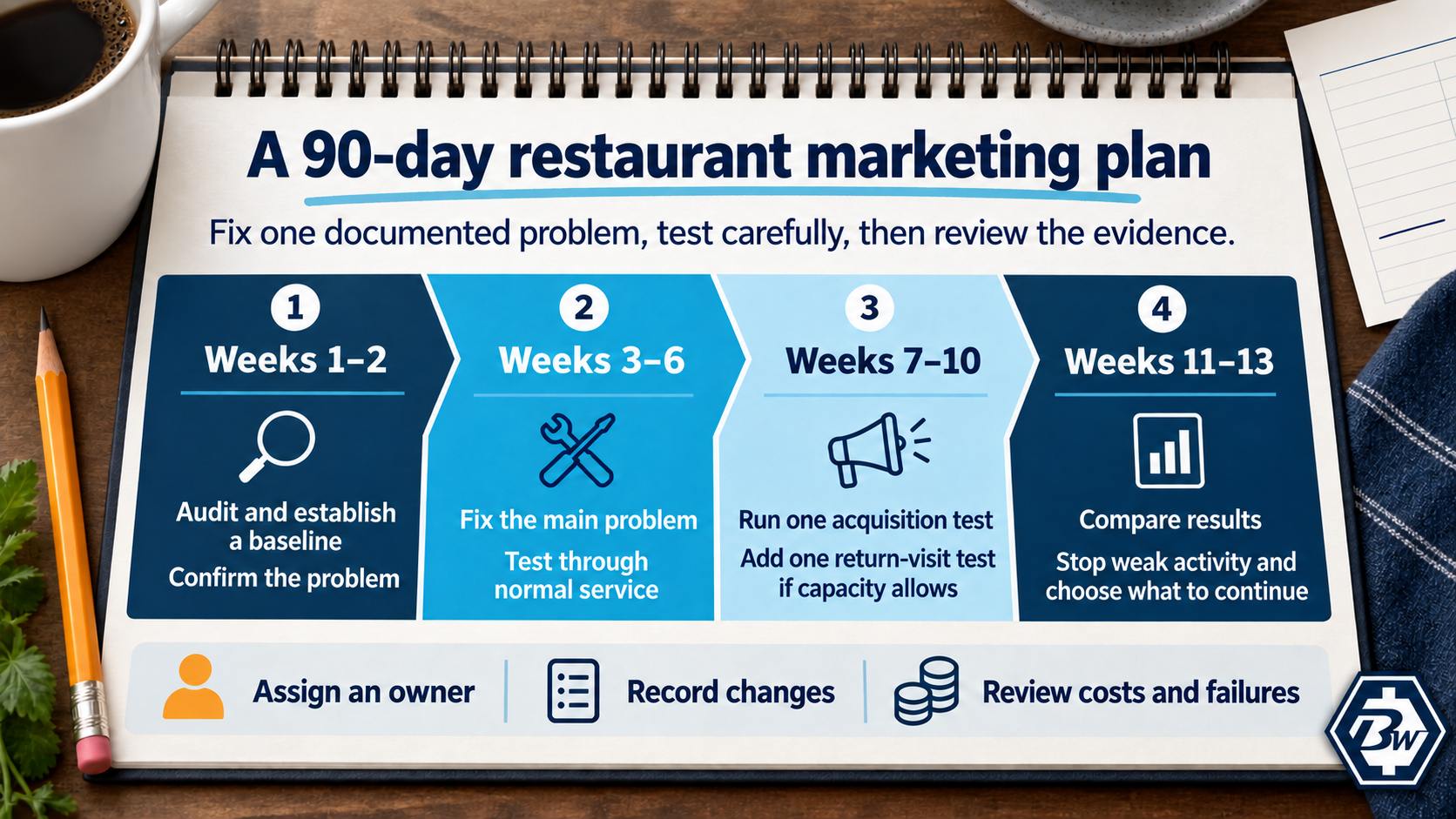
Give each action a responsible person, a completion date and a result to review. A short, regularly maintained plan is easier to use during restaurant service than a long list without ownership.
| Period | Main work | Evidence to review |
|---|---|---|
| Weeks 1–2 | Audit information, calls, website tasks and recent customer feedback; establish the baseline. | A list of confirmed problems and consistent starting measurements. |
| Weeks 3–6 | Correct the main problem and test the revised process through ordinary service. | Completed orders or bookings, errors, complaints and staff observations. |
| Weeks 7–10 | Test one acquisition activity and one repeat-visit activity if capacity allows. | Spending, identifiable results, order contribution and service performance. |
| Weeks 11–13 | Compare results, stop weak activity and decide what to continue. | Additional contribution where estimable, repeat behavior and unresolved costs or failures. |
Keep a change log during the period. Record a price increase, staff shortage, altered opening time or unusual event alongside the marketing work. These details help explain why two weeks may not be directly comparable.
If sales increase while the amount left after costs falls, examine discounts, product mix, fees and extra labor. If inquiries increase but completed bookings do not, review availability, response handling and whether the campaign attracted the intended customer. If first visits increase without repeat business, return to the service and follow-up records.
Use the final review to choose which activities deserve another month of spending or staff time. Where the result is unclear, identify what information is missing before repeating the test. Assign responsibility for maintaining the measurements you will use in that decision.
Need help choosing what to fix first?
If you would like help acting on your findings, discuss your restaurant’s marketing needs with Bless Web Designs. We offer website design, local SEO, advertising and AI automation for restaurants in Dallas. Bring the main problem identified in your audit and the records you have gathered so we can discuss the relevant service and its scope.
Common questions from Dallas restaurant owners
What should a Dallas restaurant fix first?
Fix the first documented break in the guest journey. If the restaurant cannot be found with accurate information, begin with local listings and the website. If people find it but cannot finish a booking or order, repair that route. If visits are occurring but complaints or weak repeat business persist, address the operating problem before buying more traffic.
Does a restaurant need a website if guests use Google and delivery apps?
A website gives the restaurant a controlled source for its menu, hours, location, story, reservation route, catering information and policies. Google and delivery platforms remain important discovery and transaction channels, but their information and fees can change. The restaurant should maintain its own current destination and keep the external profiles connected to it where appropriate.
How should a restaurant measure whether marketing is working?
Establish a baseline before the change, keep the definitions and comparison period consistent, and follow activity to completed orders, confirmed bookings, seated guests or qualified catering inquiries. Include discounts, advertising, management and creative costs. Where possible, compare the additional contribution created by the work rather than reporting clicks or redemptions alone.
When is an AI phone or website assistant appropriate?
Use one when records show a repeated, well-defined inquiry that staff cannot handle reliably and the assistant can use approved information or a tested system connection. Begin with a narrow task, confirm what is saved, provide a staff handoff and review failures. Allergy concerns, complaints, unusual accommodations and decisions outside the approved rules should reach a person.
Research and source notes
This guide was prepared for Bless Web Designs from restaurant-industry research, public platform information, company reports, Dallas visitor resources and a review of current local-search practitioner discussions. Platform documentation was used for product and policy statements; practitioner discussions were treated as anecdotal input rather than proof of ranking factors. Sources were checked on September 25, 2026. The calculations and proposed tests are planning examples and do not represent measured results from a Bless restaurant client. No Bless restaurant outcome is presented as a case study in this guide. Bless is the provider of the services promoted here.
The practitioner review included a restaurant SEO discussion and a broader discussion of local SEO priorities in 2026. These conversations helped identify practical questions to investigate. Their claims were not treated as evidence of Google’s ranking weights, and disputed tactics such as keyword-driven profile names, unnecessary profiles and photo-metadata manipulation were not adopted.
The National Restaurant Association sources describe national research and operating methods. Its public 2025 off-premises summary and packaging guidance support the service and pickup discussion. The full paid research report was not reviewed. The linked menu-management chapter explains basic item contribution analysis; this guide’s hypothetical order example includes additional specified variable costs.
The Chili’s figures come from the linked September 2017 announcement and August 2025 financial release. Visit Dallas provides neighborhood and event context, while current event details should be confirmed with the organizer. Platform and legal sources support the particular menu, review and email statements beside which they appear.