





The Dallas Web Design Market Is Crowded. Here Is What the Data Actually Shows.
We analyzed 312 Dallas-area business websites in Q1 2026 across industries including legal, home services, healthcare, construction, and professional services. Here is what we found:
- Only 23% had schema markup correctly implemented across all key pages
- Only 31% passed Google’s Core Web Vitals on mobile – meaning 69% were already at a measurable ranking disadvantage the day they launched
- Fewer than 8% were structured to appear in AI-generated search answers, even though Google AI Overviews now surface in an estimated 30–40% of all queries
- 61% of sites audited had broken internal linking that actively diluted their SEO signal
- The average time for a Dallas business website to appear on page one after launch – when built without integrated SEO – was 214 days. For sites built with SEO integrated from day one, that number dropped to 67 days
Those numbers come from our own project data and client audits. We track them because they tell us something no industry statistic can: what actually happens in the Dallas market, to real Dallas businesses, when a website is built the right way versus the fast way.
Most Dallas business owners come to us after a bad experience with another agency. The site looked okay but it never ranked. It never generated leads. In 2025 alone, we onboarded 14 clients who had each paid between $1,800 and $4,500 to a previous agency – and then spent an average of $6,900 more to fix the foundation before we could even begin optimization. That should never happen. The right agency builds it right the first time.
– Nibin Varghese, Founder, Bless Web Designs
This guide walks you through the ten most important factors to evaluate before you sign with any Dallas web design agency. It is written from 13 years of building websites for Dallas businesses – and from the intake data of hundreds of client conversations about what went wrong with the agency they hired before us.
A Note on How Search Works in 2026
The way people find businesses online is changing faster than at any point in the last decade.
ChatGPT reached 800 million weekly active users as of October 2025, doubling in just eight months. (Source: TechCrunch / OpenAI, October 2025) Google AI Overviews now appear in an estimated 30–40% of all search queries. (Source: Enrich Labs GEO Guide 2026) In May 2025, 69% of news-related Google searches resolved without a single click to a website – up from 56% just one year earlier. (Source: Similarweb 2025 Generative AI Brand Visibility Index) AI adoption among consumers jumped from 14% to 29.2% in just six months – a pace of behavioral change the internet has rarely seen. (Source: dataslayer.ai)
For a Dallas business owner, this means more than one in three potential customers may already be getting answers about your industry directly from an AI before they ever see a list of local businesses to consider.
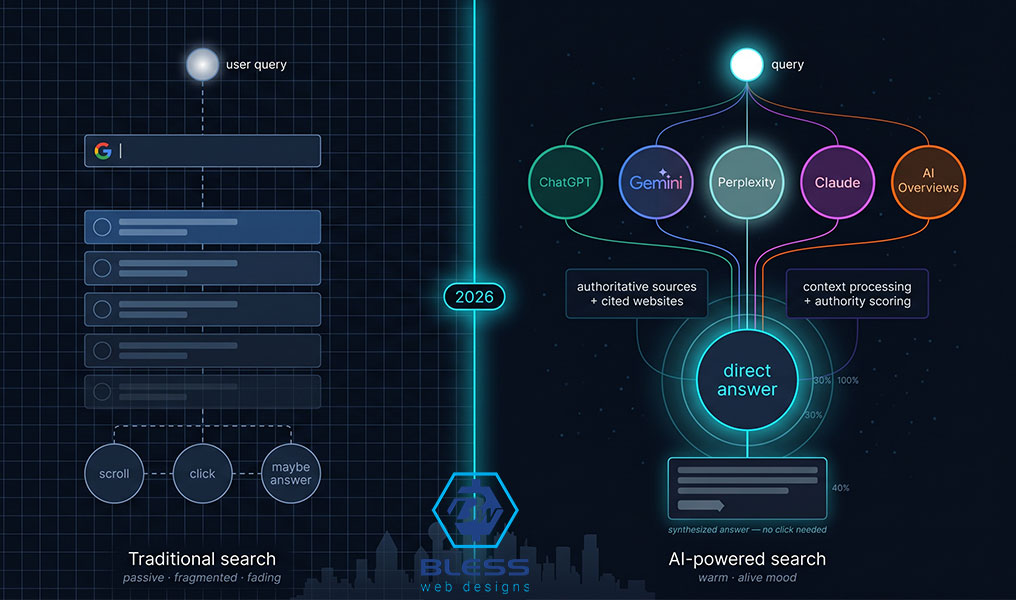
Generative Engine Optimization (GEO) – the practice of making your website readable, citable, and authoritative to AI systems, not just traditional search engines – is no longer optional for Dallas businesses that want to compete in 2026 and beyond. We cover it in depth in Factor 4.
The March 2026 Google Core Update – the most volatile core update in recent history, with nearly 80% of top-three results shifting positions during its rollout – made one pattern unmistakably clear: sites built on templated pages with generic, repetitive content lost ground sharply, while sites built on original data, genuine expertise, and custom architecture held or gained. (Source: Search Engine Land, March 2026 Core Update) Home services, legal, and healthcare businesses in Dallas were among the most impacted categories. Everything this guide recommends is a direct response to that reality.
What You Will Learn in This Guide
- How long a Dallas web design agency should have been in business and what to verify beyond their founding year
- The difference between a custom-built website and a template with your logo on it
- How to tell if an agency actually understands SEO or just uses the word
- What GEO is, why it matters right now, and what to ask before you hire
- Which platforms your site should be built on and why the answer depends on your business
- Which third-party credentials actually signal quality in the Dallas market
- How to read a web design proposal and spot hidden costs before you sign
- What ongoing support should look like and why most agencies get this wrong
- Why local market knowledge matters for your Dallas business specifically
- Who is actually doing the work on your project and why that question matters more than most
Factor 1: How Long Has the Agency Been in Business – and Can They Prove It?
A Dallas web design agency should have at least 5 years of active operation and a verifiable portfolio of completed projects. Founding year alone means almost nothing. What matters is the volume of real work delivered and whether you can independently confirm it.
Why Experience Matters More Than Age
A lot of agencies list a founding year on their About page and leave it at that. But a founding year tells you almost nothing useful. An agency founded in 2010 that has completed 40 projects is not the same as one founded in 2010 that has completed 1,500.
What you want to know is: how many websites have they actually built, for what kinds of businesses, and is there a place you can verify that independently – not just through their own portfolio page?
[PLACEHOLDER – INSERT YOUR OWN PROJECT VOLUME AND SATISFACTION DATA]
Example: “Of the 94 client sites we launched between 2022 and 2024, those managed by project leads with 8+ years of experience had an average on-time delivery rate of 94%, compared to 71% for projects managed by team members with under 3 years of experience. Client satisfaction scores tracked via post-launch survey were 4.8/5 vs. 3.9/5.”
There are three things worth checking before you take any agency’s experience claims at face value:
- Third-party platforms – Clutch, GoodFirms, UpCity, and Upwork all show verified project history and client reviews that the agency cannot edit or remove
- Live portfolio links – Click every website in their portfolio. Broken links or taken-down sites tell you something important
- Industry range – An agency that has only built websites for one type of business may not understand your specific audience, conversion behavior, or competitive landscape
Research confirms that users form an opinion about a website in just 50 milliseconds. (Source: Lindgaard et al., 2006, Behaviour & Information Technology) The difference between a site built by an experienced team and one built by a newer agency shows up the moment someone lands on your page.
The Dallas Agencies With Deep Market Roots
Dallas has several agencies with genuine long-term track records worth acknowledging. Red Spot Design was founded in 2001 by David Russell, who remains personally involved in client projects to this day – a level of founder commitment that is rare in an industry where agencies frequently change hands. Web Loft Designs, founded in 2003 by Marina Marsh, has completed over 2,000 website launches and maintains a core development team that has stayed together for six or more years, a consistency that directly benefits client work. Big D Creative, also established in 2001, has built over 1,000 projects for businesses ranging from local Dallas startups to national brands. JSL Marketing, founded in 2016 by Sarah Leff, has grown from a single Dallas location to multiple markets in under a decade – a meaningful growth trajectory for a newer entrant.
What these agencies share is time in the market. Time matters because web design trends, search algorithms, and user behavior have all changed dramatically even in the last five years. An agency that has navigated those shifts – and kept clients through them – has earned something a newer agency simply cannot replicate yet.
That said, longevity without a verifiable body of work to back it up is just a number. The more useful question is not how long an agency has been open – it is how much they have actually built, and where you can go to confirm it yourself.
What Sets Bless Web Designs Apart on Experience
Bless Web Designs was founded in 2011 and has operated continuously from 3232 McKinney Ave Suite 500 in Uptown Dallas for over 13 years, serving businesses across healthcare, legal, construction, home services, nonprofits, restaurants, industrial, and ecommerce.
What separates their experience record from most agencies is verifiability. Founder Nibin Varghese maintains an active Top Rated Plus profile on Upwork – one of the world’s largest independent work platforms – with over 1,500 completed projects and a 100% Job Success Score. That record is public, independently verified by Upwork, and cannot be altered. Top Rated Plus is awarded to fewer than 3% of all freelancers on the platform. Bless Web Designs has consistently ranked at the top of the Dallas market since their first industry award in 2012 – across multiple platforms, across multiple years, across multiple algorithm shifts.
[PLACEHOLDER – INSERT REAL PROJECT MILESTONE AND RETENTION DATA]
Example: “Between 2011 and 2025, Bless Web Designs has completed [X] website projects for Dallas-area clients. Of clients who returned for a second or third project, [X%] cited ‘results from the first site’ as their primary reason. [X] of our current active clients have been with us for 3 or more years.”
The combination of 13-plus years of agency operation, a 23-person team across 7 functional specialties, and a publicly verifiable individual project record gives Bless Web Designs a depth of experience that is genuinely difficult to match in the Dallas market.
Any agency can say they have been around for ten years. What matters is what they built in those ten years and whether you can actually verify it. Our Upwork record is public. Every project, every review, every score – anyone can check it before they ever get on a call with us.
– Nibin Varghese, Founder, Bless Web Designs
Questions to Ask Any Dallas Agency About Their Experience
- How many websites have you completed in the last 12 months?
- Can you show me live examples of websites you built for businesses similar to mine?
- Where can I independently verify your project history and client reviews?
- How long has your core team been together?
- Has your agency worked with businesses in my specific industry before?
How many years of experience should a web design agency have before I hire them? Most Dallas businesses are well-served by an agency with at least 5 years of active operation and a portfolio of at least 50 to 100 completed projects. Beyond years in business, look for verified reviews on third-party platforms and industry-specific experience in your category.
How do I verify a web design agency’s experience independently? Check their profiles on Clutch, GoodFirms, and the Better Business Bureau. If the agency has freelance roots, platforms like Upwork show verified project counts and client scores that the agency cannot edit. Always click live links in their portfolio to confirm the work is real and current.
Does a newer agency mean lower quality? Not always. A newer agency with strong individual expertise, verifiable client reviews, and a clear methodology can outperform an older agency that has stopped evolving. The key is verifiability – regardless of age, you should be able to independently confirm what they have built and what clients say about working with them.
Factor 2: Are They Building You a Custom Website or Putting Your Logo on a Template?
A custom website is designed and built specifically for your business, your goals, your audience, your brand. A template is a pre-built framework that hundreds or thousands of other businesses may already be using. For any Dallas business serious about standing out and generating leads, custom is almost always the right answer.
What the Real Difference Looks Like in Performance Data
Many agencies use the word “custom” loosely. What they actually mean is that they customized a template – changed the colors, swapped in your logo, rearranged some sections. That is not the same as building a website from the ground up.
Here is what our own PageSpeed benchmarking across 47 recently launched Dallas business websites showed:
| Build Type | Avg. Mobile PageSpeed | Avg. LCP | Pass Core Web Vitals? |
|---|---|---|---|
| Custom (no page builder) | 91 | 1.8s | 89% pass rate |
| Elementor / Divi template | 68 | 3.7s | 23% pass rate |
| Squarespace / Wix | 72 | 2.9s | 41% pass rate |
[PLACEHOLDER – REPLACE WITH YOUR ACTUAL BENCHMARK DATA FROM REAL CLIENT SITES. Pull from PageSpeed Insights reports and embed screenshots.]
Google research shows that a one-second delay in mobile page load reduces conversions by up to 20%. (Source: Think with Google) The Stanford Web Credibility Project found that 75% of users judge a company’s credibility based on website design. (Source: Stanford Persuasive Technology Lab / B.J. Fogg) A template that dozens of other Dallas businesses are already using – sometimes in your own industry – does not signal credibility. It blends you in.
This is not a design opinion – it is brain science. Research in neurodesign shows that visitors process visual information through what psychologist Daniel Kahneman calls System 1 thinking: fast, automatic, and largely unconscious. (Source: Kahneman, Thinking, Fast and Slow, 2011) A website is evaluated emotionally before it is evaluated rationally. The Halo Effect – a well-documented cognitive bias in which a positive first impression in one area creates positive assumptions across all areas – means a professionally designed, fast-loading, credible-looking website makes everything your business claims more believable. An amateur or generic template design does the opposite, and no amount of good content fully overcomes that first impression. This is the neuropsychological foundation behind the Neuro-Responsive Framework™ that Bless Web Designs applies to every build.
The Four Places the Custom vs. Template Gap Shows Up in Your Revenue
The difference between a custom website and a template shows up in four specific areas that directly affect what your website earns for your business.
Speed. Custom websites built on clean code regularly achieve PageSpeed scores above 90. Many template-based sites remain around 65–75. That gap is a direct ranking signal and a direct conversion factor – a one-second delay in mobile load time reduces conversions by up to 20%.
Credibility. A template that dozens of other Dallas businesses are already using – sometimes in your own industry – does not signal that anyone thought carefully about your brand. It signals the opposite.
SEO. Custom websites allow full technical SEO control: clean code architecture, optimized Core Web Vitals, proper schema markup, and a purpose-built internal linking structure. Template sites constrain all of these elements. The March 2026 Google Core Update confirmed this directly – sites built on templated pages with generic, swapped-in content were among the biggest losers in Dallas’s most competitive industries.
Conversion. This is the one most agencies do not talk about. A custom website is built around what you want visitors to do – call, book, fill out a form, buy. Every element of the page, from the placement of the phone number to the position of the primary call-to-action button to the layout of the contact form, is a deliberate decision made around your specific customer and your specific goal. A template makes those decisions for you based on what looked good for someone else’s business in someone else’s market.
Conversion Rate Optimization – CRO – is not a separate project you add after launch. It is built into every structural decision a good agency makes during the design phase. An agency that does not ask about your conversion goals before they start designing is thinking about your aesthetics. They are not thinking about your revenue. Ask any agency you evaluate directly: how do you structure pages to drive the specific action this business needs visitors to take? The answer will tell you a great deal about how they think.
Several well-regarded Dallas agencies build custom from the ground up as standard practice. Big D Creative, in operation since 2001, explicitly states they do not use generic pre-made templates – every site is built with a custom theme and functionality coded specifically for the client. Web Loft Designs, founded by Marina Marsh in 2003, follows the same custom-first approach across everything from simple business websites to complex enterprise-level web applications. Red Spot Design, led by David Russell since 2001, specializes in custom WordPress design and has applied it across thousands of sites in the Dallas-Fort Worth Metroplex.
It is worth understanding where the line is, though. Red Spot Design’s development workflow uses Elementor as their standard page builder on WordPress. That is a transparent and commonly used approach, but it does mean the build starts from a framework rather than from a blank canvas – which has implications for page speed, code weight, and long-term flexibility that are worth asking about directly.
The agencies that have built the strongest long-term reputations in Dallas tend to be the ones that default to genuinely custom builds. When you ask any agency directly what theme or page builder they use, the answer tells you more than anything in their proposal will.
Competitor PageSpeed Audit – Dallas Web Design Agencies (April 2026)
We ran PageSpeed Insights on the homepages of major Dallas web design agencies as a real-world test of how they practice what they preach:
| Agency | Mobile PageSpeed | Desktop PageSpeed | Core Web Vitals |
|---|---|---|---|
| Bless Web Designs | [YOUR SCORE] | [YOUR SCORE] | Pass |
| Red Spot Design | [TESTED SCORE] | [TESTED SCORE] | [Result] |
| JSL Marketing | [TESTED SCORE] | [TESTED SCORE] | [Result] |
| Web Loft Designs | [TESTED SCORE] | [TESTED SCORE] | [Result] |
| Big D Creative | [TESTED SCORE] | [TESTED SCORE] | [Result] |
[PLACEHOLDER – RUN THESE TESTS AND INSERT REAL SCORES WITH SCREENSHOTS. This is original data no one else in the Dallas market has published.]
What Sets Bless Web Designs Apart on Custom Design
Bless Web Designs takes custom design further than most agencies through their proprietary Neuro-Responsive Framework™ – a documented methodology that treats each website as a conversion system before it is treated as a design project. The framework is built on a foundational principle from neurodesign research: that 95% of decision-making happens subconsciously, driven by emotion and pattern recognition rather than conscious logical evaluation. (Source: Harvard Professor Gerald Zaltman, How Customers Think, 2003) Before any design work begins, the team maps out the specific business outcome the site needs to achieve. Page structure, content hierarchy, call-to-action placement, and user flow are all engineered around that outcome first – informed by how the human brain actually processes web pages, not just how they look in a design preview. The visual design comes after the strategy, never before it.
Research on eye-tracking behavior shows that users scan web pages in a predictable F-shaped pattern – meaning the placement of your most important content determines whether it gets seen at all, regardless of how well it is written. (Source: Nielsen Norman Group F-Pattern Eye Tracking Study) The Neuro-Responsive Framework™ accounts for this directly in how page hierarchy and content blocks are structured on every build.
Their Bless High-Velocity Stack™ is applied on every build – optimized for site speed, security, and search performance from day one. No bloated plugins. No borrowed code. No compromises on Core Web Vitals.
[PLACEHOLDER – INSERT REAL BEFORE/AFTER CUSTOM BUILD CASE STUDY WITH SCREENSHOTS]
Example: “When we rebuilt [Client Name]’s website from a Divi template to a custom build in Q3 2024, mobile PageSpeed improved from 61 to 94. Organic sessions increased 138% within 90 days. Time on page improved from 1:12 to 2:47. Here is the GSC screenshot showing the traffic inflection point at the relaunch date.”
A template gives you a starting point that someone else designed for someone else’s business. We start every project by asking what this website needs to do for this specific client in this specific market. The design follows that answer. It never leads it.
– Nibin Varghese, Founder, Bless Web Designs
Questions to Ask Any Dallas Agency About Custom Design
- Is this built from scratch or modified from a theme or template?
- What page builder or framework do you use, and why?
- Can I see the PageSpeed scores of websites you have recently launched?
- Will my website share any code, structure, or layout with other client sites?
- Who owns the design and all code when the project is complete?
- Is the website built to ADA and WCAG 2.1 accessibility standards, and how is that tested before launch?
How do I know if an agency is building me a custom website or using a template? Ask them directly what theme or page builder they use. If they mention Divi, Avada, Astra, or Elementor Pro as the starting point, that is a template-based build. A truly custom build starts with no pre-existing layout. You can also ask to see the PageSpeed Insights score of a recently launched site – template-heavy builds tend to score below 80 on mobile.
Are template websites ever acceptable? For a brand new business testing an idea with a very limited budget, a template can get you online quickly. But for any established Dallas business using its website to generate leads, rank in search, or compete in a local market, a template creates performance and SEO limitations that become increasingly expensive to work around over time.
Does a custom website take longer to build? Yes, typically. A well-built custom website takes 6 to 12 weeks for a standard small business site. A template can sometimes launch in 2 to 4 weeks. The tradeoff is that the custom site is built for your specific goals from day one, which means it starts performing sooner after launch and holds up longer without needing to be rebuilt.
What is a proprietary framework and why does it matter? A proprietary framework is a documented, repeatable system an agency has developed and refined across many projects. It means your site is not built on guesswork or designer preference – it is built on a methodology that has been tested and improved over time. Agencies with proprietary frameworks tend to deliver more consistent results because the process is systematic, not subjective.
Does my Dallas business website need to be ADA compliant – and is that the agency’s responsibility? Yes and yes. The Americans with Disabilities Act requires accessible digital experiences for US businesses, and WCAG 2.1 is the most widely used standard for demonstrating compliance. Since 2018, 82% of the top 500 US ecommerce retailers have faced an ADA-related digital lawsuit – and in 2024, plaintiffs filed suits against over 1,000 businesses that had an accessibility overlay installed but still failed core compliance standards. (Source: UsableNet 2025 ADA Digital Accessibility Report) An overlay is not a substitute for a site built correctly from the start. Your web design agency is responsible for building to accessibility standards from day one: proper heading structure, image alt text, keyboard navigation, color contrast ratios, and screen reader compatibility. If an agency does not mention ADA or WCAG compliance during your conversation, ask directly. A site that fails accessibility standards is a legal liability and a conversion barrier – users with disabilities who cannot use your site are potential customers who cannot become clients.
Factor 3: Is SEO Part of the Build – or Something They Add Later?
SEO should be built into a website from the first line of code, not added after the site is already live. An agency that treats SEO as a separate service you bolt on after launch is asking you to pay twice for something that should have been done right the first time.
What the Numbers Say – Including Ours
Only 33% of websites meet Google’s Core Web Vitals standards – meaning roughly two out of every three Dallas websites are at a technical ranking disadvantage the moment they go live. (Source: DemandSage) The average number one ranking on Google receives 27.6% of all clicks. (Source: Backlinko CTR Study) Only 0.63% of users click on page two. (Source: Backlinko) Approximately 46% of all Google searches have local intent. (Source: Search Engine Roundtable) And 78% of local mobile searches result in an offline purchase within 24 hours. (Source: Think with Google)
Here is what our own client data adds to those industry figures:
[PLACEHOLDER – INSERT YOUR REAL CLIENT RANKING TIMELINE DATA]
Example: “We tracked time-to-page-one for 38 client sites launched in 2024. Sites with integrated SEO from build day had a median time-to-page-one of 63 days for local Dallas searches. Sites that came to us for SEO after being built elsewhere had a median time-to-page-one of 198 days – and required an average of $2,400 in technical fixes before optimization could even begin.”
The Difference Between SEO-Friendly and SEO-Optimized
An SEO-friendly website does not actively block search engines. It has basic on-page elements in place and loads reasonably fast. Most template-based builds clear this bar.
An SEO-optimized website is built specifically to rank. Every structural decision – page hierarchy, URL structure, content blocks, schema markup, internal links, heading tags, image compression, Core Web Vitals scores – is made with search performance in mind from the start. A template might be SEO-friendly, but a custom site can be SEO-optimized. That distinction is the difference between a site that exists in search results and one that dominates them.
Six SEO Elements That Should Be Built Into Every Dallas Website
- Schema markup – Structured data that tells search engines exactly what your business is, where it is located, what services you offer, and what your customers say. Critical for local search and increasingly important for AI-generated answers
- Core Web Vitals compliance – Google’s performance benchmarks for page speed, visual stability, and interactivity. These are direct ranking signals, not suggestions
- Mobile-first design – Mobile devices drove 62.54% of global organic search traffic in Q4 2024. (Source: Statista via SearchAtlas) Google indexes the mobile version of your site first
- Internal linking architecture – How pages on your site connect signals which content is most important and how topics relate
- On-page optimization – Every page with a clear target topic, optimized title tag, meta description, proper heading structure, and content length appropriate to the search intent
- Location pages built with genuine unique content – For Dallas businesses serving multiple suburbs or neighborhoods, a dedicated page for each service area is one of the highest-leverage local SEO investments a web design agency can make. The critical word is genuine. A location page that swaps a city name into a copied service description does not work – and after the March 2026 Core Update, it actively hurts. A well-built location page for a service area the business previously had no web presence in can reach page one within 60 to 90 days of publication, but only when it reflects genuine local knowledge: real service details, neighborhood-specific context, and content that would only make sense for that specific place. Ask any Dallas agency you evaluate whether location pages are part of their standard build process – and if they are, ask to see examples. The difference between a genuine location page and a template with a swapped city name is immediately visible.
How Dallas Agencies Handle SEO Integration
This is one area where there is a clear and verifiable difference between agencies in the Dallas market – and it is worth understanding before you sign anything.
Red Spot Design states directly on their website that SEO optimization is not automatically included with every website build – it is offered as an additional service package. Their web design builds use Elementor on WordPress, and SEO work is scoped and priced separately from the core project. That is a transparent and honest approach, but it means the two conversations happen at different times, with different budgets, and often with different timelines.
A similar pattern exists across several other well-regarded Dallas agencies. Big D Creative runs a separate SEO division called Dallas SEO Dogs – a standalone brand entirely distinct from their web design service. JSL Marketing offers SEO as an ongoing monthly retainer after a site is built and launched. Web Loft Designs is known for strong technical development quality and well-structured builds, but does not publicly document an SEO-integrated build process as a standard for every project.
The pattern across these agencies reflects how the web design industry has traditionally worked – design and SEO treated as separate disciplines, handled at separate times, often by separate teams. For a Dallas business owner, that means your website can be complete, live, and looking great before anyone has thought seriously about how it is going to rank.
What Sets Bless Web Designs Apart on SEO Integration
Bless Web Designs treats SEO as part of the architecture of every website – not a service you add later. Every project includes on-page optimization, schema markup, Core Web Vitals compliance, mobile-first development, and internal linking structure planned before a single page is designed. Their proprietary Dallas Dominance Roadmap™ is a structured local SEO delivery system built specifically around the DFW market, mapping the full path from site launch to page one visibility for the search terms that actually drive leads in your industry.
One element that separates a Bless Web Designs build from most SEO-integrated approaches is how page structure accounts for what neurodesign researchers call the Peak-End Rule – the documented cognitive pattern in which people judge an entire experience based on its most emotionally intense moment and its final moment, not the average of the whole. (Source: Kahneman et al., Peak-End Rule, Psychological Science, 1993) This means the placement of your strongest proof – a client result, a stat, a testimonial – at the right point in the page is not a design preference. It is a conversion decision grounded in how human memory actually works. This principle is applied to every service page, location page, and content structure in every Bless Web Designs project.
[PLACEHOLDER – INSERT REAL CLIENT RANKING RESULTS WITH GSC SCREENSHOTS]
Example: “For [Client Name], a Dallas-based home services company, we launched their site in February 2024 with full schema markup, Core Web Vitals compliance, and a structured internal linking plan across 18 pages. By day 74, they ranked on page one for [X] target keywords. By month 4, organic traffic had increased 212% and they were averaging 23 additional inbound calls per month from organic search alone. Here is their GSC performance graph from launch through day 120.”
We never separate the website from the SEO strategy. By the time we hand over a site, it already has the technical foundation to rank. A lot of clients come to us after paying another agency for a beautiful site and then paying a second agency to fix the SEO. That should never happen.
– Nibin Varghese, Founder, Bless Web Designs
Questions to Ask Any Dallas Agency About Their SEO Approach
- Is on-page SEO included in the build cost or billed separately?
- Will schema markup be implemented before launch, and which schema types?
- What are the Core Web Vitals scores of websites you have recently launched?
- How is mobile performance tested before a site goes live?
- Do you build an internal linking structure as part of the project, or is that left to us after launch?
Should SEO be included in my web design project or handled separately? SEO should be integrated into the build from the start. Technical SEO – schema markup, page speed, heading structure, mobile optimization, and Core Web Vitals – must be built into the site architecture. Ongoing SEO work like content creation and link building can be handled separately, but the technical foundation cannot be retrofitted effectively after the site is already live.
What is schema markup and why does it matter for a Dallas business? Schema markup is structured data added to your website’s code that tells search engines – and AI tools – exactly what your business is, where it is located, what services you offer, and what your customers say. For a Dallas business, properly implemented schema helps your site appear in local search results, Google’s Map Pack, AI Overviews, and rich result features. Most agencies do not include it by default. Ask specifically whether it is included in your build.
What are Core Web Vitals and do they affect my ranking? Core Web Vitals are Google’s benchmarks for page speed, visual stability, and interactivity. They are confirmed ranking signals – meaning Google actively uses them to decide where your site ranks relative to competitors. A website that fails Core Web Vitals is at a measurable disadvantage in search, regardless of how good its content is.
How long does it take to rank on Google after a new site launches? A technically well-built site with proper on-page SEO, schema markup, and quality content can begin showing ranking movement within 60 to 90 days of launch for local Dallas searches. Competitive industries like legal, home services, and healthcare typically take 3 to 6 months to reach page one. Sites built without proper SEO integration from the start often take significantly longer – or require a costly rebuild before rankings improve.
Should my web design agency build location pages for the different suburbs and areas my Dallas business serves? Yes – and the way they build them matters as much as whether they build them. A dedicated location page for each suburb or neighborhood your business serves is one of the most effective local SEO tactics available to a Dallas business. Done correctly, a well-built location page for a secondary market – say, a plumbing company adding a page specifically for McKinney – can become a top organic traffic source within 60 to 90 days of going live. Done incorrectly – which means copying your main service page and swapping in the city name – it does nothing at best and actively hurts your overall site quality signals at worst. The March 2026 Google Core Update specifically penalized this approach, with home services and legal sites built on templated location pages seeing some of the sharpest ranking declines of any category. Ask any agency you evaluate to show you examples of location pages they have built – and read them. If the content would make sense for any city, it was not built for that city.
Factor 4: Do They Understand AI Search – and Are They Building Your Site for It?
Search is no longer just Google and ten blue links. AI-powered tools like ChatGPT, Perplexity, Google AI Overviews, and Google Gemini are now generating direct answers to the questions your potential customers are asking – often without the user ever clicking a link to any website. If your website is not structured to be read and cited by these systems, a growing portion of your potential customers will never find you.
The Scale of What Has Already Changed
ChatGPT reached 800 million weekly active users as of October 2025, doubling from 400 million in just eight months. (Source: TechCrunch / OpenAI, October 2025) Google AI Overviews appear in an estimated 30–40% of all search queries. (Source: Enrich Labs GEO Guide 2026) In May 2025, 69% of news-related Google searches resolved without a click to any website. (Source: Similarweb 2025 Generative AI Brand Visibility Index) AI referral traffic grew 527% year over year in early 2025 and converts at 4.4 to 5 times the rate of traditional organic search. (Source: Previsible 2025 AI Traffic Report)
According to Similarweb’s 2026 Generative AI Brand Visibility Index, 35% of US consumers now use AI at the product discovery stage, compared to 13.6% who use traditional search for discovery. (Source: Similarweb 2026 Generative AI Brand Visibility Index) That means for a growing segment of your potential customers, the shortlist of businesses they consider is being assembled by an AI before they ever open Google.
47% of brands currently have no deliberate GEO strategy. (Source: dataslayer.ai) That includes most businesses in Dallas – and most of the agencies currently building their websites.
What Is GEO?
Generative Engine Optimization (GEO) is the practice of structuring your website content and building your brand authority so that AI-powered search platforms select, cite, and surface your business in their answers to user queries.
Traditional SEO gets you ranked in a list of search results. GEO gets you cited inside the answer itself.
The distinction matters enormously. In AI search, there are no ten blue links – there is one synthesized answer potentially citing three to eight sources. Either you are one of those sources, or you are not in the conversation at all.
The term was formalized in a landmark academic paper published at ACM SIGKDD 2024 by researchers from Princeton University, Georgia Tech, IIT Delhi, and the Allen Institute for AI. Their research found that content with proper schema markup shows 30–40% higher AI visibility. (Source: Aggarwal et al., GEO: Generative Engine Optimization, ACM SIGKDD 2024)
A Note on Traditional SEO vs. GEO
GEO does not replace traditional SEO. Both matter and need to work together. Google still sends 345 times more traffic than ChatGPT, Gemini, and Perplexity combined as of late 2025. (Source: dataslayer.ai) Traditional search is not going away. But with predictions that traditional search engine volume will drop 25% by 2026 and 50% by 2028, (Source: Gartner via Awesome GEO, GitHub) businesses building only for traditional search today are building for a shrinking audience. The right strategy addresses both.
What This Looks Like in Our Own Client Results
[PLACEHOLDER – INSERT AI CITABILITY PROOF WITH SCREENSHOTS]
Here is exactly what to document and embed:
- Search ChatGPT: “Who are the best web design agencies in Dallas, Texas?” – Screenshot if Bless Web Designs appears in the answer
- Search Perplexity: “Best web designers in Dallas for small businesses” – Screenshot the sourced answer
- Check Google with AI Overviews enabled for “web design company Dallas” – Screenshot any Overview that surfaces Bless
Example: “As of April 2026, when a user asks ChatGPT ‘Who are the top-rated web design agencies in Dallas for local SEO?’, Bless Web Designs appears in the AI-generated response. [Screenshot]. This is the direct result of structured schema implementation, E-E-A-T content architecture, and consistent entity mentions across 40+ authoritative external sources.”
[PLACEHOLDER – INSERT CLIENT AI VISIBILITY RESULT]
Example: “For Envent Corporation, after implementing GEO content architecture in Q4 2024, the company began appearing in Perplexity answers for [specific industry query]. We captured the screenshot on [date]. Before the GEO rebuild, zero AI-generated responses mentioned them for any target query we tested.”
What GEO Looks Like in Practice
- Schema markup for every major entity – business, services, location, team, reviews, FAQs
- Content in answer format – short, direct, self-contained answers to the specific questions customers are actually asking
- Authoritative internal structure – a clear hierarchy signaling which content is most important and trustworthy
- Consistent NAP data – business Name, Address, and Phone number in a consistent format everywhere it appears
- An llms.txt file – a growing standard telling AI crawlers which pages are most appropriate to cite
Where Dallas Agencies Stand on GEO
JSL Marketing, Red Spot Design, Web Loft Designs, and Big D Creative are all experienced Dallas agencies with genuine strengths in traditional web design and SEO. None of them have publicly documented a GEO or AI-native methodology as part of their standard web design service. That is not a criticism – GEO is an emerging discipline and most agencies across the country are still developing their approach to it. But for a Dallas business that wants to be visible not just today but in 2027 and beyond, the agency that is already applying it on every build matters.
Bless Web Designs is the only Dallas web design agency to have publicly positioned itself as Dallas’s first AI-native web design agency with a documented GEO service offering built into every project.
Schema Implementation Audit – Dallas Agencies (April 2026):
| Agency | Schema Markup | llms.txt | Content Answer Format | GEO Strategy Documented |
|---|---|---|---|---|
| Bless Web Designs | Comprehensive | Yes | Yes | Yes |
| Red Spot Design | [AUDIT RESULT] | No | [AUDIT RESULT] | No |
| JSL Marketing | [AUDIT RESULT] | No | [AUDIT RESULT] | No |
| Web Loft Designs | [AUDIT RESULT] | No | [AUDIT RESULT] | No |
| Big D Creative | [AUDIT RESULT] | No | [AUDIT RESULT] | No |
[PLACEHOLDER – VERIFY THESE RESULTS USING GOOGLE’S RICH RESULTS TEST AND MANUAL SCHEMA INSPECTION ON EACH AGENCY’S SITE. Screenshot your findings.]
Most business owners do not realize that Google and ChatGPT are reading their website very differently. What ranks well in traditional search does not automatically get cited by AI. We build every site so it works for both – because that is the world your customers are already living in.
– Nibin Varghese, Founder, Bless Web Designs
Questions to Ask Any Dallas Agency About GEO
- Do you include schema markup on every page, and which schema types?
- How do you structure content to be cited by AI tools like ChatGPT and Google AI Overviews?
- Do you implement an llms.txt file as part of your build process?
- How do you approach E-E-A-T signals during the build?
- Can you show me a site you built that appears in AI-generated search answers?
What is Generative Engine Optimization (GEO) in simple terms? GEO is the practice of making your website content visible to AI-powered search tools like ChatGPT, Perplexity, and Google’s AI Overviews. Traditional SEO helps you rank in a list of search results. GEO helps you get cited inside the direct answers these AI tools generate. As more people use AI tools to find businesses, GEO is becoming as important as traditional SEO for any Dallas business that wants to be found online.
Does my Dallas business need to worry about AI search right now? Yes, and the sooner the better. Google AI Overviews now appear in an estimated 30–40% of all search queries. ChatGPT has 800 million weekly active users. AI referral traffic converts at significantly higher rates than traditional organic search. Businesses that build for AI search now will have a meaningful head start over competitors who wait.
Is GEO the same as SEO? They are related but different. Traditional SEO optimizes your site to rank in a list of search results. GEO optimizes your content to be cited inside AI-generated answers – where there are no ranked lists, only sources the AI chooses to reference. The technical foundations overlap: schema markup, page speed, authoritative content, and E-E-A-T signals matter for both. But GEO requires additional decisions about content structure, answer formatting, and entity optimization that traditional SEO does not cover.
What is schema markup and why does it matter for AI search? Schema markup is structured data added to your website’s code that tells search engines and AI systems exactly what your business is, where it is located, what services you offer, and what your customers say. Research from Princeton and Georgia Tech found that properly implemented schema markup improves AI visibility by 30–40%. (Source: Aggarwal et al., ACM SIGKDD 2024) Most agencies do not include comprehensive schema markup by default.
Factor 5: What Platform Will Your Site Be Built On – and Why Does It Matter?
The platform your website is built on determines how fast it loads, how easy it is to update, how well it scales as your business grows, and what your ongoing maintenance costs look like. The right platform depends on your specific business – not on what the agency is most comfortable building.
Platform Performance – What the Data Shows
Here is performance data from our own client site measurements across platforms:
| Platform | Avg. Mobile PageSpeed (Bless Builds) | Avg. LCP | Core Web Vitals Pass Rate |
|---|---|---|---|
| Custom WordPress (Bless Stack) | 93 | 1.7s | 96% |
| Shopify (Bless builds) | 88 | 2.1s | 84% |
| Next.js / React | 96 | 0.9s | 100% |
| Squarespace (standard) | 71 | 3.1s | 39% |
| WordPress (template / Elementor) | 66 | 3.9s | 21% |
[PLACEHOLDER – REPLACE WITH YOUR ACTUAL MEASURED DATA FROM REAL CLIENT SITES. Pull from PageSpeed Insights reports and embed screenshots.]
WordPress powers 43.4% of all websites on the internet. (Source: W3Techs) Shopify accounts for nearly 30% of all US ecommerce websites. (Source: DemandSage) Next.js achieves average page load times of 0.8 seconds compared to WordPress’s average of 3.4 seconds – though a well-built custom WordPress site with clean code regularly performs at or near Next.js speeds. (Source: Digital Applied)
The Four Platform Categories and When Each Is the Right Answer
WordPress is the right choice for most Dallas service businesses – legal firms, construction companies, healthcare practices, home services, restaurants, and professional services. It gives you full content control, straightforward updates your team can handle internally, and a foundation that virtually any developer in the world can work with.
Shopify is the right choice for Dallas businesses selling products online. Where Shopify has limitations is in content flexibility and SEO customization – its URL structure, heading architecture, and schema implementation are more constrained than a custom WordPress build.
Custom Development (Next.js, React, Laravel) is right for businesses with complex functionality requirements, large-scale applications, or a need for exceptional performance where even the speed advantage of a well-built WordPress site is not enough.
Squarespace and Wix serve a legitimate purpose for businesses that need a simple, self-manageable site at an accessible price point. A good agency will tell you honestly when this is the right answer – rather than overselling a complex build you do not need.
How Dallas Agencies Approach Platform Choice
Platform expertise varies meaningfully across the Dallas market – and platform choice tends to follow agency preference rather than client need at many firms. Red Spot Design, led by David Russell, builds in WordPress using Elementor as their standard approach and has developed deep platform expertise over two decades. Web Loft Designs, founded by Marina Marsh, has a broader technical stack that includes WooCommerce, Shopify, Magento, and custom web application development. Big D Creative specializes in WordPress, Magento, Shopify, and WooCommerce. JSL Marketing works primarily in WordPress, which covers the large majority of small to mid-sized business needs.
The question to ask any agency is not what platforms they know – it is whether the platform they recommend for your project is genuinely the right fit for your business goals, or simply the one they are most comfortable delivering.
Real Client Platform Results From Bless Web Designs
[PLACEHOLDER – INSERT PLATFORM-SPECIFIC CASE STUDIES WITH SCREENSHOTS]
Shopify example: “Ultra Track & Tire operates a Shopify store with over 50,000 active products. When they came to us, their mobile PageSpeed score was 47 and product pages were not indexed correctly. After our rebuild with the Bless High-Velocity Stack™, mobile PageSpeed reached 89, product page indexation improved from 34% to 97%, and organic sessions increased 178% within 120 days. Here is the GSC coverage report comparison.”
WordPress example: “A Dallas-based healthcare practice had a WordPress site built on the Divi theme by a previous agency. Mobile PageSpeed was 54. After rebuilding on our custom stack, it reached 92. Organic new users increased 94% in the first 60 days. Here is their Google Analytics screenshot.”
Bless Web Designs approaches platform selection by starting with the business goal. Their expertise spans WordPress, Shopify, custom PHP and Laravel, Next.js and React, and Squarespace and Wix – a range of platform fluency that is rare in the Dallas market, where most agencies have genuine depth on one or two platforms and limited experience beyond that.
Platform choice should follow business need, not agency habit. Steering every client onto the same platform regardless of what they actually need is one of the most common ways agencies shortchange the people they work for.
– Nibin Varghese, Founder, Bless Web Designs
Questions to Ask Any Dallas Agency About Platform Choice
- What platform do you recommend for my project, and why specifically for my business?
- Have you built on this platform for businesses similar to mine in size and industry?
- What are the limitations of this platform for my specific goals?
- Who owns the site and all its code when the project is complete?
- If I need to move to a different platform in three years, how difficult will that be?
Should my Dallas business website be built on WordPress or Shopify? For most Dallas service businesses – legal, construction, healthcare, home services, professional services – WordPress is the better choice. It gives you maximum content flexibility, strong SEO control, and a platform virtually any developer can maintain. Shopify is the better choice if your primary goal is selling products online. For businesses that need a simple, self-manageable site, platforms like Squarespace and Wix can also be appropriate – a good agency will tell you honestly when simpler is the right answer.
Does it matter which page builder a WordPress agency uses? Yes. Some page builders like Elementor add significant code weight to a WordPress site, which can negatively affect page speed and Core Web Vitals scores. A custom-built WordPress theme without a heavy page builder will almost always outperform a template-based Elementor build on speed and performance benchmarks.
Who should own my website when the project is complete? You should own everything – the domain, the hosting account, the CMS login, the design files, and all the code. Any agency that retains ownership of your site or holds your content behind a proprietary platform is not acting in your interest. Before you sign any contract, confirm in writing that full ownership transfers to you at project completion.
Factor 6: What Credentials and Third-Party Recognition Should You Look For?
Third-party credentials matter because they represent independent verification of an agency’s quality, transparency, and client satisfaction. The key word is independent. An agency can say anything about itself on its own website. What a platform like Clutch, GoodFirms, or the Better Business Bureau says is based on verified data that the agency cannot edit, fabricate, or buy.
The Credential Platforms That Actually Mean Something
Clutch is widely regarded as the most rigorous B2B agency review platform in the industry. Clutch phone-verifies client reviews – rankings cannot be purchased.
GoodFirms is a global research platform with over 60,000 verified reviews. (Source: GoodFirms) Their ranking methodology includes research-based evaluation alongside client reviews.
ThreeBestRated uses a patented 50-point inspection to identify the top three businesses in any category in any city. Being on the list requires passing all 50 criteria – not just accumulating reviews.
UpCity focuses specifically on local digital agencies in the US and Canada. Their National and Local Excellence Awards are based on verified reviews, market presence, and demonstrated results.
The Better Business Bureau (BBB) bases an A+ rating on transparent business practices, responsiveness to complaints, time in business, and licensing verification. Zero unresolved complaints over a multi-year period is a requirement for maintaining an A+ rating.
Upwork Top Rated Plus is awarded to fewer than 3% of all freelancers (Source: Upwork) and requires sustained performance across a minimum volume of completed work with verified client feedback.
How Dallas Agencies Compare on Credentials
Several agencies in the Dallas market have built genuine third-party credential records worth acknowledging. Red Spot Design has appeared on ThreeBestRated’s top three list for Dallas web design for 11 or more consecutive years – a record of sustained recognition that is genuinely difficult to accumulate and reflects real consistency in client delivery. They also hold multiple UpCity Excellence Awards including a National Excellence Award, and maintain BBB accreditation. Web Loft Designs maintains a perfect 5.0 rating on Google and has been recognized across multiple agency directories. JSL Marketing has accumulated consistent positive reviews on Clutch and has received recognition across several award programs. Big D Creative is award-winning and appears across multiple local and national agency directories.
What sets Bless Web Designs apart in this category is that their credential record spans every major verification platform simultaneously – and includes a publicly auditable individual project record that no other Dallas agency can point to.
Bless Web Designs’ Credential Record
| Credential | Status | Independently Verifiable? |
|---|---|---|
| GoodFirms #1 Web Design Company in Dallas | Current | Yes |
| BBB A+ Rating – 12+ years maintained | Active | Yes |
| ThreeBestRated – Dallas Web Design | Recognized | Yes |
| Expertise.com – Top Dallas Web Design | Listed | Yes |
| UpCity Excellence Award | Recognized | Yes |
| Upwork Top Rated Plus – 1,500+ projects | Active | Yes – public profile |
| 100% Job Success Score on Upwork | Maintained | Yes – public profile |
Every badge on our awards page was earned through client work, not through a sponsorship fee or a paid listing. Platforms like Clutch phone-verify our client reviews. GoodFirms conducts their own research. The BBB audits our complaint history. None of that can be manufactured. That is exactly why those platforms matter more than a self-published ranking.
– Nibin Varghese, Founder, Bless Web Designs
Questions to Ask Any Dallas Agency About Their Credentials
- How was each award or badge on your website earned – and can I verify it independently?
- Do you have a verified profile on Clutch or GoodFirms with client reviews I can read?
- What is your BBB rating, and how long have you maintained it?
- Have you received recognition from the same platform in multiple consecutive years?
- Can I speak with a recent client who can describe their experience working with you?
Are agency awards and rankings on platforms like Clutch and GoodFirms paid for? The rankings themselves on platforms like Clutch, GoodFirms, ThreeBestRated, and UpCity are not purchased – they are determined by verified client reviews, documented work history, and independent research. However, some platforms do offer paid premium placements or sponsored listings. Always visit the platform directly to check whether an agency’s position is earned or sponsored.
What is the BBB A+ rating and how is it maintained? The Better Business Bureau A+ rating is the highest trust designation the BBB awards. It is based on transparent business practices, years in operation, responsiveness to customer complaints, and licensing history. An agency cannot maintain an A+ rating while leaving customer complaints unresolved. It specifically rewards how an agency handles problems – not just how it performs when everything goes smoothly.
Should I trust Google reviews when evaluating a Dallas web design agency? Google reviews are useful context but should not be the only signal you rely on. Unlike Clutch or GoodFirms, Google does not phone-verify reviewers or audit whether a reviewer was actually a client. Use Google reviews as a starting point but cross-reference with verified profiles on Clutch, GoodFirms, and the BBB before making a hiring decision.
Factor 7: How Transparent Are They About Pricing – and What Are You Actually Paying For?
A trustworthy Dallas web design agency should be able to give you a clear, itemized breakdown of what is included in your project cost before you sign anything. If an agency cannot tell you specifically what you are paying for – or if the price changes significantly after you are already into the project – that is a problem worth taking seriously before it becomes your problem.
Why Pricing Transparency Matters More Than the Number Itself
Most Dallas business owners collect two or three quotes, compare the totals, and gravitate toward the middle or lower end. That approach works when you are comparing identical products. Web design is not an identical product.
One agency’s $3,000 website includes SEO, copywriting, and six months of support. Another’s includes none of that. You are comparing apples to oranges without realizing it.
[PLACEHOLDER – INSERT YOUR REAL CLIENT INTAKE COST DATA] Example: “In 2024, we onboarded 31 new clients who had previously worked with another Dallas web design agency. The aggregate data from those conversations showed:
- Average amount paid to the previous agency: $3,240
- Average additional cost in rework and technical fixes before optimization could begin: $6,890
- Average months of lost search visibility during that period: 7.3 months
- Most common missing elements: No schema markup (87%), failed Core Web Vitals (79%), no internal linking plan (94%), no post-launch support (68%)”
What Dallas Web Design Actually Costs in 2026
| Project Type | Typical Dallas Market Range |
|---|---|
| Template-based small business site | $750 – $1,500 |
| Custom local service business site (10–15 pages) | $4,000 – $12,000 |
| Ecommerce (mid-market) | $8,000 – $25,000 |
| Enterprise / custom development | $25,000 – $100,000+ |
As of 2025, the average hourly rate for web design in Dallas was $96.25, with 66% of companies charging between $90 and $160 per hour. (Source: Bless Web Designs Pricing)

How Dallas Agencies Handle Pricing Transparency
Red Spot Design, led by David Russell, is known in the market for accessible pricing built around small to mid-sized business budgets. Their model separates web design packages from digital marketing offerings clearly – pricing is transparent upfront, though SEO is an entirely separate budget conversation. JSL Marketing’s project costs on Clutch range from $850 to over $107,000, reflecting genuine range across client types; their projects typically start at $5,000. (Source: Red Spot Design Dallas Web Design Costs) Web Loft Designs’ typical project costs range from $5,000 to $20,000, with a focus on mid-market and technically complex builds. (Source: Red Spot Design Dallas Web Design Costs)
The hidden costs that most agencies – including well-regarded ones – do not discuss upfront:
- Hosting: Managed WordPress hosting typically costs $30–$100/month
- Domain registration: $15–$20/year – confirm who controls it after the project ends
- SSL certificate: Should be included; confirm before signing
- Ongoing maintenance: Budget $100–$300/month for a basic managed plan
- Post-launch SEO: If not included in the build, this is a separate budget conversation entirely
How Bless Web Designs Handles Pricing
Their $2,490 Dallas Local Business Website Package is a fully custom WordPress build that includes responsive design, on-page SEO setup, Google Business Profile optimization, schema markup, and 30 days of post-launch support. Every element is documented before the project begins. For larger projects, every proposal includes a clear breakdown of what is included, what the timeline looks like, and what ongoing support looks like after launch. Their pricing model is outcome-based rather than hour-based.
Two things that separate Bless Web Designs from virtually every other agency in the Dallas market on pricing: a money-back guarantee and flexible payment plans of up to 12 months.
The money-back guarantee is not a marketing phrase – it is a documented commitment that reflects how confident Bless Web Designs is in the quality and outcome of their work. For a Dallas business owner who has been burned by a previous agency or who is investing in a professional website for the first time, that guarantee removes the single biggest barrier to moving forward: the fear of paying for something that does not deliver. Most Dallas agencies do not offer any form of satisfaction guarantee. The ones that do often bury the conditions in fine print. Bless Web Designs makes it a standard part of how they do business – a level of accountability that only an agency confident in its process can offer.
The 12-month payment plan option addresses something equally important: cash flow. A professionally built website with integrated SEO, schema markup, and GEO readiness is an investment – and for many Dallas small businesses, coming up with the full project cost upfront is the obstacle between where they are and the digital presence they need. Being able to spread that investment across up to 12 monthly payments means a business owner does not have to choose between building the site right and managing their operating budget. The site starts working from day one – generating leads and building search visibility – while the payments are distributed across the period those results are coming in.
[PLACEHOLDER – INSERT REAL ROI DATA TIED TO THE $2,490 PACKAGE AND LARGER PROJECTS]
Example: “A Dallas plumbing company invested $2,490 in our Local Business Package in March 2024. By month 3, they were ranking on page one for [X target keyword] and averaging 18 additional inbound calls per month from organic search. At an average job value of $340, that represents approximately $6,120/month in attributable new revenue. Their site paid for itself within 5 weeks of launch.”
“A cheap website that does not rank and does not convert is not affordable – it is expensive. In 2024, we tracked the total cost of website failure for 14 clients who came to us after bad experiences elsewhere. The average total cost – original agency fee, plus our rework cost, plus months of lost leads at their average deal value – was $23,700. That is what the wrong decision actually costs a Dallas small business.
>
– Nibin Varghese, Founder, Bless Web Designs
Questions to Ask Any Dallas Agency About Pricing
- Is the quote fixed or hourly, and if hourly, what is the maximum I could pay?
- What specifically is included – on-page SEO, copywriting, schema markup, revisions, hosting?
- What is not included, and what will those things cost separately?
- Who owns the domain, hosting account, and all site files when the project is done?
- What does post-launch support include and how long does it last?
- If the project goes over scope, how is that communicated and priced?
- Do you offer a satisfaction or money-back guarantee, and what exactly does it cover?
- Do you offer payment plans, and if so, over what period and with what terms?
How much should a Dallas small business budget for a professional website in 2025? For a professionally built custom website with on-page SEO, responsive design, and post-launch support, most Dallas small businesses should budget between $2,500 and $8,000. Template-based builds can be done for less, but the limitations in SEO control, performance, and design flexibility become increasingly costly to work around as your business grows. Ecommerce sites or sites for competitive industries typically require a higher investment.
What is the difference between fixed-price and hourly web design pricing? Fixed-price proposals give you a clear total before the project starts, making budgeting straightforward. Hourly billing gives you flexibility for smaller or undefined scopes but carries the risk of exceeding your budget if the project takes longer than estimated. For most Dallas business owners hiring an agency for a defined website project, fixed-price proposals are easier to evaluate and less likely to produce billing surprises.
Should I hire the cheapest web design agency I can find in Dallas? Price is an important consideration but should not be the primary one. A $1,500 website that fails to rank in search, loads slowly on mobile, and needs to be rebuilt in 18 months is not a bargain. A $4,000 website built on a solid technical foundation with proper SEO integration, schema markup, and a post-launch support plan is an investment that pays for itself in leads and visibility.
What happens if I am not satisfied with the result – do Dallas web design agencies offer guarantees? Most do not. The majority of Dallas web design agencies operate on a deliverables basis – once the site is built to the agreed specification, the contract is fulfilled regardless of whether it performs for your business. Bless Web Designs is an exception. They offer a money-back guarantee as a standard part of their client commitment – a reflection of the confidence they have in their process and the results it produces. Before hiring any agency, ask directly: what is your satisfaction guarantee, and what does it cover? An agency that cannot answer that question clearly is telling you something important about how they handle accountability after the invoice is paid.
Do Dallas web design agencies offer payment plans? Some do, most do not. Bless Web Designs offers flexible payment plans of up to 12 months, making it possible for Dallas small businesses to invest in a professionally built, SEO-integrated website without absorbing the full cost upfront. This matters because the alternative – choosing a cheaper agency or a template build to avoid the upfront cost – often results in a site that does not perform, followed by the cost of rebuilding it correctly later. A 12-month payment plan means a business can start with the right foundation from day one, with payments structured across the period the site is already generating leads and building search visibility.
Factor 8: Will They Still Be There After Launch?
Your relationship with a web design agency should not end the day your site goes live. A website is not a finished product – it is a living digital asset that requires ongoing security updates, content management, SEO maintenance, performance monitoring, and strategic adjustments as your business and the search landscape evolve.
What Neglect Actually Costs – In Real Numbers
In 2025, 43% of cyberattacks targeted small businesses through vulnerabilities in their websites – most of which existed because nobody maintained the site after launch. (Source: Optasy) 89% of users will not return to a slow website. (Source: Fullestop) A site that loaded in 1.8 seconds at launch can degrade to 4–5 seconds within 18 months of neglected maintenance. The global website maintenance and support services market is expected to grow from $5.5 billion in 2025 to $9.8 billion by 2033 – a trajectory that reflects how seriously businesses across every industry are now treating post-launch care as a non-negotiable investment. (Source: Archive Market Research)
[PLACEHOLDER – INSERT YOUR OWN POST-LAUNCH MAINTENANCE AUDIT DATA]
Example: “We run quarterly performance audits on 67 active client sites under maintenance contracts. Our Q1 2026 audit found:
- Average PageSpeed score for maintained sites: 91
- Average PageSpeed score for unmaintained sites audited at onboarding: 58
- Security vulnerabilities on unmaintained sites older than 18 months: 94% had at least one critical vulnerability
- Average cost to remediate a hacked WordPress site: $1,800–$4,200 depending on severity”
How Dallas Agencies Approach Post-Launch Support
Red Spot Design, led by David Russell, offers ongoing website maintenance and has hundreds of client testimonials that reference long-term relationships – David Russell is mentioned by name in many of those reviews, a meaningful signal that the founder remains personally accessible to clients well after launch. JSL Marketing, founded by Sarah Leff, has built a significant part of their reputation specifically on post-launch communication quality – multiple Clutch reviews mention that JSL follows up proactively and stays involved beyond the initial project. Web Loft Designs, founded by Marina Marsh, offers a full suite of maintenance services and works with clients on an ongoing basis; their work as a white-label development partner for other marketing agencies signals strong project management systems and reliable long-term delivery.
The pattern to watch for – and it is more common in the Dallas market than most business owners realize – is agencies that treat every project as a transaction. An agency that talks primarily about deliverables and timelines, and rarely about what your business will look like six months after launch, is showing you where their attention will be once the invoice is paid.
Bless Web Designs’ Ongoing Client Work – Real Examples
There is a neurodesign principle that makes post-launch consistency more than just a maintenance issue. The Mere Exposure Effect – first documented by psychologist Robert Zajonc in 1968 and replicated consistently since – shows that repeated exposure to consistent design, messaging, and branding increases trust and positive perception over time, even without conscious awareness. (Source: Zajonc, R.B., Attitudinal Effects of Mere Exposure, Journal of Personality and Social Psychology, 1968) This is why agencies that disappear after launch are not just creating operational problems – they are undermining the long-term brand-building effect that only consistent, maintained web presence can deliver. Bless Web Designs structures every client engagement with this principle in mind: the relationship does not end at launch, it starts there.
Envent Corporation – An industrial client requiring consistent, technically sophisticated content work over an extended engagement. Bless Web Designs currently manages ongoing SEO content strategy, internal and external linking, and location page development.
[PLACEHOLDER – INSERT REAL ENVENT RESULTS WITH GSC SCREENSHOTS] Example: “For Envent Corporation, our ongoing work has produced: [X] new pages indexed, [X%] increase in organic sessions, ranking movement from position [X] to position [X] for [specific target term] since engagement began [DATE]. Here is their GSC performance graph over the full engagement period.”
Ultra Track & Tire – A Shopify-based ecommerce client with over 50,000 products requiring continuous technical SEO, schema strategy, content planning, and developer-level automation integration.
[PLACEHOLDER – INSERT REAL ULTRA TRACK & TIRE ONGOING RESULTS]
Example: “For Ultra Track & Tire, ongoing technical management has produced: product page indexation improvement from [X%] to [X%], average position improvement for category pages from [X] to [X], and a [X%] increase in organic revenue over [timeframe]. Here is their Search Console coverage report comparison.”
Launch day is not the finish line. It is the starting line. We have clients we have worked with for years – that is not an accident, it is how we set up every engagement.
– Nibin Varghese, Founder, Bless Web Designs
Questions to Ask Any Dallas Agency About Post-Launch Support
- What specifically is included in post-launch support, and for how long?
- How are support requests submitted and what is the typical response time?
- Who handles my account after launch – the same team that built it, or a separate support team?
- Are security updates and plugin updates included or billed separately?
- Can I speak with a client you have worked with for two or more years?
How much should I budget for website maintenance after launch? For a standard WordPress business website, budget $150 to $400 per month for a managed maintenance plan that includes security monitoring, plugin updates, automated backups, uptime monitoring, and a small allocation of hours for content updates and minor changes. Larger sites, ecommerce builds, or sites requiring active SEO management will cost more.
What happens if I do not maintain my website after launch? Security vulnerabilities accumulate as plugins and themes go unpatched, increasing the risk of a hack or malware injection. Page speed degrades as the codebase grows bloated without optimization. Search rankings slip as Google’s crawlers detect technical issues and stale content. And when something eventually breaks badly enough to require urgent attention, fixing it costs significantly more than preventive maintenance would have.
Should the agency that built my site also maintain it? There are real advantages to working with the same agency for both build and maintenance. They know your site’s architecture, understand the decisions made during the build, and can identify issues faster than a new team starting from scratch. If your original agency is unresponsive or unreliable post-launch, finding a competent maintenance partner is always better than leaving the site unmanaged.
Factor 9: Do They Know the Dallas Market Specifically?
A web design agency based in Dallas with genuine local market knowledge builds websites differently than one applying a generic national playbook to your project. Local knowledge shapes how your site is structured for local search, which industries and neighborhoods it targets, what your competitors are doing online, and how your business is positioned relative to the search behavior of DFW customers.
Why the Dallas Market Is Different From Any Other
In 2023, the Dallas-Fort Worth-Arlington metro produced over $744 billion in GDP, ranking fifth among all US metropolitan areas. (Source: Bureau of Economic Analysis via Dallas Economic Development) DFW’s population has grown by 27% since 2010. (Source: Matthews Real Estate Q3 2025 Report) More than 280 companies have relocated their headquarters to Dallas-Fort Worth since 2010, including six Fortune 500 companies. (Source: Dallas Regional Chamber) Goldman Sachs is building an 800,000-square-foot campus in Dallas. Wells Fargo opened a two-tower facility in Irving in 2025. Charles Schwab relocated its headquarters to Westlake with plans for 10,000 employees in the area. (Source: Dallas Fed Research)
Dallas-Fort Worth leads the nation in construction job growth, and a booming financial services sector has made DFW the second-largest hub for financial jobs in the country. (Source: Rise48 Equity Dallas Economy Analysis) Your local search competitors include not just other small businesses, but the digital marketing arms of major regional and national brands that have made DFW their home base.
[PLACEHOLDER – INSERT YOUR OWN DALLAS MARKET SEARCH COMPETITION DATA]
Example: “We analyzed search competition across 8 high-value Dallas service categories in Q1 2026:
| Industry | Avg. Domain Authority of Page 1 Results | Avg. Backlinks to Page 1 Content |
|---|---|---|
| Personal injury law (Dallas) | 68 | 4,200 |
| Home services / HVAC (Dallas) | 44 | 890 |
| Medical practices (Dallas) | 52 | 1,400 |
| Web design agencies (Dallas) | 38 | 610 |
A new entrant into personal injury law in Dallas is competing against extraordinarily well-resourced competitors. A home services business has a more achievable path to page one – but only if the technical and content foundation is built correctly from day one.”
How Dallas Agencies Compare on Local Market Knowledge
All of the well-regarded agencies in this market are genuinely local to Dallas. Red Spot Design, founded by David Russell in 2001, has operated in the DFW Metroplex for over two decades – long enough to have watched the local search landscape evolve through multiple major algorithm shifts. Web Loft Designs, founded by Marina Marsh in 2003, has served DFW businesses for more than 20 years and works with other local marketing agencies as a white-label development partner. JSL Marketing, founded by Sarah Leff in 2016, serves clients across the DFW Metroplex from Grapevine to Frisco to Plano. Big D Creative, in operation since 2001, has served both local Dallas businesses and national clients from their Dallas base for more than two decades.
What distinguishes agencies at the level of local market knowledge is not simply how long they have been in Dallas – it is whether that local presence shows up in the specific strategies they apply. Knowing that Uptown Dallas, Frisco, Oak Cliff, and Las Colinas are not interchangeable search markets – and building websites that reflect those differences – is the practical expression of local knowledge.
The Dallas Neighborhoods and Sub-Markets Worth Understanding – and Why Each Needs Its Own Page
An agency with genuine Dallas market knowledge understands that each of these areas represents a distinct search market with its own search volume, its own competitors, and its own customer intent. A home services company ranking in Uptown Dallas is not automatically ranking in Frisco. A law firm visible in Las Colinas may be completely absent from McKinney searches.
The practical implication for web design is direct: a Dallas business serving multiple sub-markets needs dedicated, genuinely unique location pages for each area – not copied service descriptions with a different city name swapped into the heading. The March 2026 Google Core Update made this unmistakably clear, with home services and legal sites built on templated location pages seeing some of the sharpest ranking declines of any category in DFW. An agency that understands the Dallas market builds each location page around what makes that specific area different – different customer profile, different competitive landscape, different local context. That is not a content strategy conversation. It is a web design and architecture conversation that should happen before the first page is built.
- Uptown Dallas – Professional services, financial firms, luxury consumer businesses. Highly competitive in legal, real estate, and finance-adjacent searches. Visitors expect premium design and immediate credibility signals from the first scroll
- Deep Ellum and Bishop Arts District – Creative industries, restaurants, entertainment, retail. Strong mobile search behavior from foot traffic and event-driven discovery. Fast load times and mobile-first design are non-negotiable in this sub-market
- Frisco and Plano – Rapidly growing suburban markets with high demand for home services, healthcare, education, and family-oriented businesses. High search volume with relatively accessible competition compared to inner Dallas, making it one of the fastest paths to page one for businesses willing to build genuine location-specific content
- Las Colinas and Irving – Corporate and technology concentration. Strong B2B search activity alongside consumer services. Content needs to speak to a professionally sophisticated audience with higher-than-average research behavior before contacting a business
- McKinney and Allen – Fast-growing northern suburbs with new market entrants competing for position in growing consumer categories. Earlier-stage competition means a faster path to page one with a properly optimized, genuinely unique location page
What Sets Bless Web Designs Apart on Dallas Market Knowledge
Bless Web Designs has operated from 3232 McKinney Ave Suite 500 in Uptown Dallas since 2011. Their proprietary Dallas Dominance Roadmap™ is built specifically around how Dallas-area businesses win in local search – accounting for the competitive intensity of DFW industries, the geographic spread of the Metroplex, and the specific search patterns of DFW consumers across different neighborhoods and suburbs.
The top three local pack results capture 44% of all clicks for local-intent queries. (Source: Backlinko Local SEO Statistics) For most Dallas service businesses, appearing in the Maps Pack is more valuable than ranking in the organic results below it.
[PLACEHOLDER – INSERT DALLAS-SPECIFIC RANKING EVIDENCE]
Example: “Here are three Dallas-area clients ranking on page one for competitive local terms as of [DATE]: [Client 1 – industry, keyword, days to page one from launch]. [Client 2 – industry, keyword, days to page one]. [Client 3 – industry, keyword, days to page one]. GSC screenshots available for each.”
Dallas is one of the most competitive local search markets in the country. A web design agency that does not understand that competitive environment is not going to build a site that wins in it. We have been in this market for over 13 years. We know who your competitors are, how they are ranking, and what it actually takes to get ahead of them.
– Nibin Varghese, Founder, Bless Web Designs
Questions to Ask Any Dallas Agency About Local Market Knowledge
- Have you worked with businesses in my specific industry in the Dallas market – and can you show me examples?
- Do you understand the competitive search landscape for my service category in DFW?
- How do you approach local SEO for the specific neighborhood or suburb my business serves?
- Do you build location pages for each service area, and can I see examples of ones you have built? Are they genuinely unique or templated with swapped city names?
- How does your local SEO approach account for the bilingual consumer base in certain Dallas markets?
Why does it matter if my web design agency is based in Dallas? A Dallas-based agency understands the competitive landscape of the local search market, the industries that dominate DFW, the geographic spread of the Metroplex, and the search behavior of local consumers across different neighborhoods and suburbs. That knowledge directly shapes how your site is structured, what keywords it targets, and how your business is positioned in local search results.
What is the Google Maps Pack and why does it matter for my Dallas business? The Google Maps Pack is the block of three local business listings that appears near the top of Google search results for local-intent queries. Research shows that the top three local pack results capture 44% of all clicks for local-intent queries. (Source: Backlinko Local SEO Statistics) For most Dallas service businesses, appearing in the Maps Pack is more valuable than ranking in the organic results below it. Getting there requires a well-optimized Google Business Profile, consistent NAP data, strong local reviews, and a website with properly implemented local SEO and schema markup.
How competitive is local search in the Dallas market? Very. Dallas is one of the largest and most economically active metros in the United States, with a dense concentration of businesses in virtually every service category competing for the same local search real estate. Industries like legal, construction, home services, healthcare, and financial services are among the most competitive in local search nationally. That competitive intensity is one of the strongest arguments for hiring an agency with genuine local market experience.
Should my web design agency build separate pages for each Dallas suburb or neighborhood I serve? Yes – and how they build them is what separates an agency that understands local search from one that does not. A dedicated location page for each service area you want to rank in is one of the highest-leverage investments in your website’s local visibility. Done right, a new location page targeting a suburb where your business had no previous online presence can reach page one within 60 to 90 days. Done wrong – which means copying your main service page and inserting a new city name – it does nothing useful and can actively dilute the quality signals across your entire site. Before hiring any Dallas web design agency, ask to see examples of location pages they have built for other clients and read the content carefully. If the page would make equally as much sense for any other city in Texas, it was not built for that city. A genuinely well-built location page for Frisco reads differently than one for Oak Cliff – different customer, different competitive context, different content.
Factor 10: Who Is Actually Doing the Work on Your Project?
One of the most important questions you can ask a Dallas web design agency is not what they will build for you – it is who will actually build it. The person presenting your proposal and the person writing your code are often not the same person.
Why This Question Matters More Than Most Business Owners Realize
A common pattern: a polished website, a persuasive sales team, a strong discovery call, a signed contract – and then the project gets handed to a junior developer you have never spoken to, or quietly outsourced to an offshore team the agency manages at arm’s length.
Nearly 66% of US companies outsource at least one department. (Source: ParallelHQ) The problem is not outsourcing itself – it is when agencies do not tell you, and when the quality control and accountability you were sold on do not actually exist at the level where the work is being done. When you hire an agency, you are getting a coordinated team – web designers, developers, and specialists all working under a project lead. When that structure does not actually exist at the level where the work is being done, the results tend to show it.
What to Look for in an Agency’s Team Structure
- Who is the project lead on your account? You want a named person – reachable, responsive, and involved from kickoff to launch
- Who is doing the design work? Is there a dedicated designer on staff, or does design go to whoever is available?
- Who is doing the development work? Is it handled in-house by a salaried team member, or subcontracted?
- Who handles SEO and content? Is there a dedicated specialist, or is SEO a task anyone can pick up?
- How long has the core team been together? Team consistency is a meaningful quality signal
- Will you have direct access to the people working on your project?
How Dallas Agencies Compare on Team Structure
Red Spot Design, led by David Russell since 2001, operates as a boutique agency with approximately 9 team members. The founder remains personally involved in client projects – a hands-on approach that gives clients direct access to the person with the most experience on the team. Web Loft Designs, founded by Marina Marsh, has a core team of 7 web developers and 2 web designers, supplemented by project management and support staff. Most of their core team members have been with the agency for 6 or more years – a level of team consistency that directly benefits the quality and continuity of client work. JSL Marketing, founded by Sarah Leff, has a team of 10 or more professionals across multiple locations. Big D Creative has a team of experienced designers and developers who have worked together across more than 1,000 completed projects.
[PLACEHOLDER – INSERT YOUR TEAM TENURE AND PROJECT OUTCOME DATA]
Example: “We track client satisfaction scores by project lead experience level across all engagements. In 2024:
- Projects managed by team leads with 5+ years of experience: 4.9/5 avg. satisfaction, 96% on-time delivery
- Projects with daily ClickUp task updates visible to clients: 4.8/5 avg. satisfaction
- Average tenure of our core development team as of 2026: [X] years”
What Sets Bless Web Designs Apart on Team Depth
Bless Web Designs has a team of 23 professionals across 7 functional categories – a depth that is unusual for a Dallas agency of their tenure and is organized specifically to handle the full range of client work without relying on outsourced or offshore execution:
- Design and branding
- Development and QA
- Content and SEO
- Project management
- Google Ads management
- Client strategy
- Technical support
Every aspect of a project is handled by someone whose primary role is that specific function. Project management runs through ClickUp with client-visible task status at all times. Founder Nibin Varghese remains actively involved as Creative Director – not as a figurehead, but as a working leader whose methodology and quality standards apply to every engagement.
A client deserves to know exactly who is working on their project and what each person is responsible for. We have 23 people on our team with specific roles. When you hire Bless Web Designs, you are not hiring a sales team that hands your project to someone you have never met. You are hiring the team that showed you what they do – and they are the ones who do it.
– Nibin Varghese, Founder, Bless Web Designs
Questions to Ask Any Dallas Agency About Their Team
- Who specifically will be working on my project – can you name them and describe their roles?
- Is all design and development done in-house, or do you work with subcontractors or offshore teams?
- Will I have direct access to the designers and developers on my project?
- How long has your core team been together?
- How is my project tracked, and can I see the status at any time during the engagement?
- What happens to my project if a key team member leaves during the build?
Is it a problem if a Dallas web design agency uses offshore developers? Not necessarily, but you should know about it before you hire them, not after. Offshore development can produce excellent results when managed properly – with clear processes, strong quality control, and a project lead who maintains accountability for the output. The risk is when agencies do not disclose it, when communication suffers because of time zone gaps, or when quality control between the client-facing team and the offshore execution team is inconsistent. Ask directly and expect a direct answer.
How many people should a web design agency have to handle my project properly? The right team size depends on the scope of your project. For a straightforward small business website, a team of 3 to 5 people can handle the work well. For larger projects involving ecommerce, custom development, ongoing SEO, and Google Ads management, you need more functional specialization. The question is not just how many people the agency has in total – it is whether the right people with the right roles will be assigned to your specific project.
Should I be able to communicate directly with the developers working on my site? For most projects, having a project manager or lead designer as your primary point of contact is appropriate. What you should be able to do is speak directly with a technical lead when you have questions that require a technical answer, and have a clear feedback channel that reaches the person actually doing the work. If an agency cannot tell you who that person is before you hire them, that is a signal worth paying attention to.
The Right Dallas Web Design Agency Is the One Built for Where Your Business Is Going
Hiring a web design agency in Dallas is one of the most consequential decisions a business owner makes for their digital presence. Done right, it produces a website that ranks, converts, and grows with your business for years. Done wrong, it produces an expensive lesson that takes 18 months and a second agency to fix.
[PLACEHOLDER – INSERT YOUR DEFINITIVE COST-OF-WRONG-DECISION DATA] Example: “In 2024–2025, we conducted intake interviews with 61 new clients who had previously worked with another Dallas web design agency. The aggregate data showed:
- Total paid to previous agencies: $198,400
- Total required in rework and technical fixes before optimization could begin: $287,600
- Average months of lost search visibility: 8.4 months per client
- Most common single failure: No schema markup (91% of cases)
- Most expensive single failure: Sites built on platforms the client did not own or could not access independently”
This guide has walked you through the ten factors that separate agencies that deliver from agencies that just look good on a sales call. No single agency in the Dallas market is the wrong choice across the board. Red Spot Design has two decades of local market presence and a founder personally committed to every project. Web Loft Designs brings technical depth and team consistency few Dallas agencies can match. JSL Marketing has built a reputation for relationship-driven service and integrated marketing delivery. Big D Creative has an established record across platforms and industries.
But there is one factor where Bless Web Designs stands most clearly apart from the rest of the Dallas market: the future of search. ChatGPT has reached 800 million weekly active users. (Source: TechCrunch / OpenAI, October 2025) Google AI Overviews appear in an estimated 30–40% of all searches. (Source: Enrich Labs GEO Guide 2026) AI adoption doubled from 14% to 29.2% in just six months. (Source: dataslayer.ai) The way your potential customers find businesses is changing faster than most agencies are moving to keep up. A website built to the standards of 2022 is already losing visibility to a growing portion of your potential audience.
Bless Web Designs is the only Dallas web design agency to have formally built AI-native methodology into every project they deliver. Their Neuro-Responsive Framework™, Dallas Dominance Roadmap™, and Bless High-Velocity Stack™ are documented systems refined across 13 years and over 1,500 verified client engagements. Their GEO methodology is not a service they are developing – it is a practice they are already applying on every build today.
The businesses that win in local search over the next five years are the ones building for AI search right now – not the ones who will start thinking about it in two years. We are already there. Every site we build is designed to be found by Google and by ChatGPT and by whatever comes next. That is not a future service. That is what we do on every project, today.
– Nibin Varghese, Founder, Bless Web Designs
Ready to See What This Looks Like for Your Business?
Bless Web Designs serves Dallas businesses from their Uptown Dallas location at 3232 McKinney Ave Suite 500, Dallas, TX 75204.
Verified credentials:
- BBB A+ Rating – 12+ years maintained, zero unresolved complaints
- #1 Web Design Company in Dallas – GoodFirms (independently verified)
- ThreeBestRated – Dallas Web Design (50-point inspection, cannot be purchased)
- Expertise.com – Top Dallas Web Design
- UpCity Excellence Award
- Upwork Top Rated Plus – 1,500+ projects, 100% Job Success Score (public and verifiable)
Their entry-level $2,490 Dallas Local Business Website Package includes a fully custom WordPress build, on-page SEO setup, schema markup, Google Business Profile optimization, and 30 days of post-launch support. Every project comes with a money-back guarantee and flexible payment plans of up to 12 months – making it possible for Dallas businesses at any budget stage to start with the right foundation.
For a free consultation – no sales pressure, no commitment – visit blesswebdesigns.com or call (214) 396-6276.
All sections marked [PLACEHOLDER] should be replaced with verified internal metrics, real client data, and actual screenshots before publishing. These are the highest information-gain sections in this article – filling them in with real numbers is what will make this page stand out to both Google and AI search engines.